
Kenwood TS-870S vs Icom IC-756PROIII
Home / Comparison / Kenwood TS-870S vs Icom IC-756PROIII
Kenwood TS-870S or Icom IC-756PROIII? I put both radios side by side: data from the manufacturers’ datasheets and photos at the same scale. Kenwood TS-870S does better: current draw on transmit; Icom IC-756PROIII: 6 m power, AM power, second receiver, spectrum and waterfall, and weight.
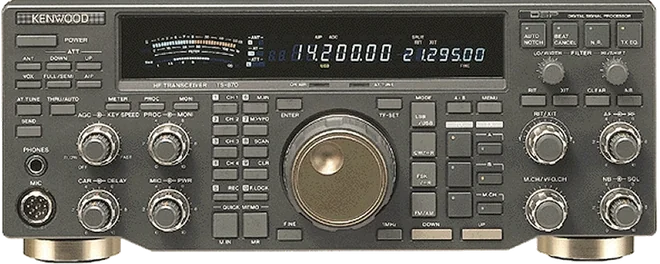
KenwoodTS-870S
HF100 Wtuner11.5 kgdiscontinued
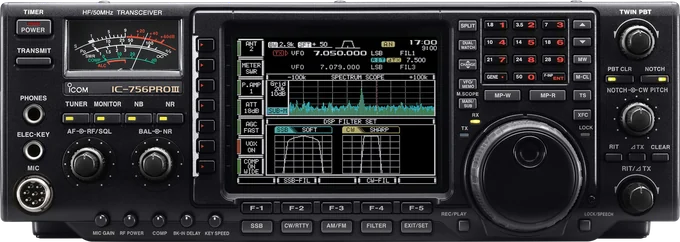
IcomIC-756PROIII
HF · 6 m100 Wtuner9.6 kgdiscontinued
Specs side by side
| KenwoodTS-870S▲ 1 | IcomIC-756PROIII▲ 5 | |
|---|---|---|
| Bands and modes | ||
| Transmit bands | HF 1.8–29.7 MHz | HF 1.8–29.7 MHz50–52 MHz |
| Receive range | 0.1–30 MHz | 0.03–60 MHz |
| Modes | SSBCWAMFMRTTY | SSBCWRTTYAMFM |
| Transmit power | ||
| HF | 100 W | 100 W |
| 50 MHz (6 m) | — | 100 W ▲ |
| AM | 25 W | 40 W ▲ |
| Receiver | ||
| Construction | superheterodyne, quadruple conversion (1st IF 73.05 MHz) + IF DSP (11.3 kHz) | superheterodyne, triple conversion (1st IF 64.455 MHz) + 32-bit floating-point IF DSP |
| Second receiver | — | dualwatch within a single band (not a separate receiver) |
| Spectrum and waterfall | — | real-time spectrum, up to ±100 kHz; no waterfall |
| Features | ||
| Antenna tuner | HF, 20–150 Ω | HF + 6 m, up to SWR 3:1 (6 m: 2.5:1) |
| Display | monochrome LCD | 5″ colour TFT |
| LAN / remote operation | — | — |
| USB | none — RS-232C (DB-9) | none — CI-V (3.5 mm jack) |
| SD card | — | — |
| Antenna connectors | 2× SO-239 + output to external receiver (RCA) | 2× SO-239 + RX input (RCA) |
| Power and case | ||
| Power | 13.8 V DC, external power supply | 13.8 V DC, external power supply |
| Transmit current draw | 20.5 A ▲ | 23 A |
| Dimensions | 330 × 120 × 334 mmwithout protruding parts; with protruding parts 339 × 135 × 375 mm | 340 × 111 × 285 mmW × H × D |
| Weight | 11.5 kg | 9.6 kg ▲ |
| Other | ||
| Memory channels | 99 | 99 |
| Release | 1995discontinued | 2004discontinued |
Data: manufacturers’ spec sheets and manuals · as of 31.10.2026
Compare with another radioSee also