Home  /  Guide  /  APRS

Guide · digital modes

APRS:
position and messages from the radio

APRS, designed by Bob Bruninga, WB4APR, sends position, messages and other data in short packets on a shared frequency. In Europe that’s 144.800 MHz. Packets heard by an iGate go to APRS-IS and onto the maps at aprs.fi. On this page you’ll find a packet encoder and an explanation of how position looks with Icom radios in D-PRS mode.

144.800 MHz AX.25 · 1200 baud WIDE1-1,WIDE2-1 D‑PRS on Icom
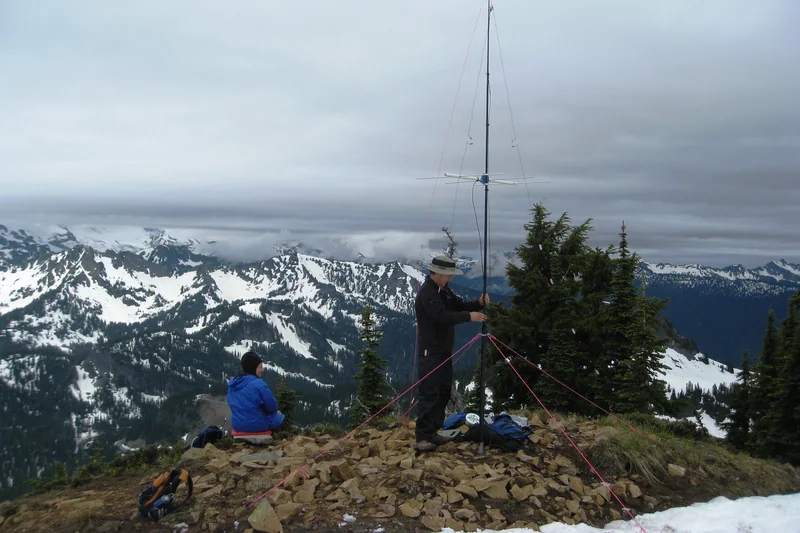
A radio amateur erects a guyed mast with a directional antenna on a rocky summit, with a snow-capped mountain range under cloud in the background. Portable station on a summit · photo: brewbooks, CC BY-SA 2.0, crop
How it works

From radio to the map

The packet goes out on the air as an AX.25 frame, to everyone at once. A digipeater can repeat it, and an iGate hands it to APRS‑IS.

The path of an APRS packet from the radio to the map on the internet A radio with APRS transmits a short packet with position on 144.800 MHz. A digipeater on a high site receives the packet and retransmits it so it reaches further. An iGate station receives packets off the air and passes them to the APRS‑IS network on the internet. The aprs.fi service uses that to draw positions on the map. on the air · 144.800 MHzinternet Your radioon the move every 1–5 minutes digipeaterrepeats the packetfurther on the air packet other radiossee your positionon the display iGatereceives off the airand sends packetsto the internet APRS-ISnetwork of servers aprs.fimap in the browser The WIDE1-1,WIDE2-1 path allows at most two hops via digipeaters. An iGate passes packets from the air to the internet.

← swipe sideways →

Packet path. The radio transmits a packet on 144.800 MHz, a digipeater repeats it further on the air, and an iGate passes the packets it has heard to the APRS‑IS network used by the aprs.fi map. Other APRS‑equipped radios see the position straight off the air.

APRS was designed by Bob Bruninga, WB4APR. He presented it publicly in 1992 at the TAPR/ARRL Digital Communications Conference, but its roots go back further: in 1982 on an Apple II at the United States Naval Academy, and in 1984 a VIC‑20 version tracked horses in a 100‑mile race. Bruninga died on 7 February 2022. In the 2000 APRS101 specification the acronym expands as Automatic Position Reporting System; today you’ll more often see Automatic Packet Reporting System.

An APRS packet is an AX.25 UI frame: sent to everyone at once, with no link‑layer acknowledgement. On VHF it most often goes at 1200 baud with AFSK modulation, i.e. two tones: 1200 Hz and 2200 Hz, as in a Bell 202 modem.

A digipeater receives a packet and retransmits it so it reaches further. The path in the packet says how many times it may be repeated. IARU Region 1 adopted the “New‑N” rules in 2008: a fixed station uses WIDEn‑N with N of at most 2, and a mobile station uses WIDE1‑1,WIDEn‑N, again with N up to 2. The typical recommended default path is WIDE1-1,WIDE2-1, i.e. two hops: the first via any digipeater, including a small “fill‑in”, the second only via a wide‑area digipeater. The aliases RELAY, WIDE and TRACE are obsolete and should not be used.

An iGate forwards the packets it has heard on the air to the APRS‑IS internet network. A bidirectional gateway can also transmit messages from the internet to local stations. The aprs.fi service uses APRS‑IS, where positions are shown on the map.
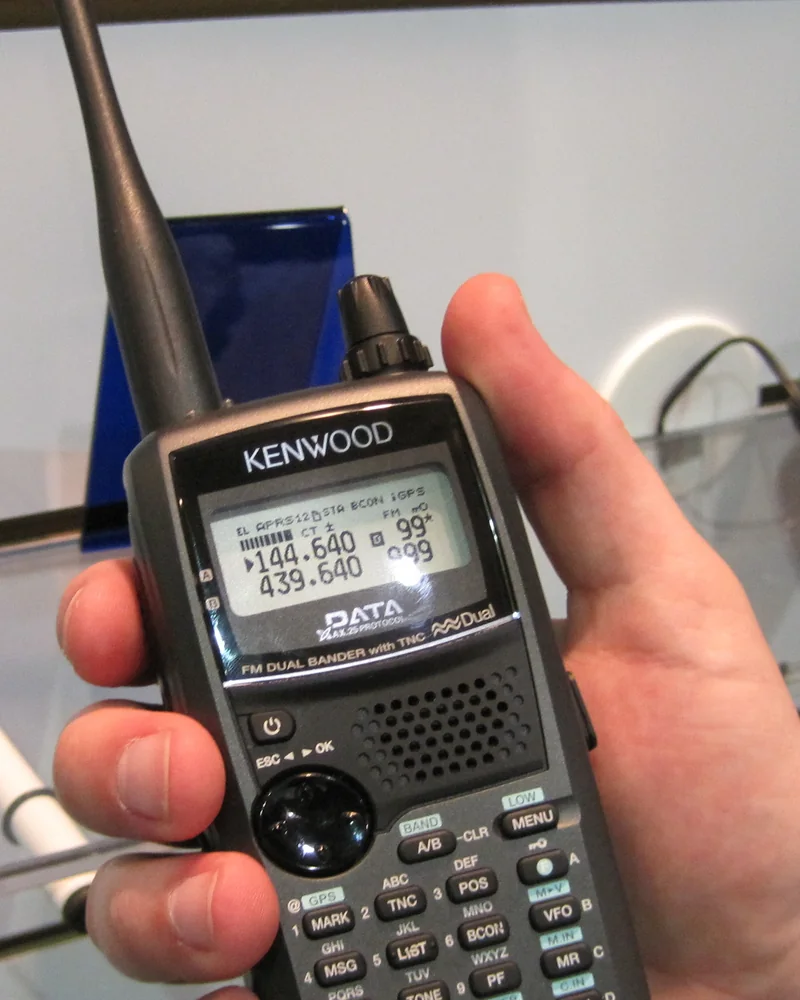
A hand holds a dual-band handheld transceiver; the display shows APRS and GPS and the frequencies 144.640 and 439.640. Handheld transceiver with GPS receiver and built-in APRS · photo: Jeff Davis, CC BY 2.0, crop
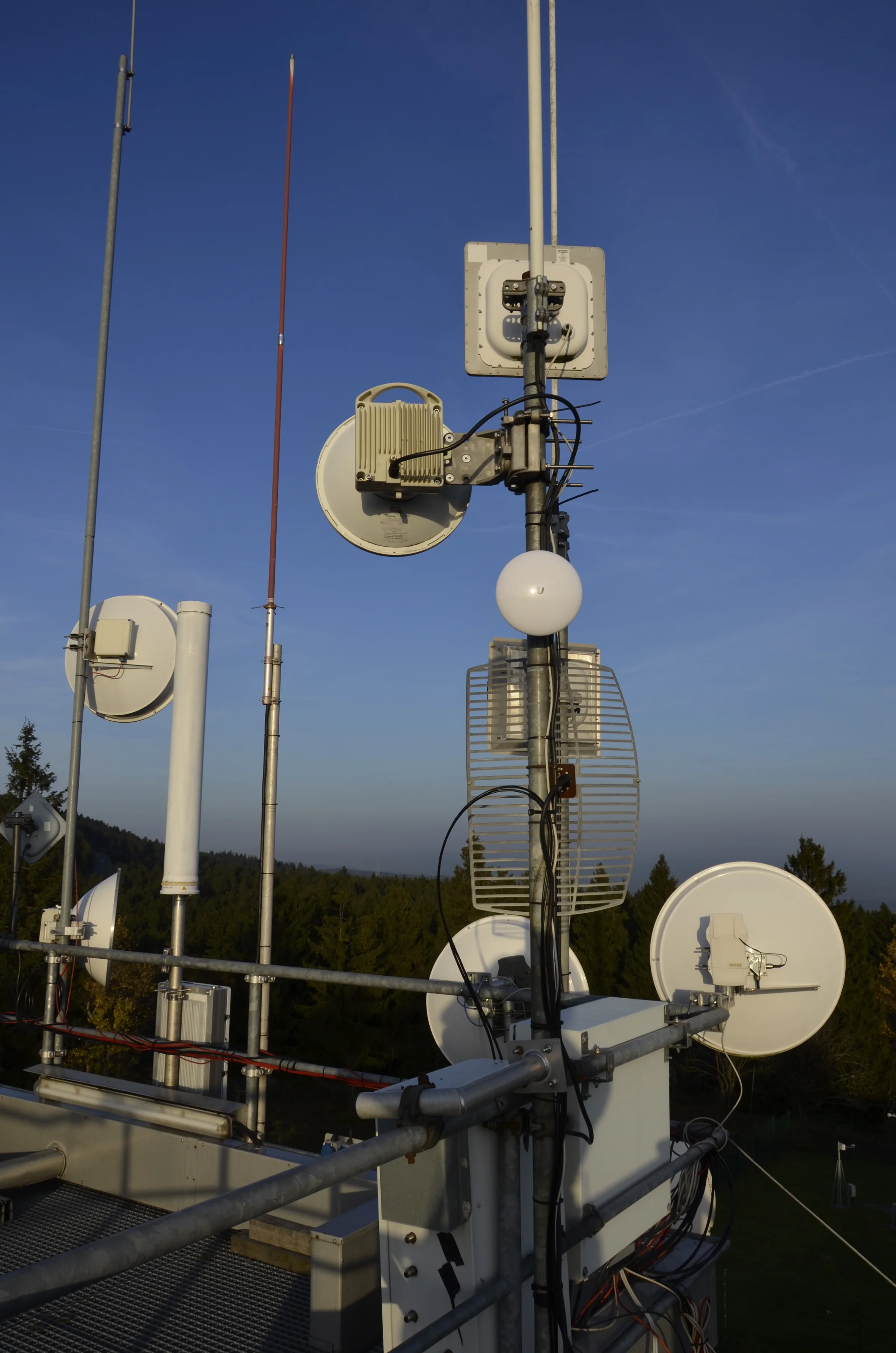
A mast on a rooftop on a hill with vertical, dish and panel antennas against the evening sky.
Amateur radio repeater site on a hill · photo: Ptolusque, CC BY-SA 4.0
An astronaut in a space station module speaks into an amateur radio microphone, holding notes, with cables and equipment around.
Amateur radio aboard the International Space Station · NASA Johnson Space Center, Public domain
A man sits on a rock in a forest beside radio gear, speaking into a hand microphone; above him, an antenna with a red flag.
Operating portable — radio and antenna on a summit in the forest · photo: Dave Clausen, CC BY 2.0
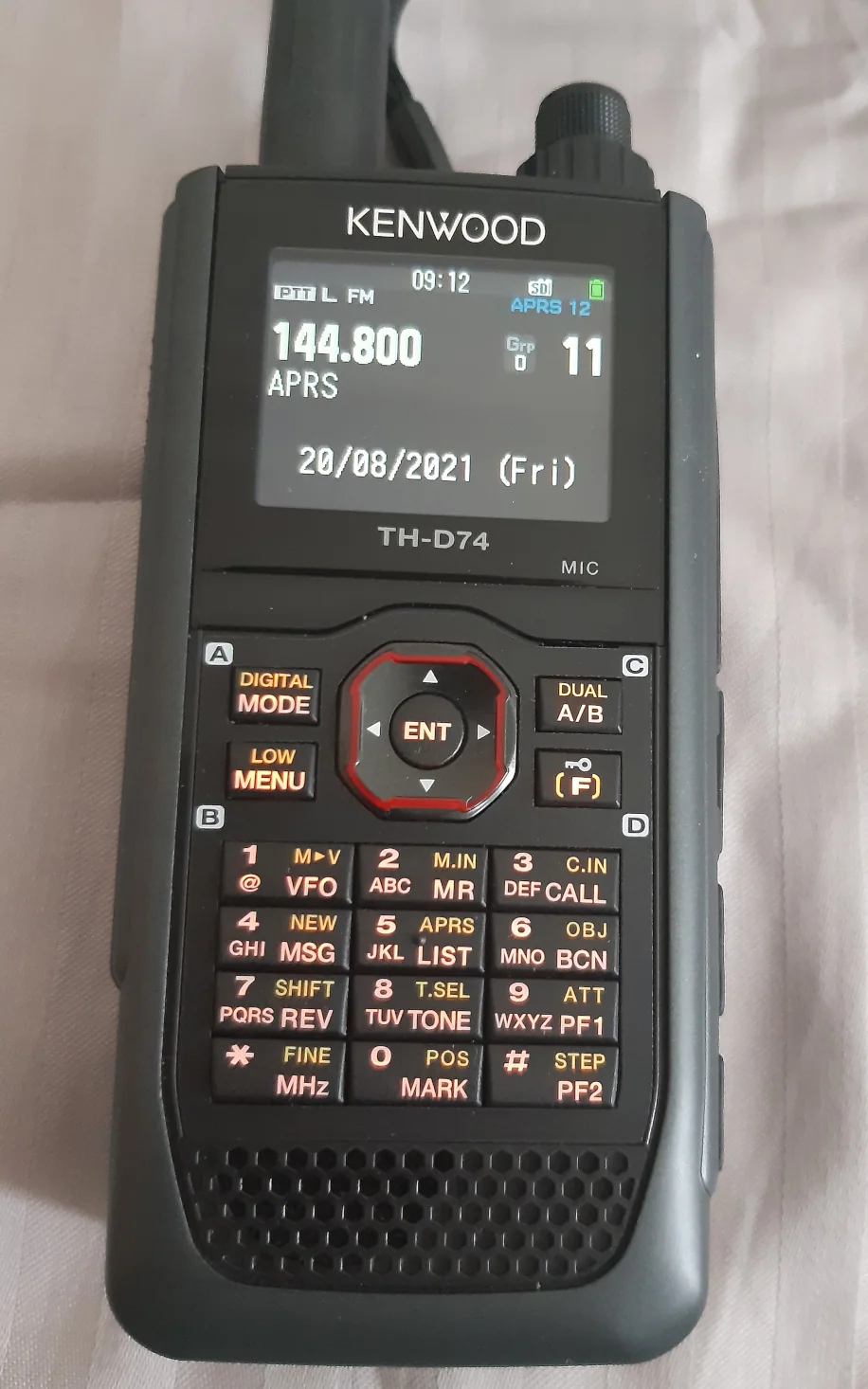
Kenwood TH-D74E transceiver: the display shows the frequency 144.800 and APRS
Transceiver set to 144.800 MHz in APRS mode · photo: Mykhal, CC0
Packet encoder

Your packet character by character

In the encoder you enter your callsign, SSID and position, or fetch location from your device via the browser. The packet is not sent anywhere.

The sample position is in Mokotów. The packet is only displayed: the page neither transmits anything nor sends it to APRS‑IS.

Packet breakdown

    A packet in TNC2 notation starts with the callsign with SSID; after the > character comes the destination address, then (if present) the path after a comma, and after a colon the data. Without a path the packet starts, for example, with SQ5CBA>APRS:!. A position without time begins with ! (a station without messages) or = (a station with messages). Latitude is always 8 characters: degrees, minutes with two decimal places, and N or S. Longitude is 9 characters, with three‑digit degrees and E or W. Between them is the symbol table character (/ is the primary table), after the longitude the symbol code, and at the end a comment up to 43 characters. Example from the specification: !4903.50N/07201.75W-Test 001234, where the final - is the home symbol, not a minus.

    The SSID tells you what kind of station it is. According to the list on aprs.org from 2012, -0 (usually omitted) is the main station, most often fixed, -7 a handheld, and -9 the main station in a car. The ID‑52 manual points to the same list.

    An APRS message begins with a colon and the addressee padded with spaces to 9 characters, then a second colon and text up to 67 characters, e.g. :WU2Z :Testing{003. The identifier after the brace (up to 5 alphanumeric characters) requests an acknowledgement: the addressee returns a message with the content ack003 or rej003. A message without a number is not acknowledged.

    Where to listen

    144.800 MHz and more

    In Europe APRS works on 144.800 MHz: that’s what the IARU Region 1 VHF bandplan and the VHF Handbook 10.03 from February 2026 say. On 70 cm the IARU Region 1 bandplan lists 432.500 MHz as the new APRS frequency. Elsewhere it’s different, for example 144.39 MHz in North America, and 145.175 MHz in Australia.

    In Poland this is confirmed by the UKE (the Polish Office of Electronic Communications) licence register. In the listing from 14.10.2026 there were 182 entries for licences with the word APRS in the station type (three of them already expired): 174 mention 144.8 MHz, and 61 mention 432.5 MHz. ARISS gives 145.825 MHz for packet contacts with the International Space Station; in 2022 the callsign RS0ISS was active there from the service module. Before you try, check the current status of the digipeater on the ISS.

    My radios

    APRS and Icom radios: D‑PRS

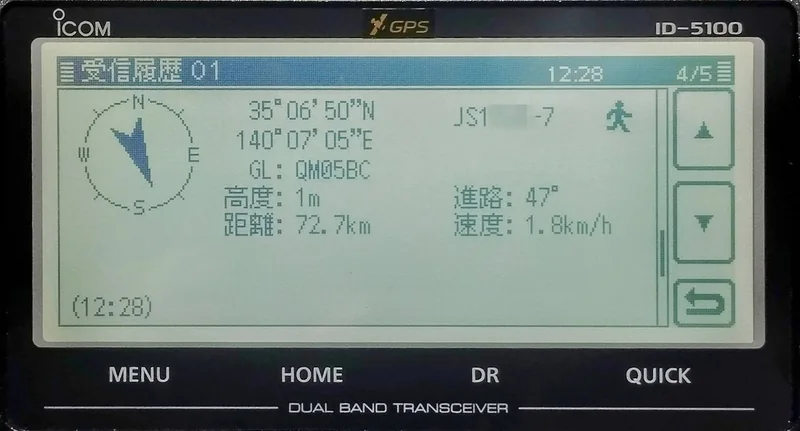
    The built‑in position reporting in my ID‑52E PLUS is D‑PRS: the radio sends position from the built‑in GPS in the data field of the DV digital voice mode, along with the audio. For such a position to reach the APRS network, you need an I‑GATE, i.e. a D‑STAR repeater with a gateway or a simplex gateway. The Icom manual shows a sample frame: JA3YUA-A>API52,DSTAR*:/002338h3437.38N/13534.29E>…. After the colon there’s / (position with a timestamp), then UTC time 002338h, i.e. 00:23:38, and then the same coordinate format as described above. Icom reminds you that transmitting via a repeater may interfere with other stations.

    In the ID‑52E PLUS and IC‑9700 manuals I didn’t find classic APRS at 1200 baud or a built‑in TNC: APRS only appears there as D‑PRS in DV mode. The IC‑9700 will take position from an external GPS (NMEA, DATA socket) or one entered manually. It also has an FM‑DATA mode with audio over USB, so with a software modem on a computer, for example Dire Wolf, you can put together an APRS station, although Icom doesn’t describe such a setup.

    Display of an Icom ID‑5100 transceiver with a received D‑PRS position from another station Icom ID‑5100: received D‑PRS position · photo: Daisuke2000, CC0
    Hardware and software

    What to use for APRS

    • Kenwood TH‑D75E (Europe, 144/430 MHz) has a standalone APRS digipeater and can operate as a temporary digipeater in the field.
    • Kenwood TH‑D75A (USA, 144/220/430 MHz) supports APRS, has a built‑in KISS TNC and offers messaging and QSOs via the ISS.
    • Yaesu FT5DR/FT5DE has a built‑in 1200/9600 bps APRS modem and a 66‑channel GPS receiver.
    • Yaesu FTM‑310DR offers 1200/9600 bps APRS and a 66‑channel GPS receiver.
    • BTECH UV‑PRO is a self‑contained GPS/APRS station, and from firmware 0.7.11 (12.12.2024) it has a KISS TNC over Bluetooth, without a separate TNC and audio cable.
    • APRSdroid (Georg Lukas DO1GL, GPLv2) on Android transmits your position, shows nearby stations and handles messaging, via APRS‑IS, AFSK or a Bluetooth TNC.
    • Dire Wolf (WB2OSZ, GPL‑2.0) is a software AX.25 modem and APRS encoder/decoder: 1200 bps AFSK on VHF/UHF, KISS interface, Windows, Linux (including Raspberry Pi) and Mac OS X.
    • PinPoint APRS is free for personal use on Windows 7, 8, 10 and 11: map, APRS messaging, APRS‑IS, KISS TNC or TNC2 and NMEA GPS.

    APRS in Poland

    In Poland the first APRS experiments appeared in the late 1990s, with the first digipeaters and igates in 2002. In June 2003 SP3BTT and SP3LYR organised the “Tama APRS” workshop with around 60 radio amateurs taking part, and in January 2004 the Polish APRS Group was formed, a Polish Amateur Radio Union (PZK) club. In October 2026 the aprs.pl website was hard to reach, so check current recommendations with your local digipeater operators. In the UKE (the Polish Office of Electronic Communications) list of licences dated 14.10.2026 there were 168 entries concerning APRS digipeaters (including a few expired ones), in Warsaw among others SR5NWA, SR5TM and SR5E. A licence doesn’t necessarily mean the station is currently on the air.

    Sources

    Where do these formats and numbers come from

    1. APRS Protocol Reference APRS101, version 1.0.1 (2000) · www.aprs.org
    2. B. Bruninga WB4APR: SSID list (2012) and New‑N rules · www.aprs.org
    3. IARU Region 1: VHF bandplan and VHF Handbook 10.03 (2026) · www.iaru-r1.org
    4. APRS‑IS: overview of the network and I‑Gates · www.aprs-is.net
    5. ARISS: APRS packets via the ISS · www.ariss.org
    6. Icom: D‑STAR D‑PRS Guide (August 2026) and the ID‑52A/E PLUS and IC‑9700 manuals · www.icomjapan.com
    7. UKE: list of radio licences (as at 14.10.2026) · www.uke.gov.pl
    8. Manufacturers’ sites: Kenwood, Yaesu, BTECH; projects: APRSdroid, Dire Wolf, PinPoint APRS
    Next step

    See who’s on the map

    In the encoder you’ll see a packet with your callsign before you transmit anything on air. You can check activity on the map at aprs.fi, and I cover D‑STAR in the D‑STAR guide.