Home  /  Antenna on a housing association roof

Guide · law

Antenna on the
housing association’s roof

You own your flat, a radio licence is in the drawer and an antenna in the box — and between you and the bands stands the housing association board. This guide brings together in one place everything that works in this conversation: the regulations, case law, ready answers to common objections and a template letter to the association that you can print and submit. This is about installations up to 3 metres high — a typical base antenna for 2 m and 70 cm.

up to 3 m · no permit no notification board decides PDF letter template
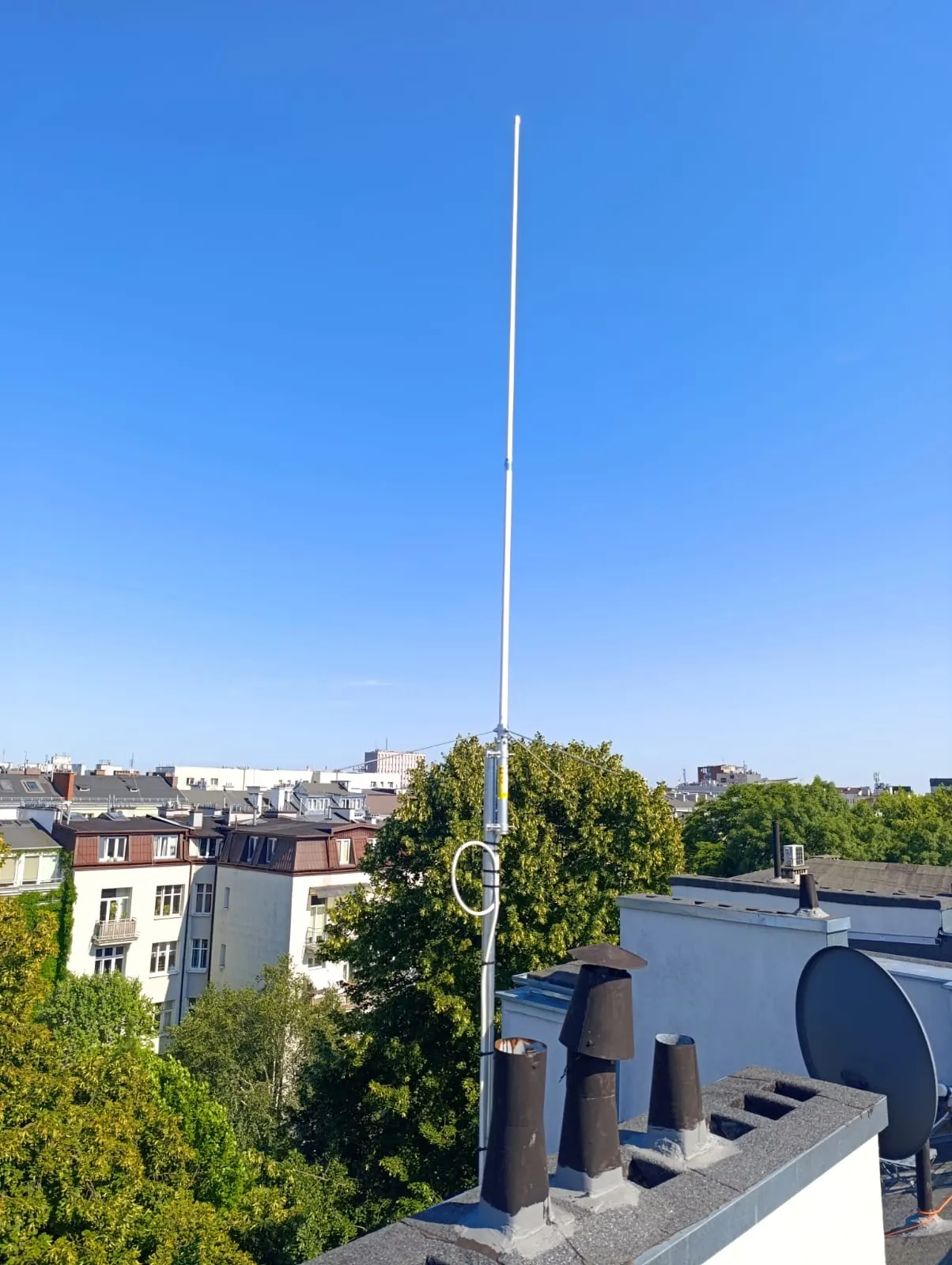
Diamond X-200N dual‑band base antenna mounted on a tenement chimney
Diamond X-200N · 2.5 m of mast and antenna combined — within the 3 m limit
At a glance

Four sentences to start with

If you’ve no time for the whole thing — this is the crux. The rest of the page expands on these four points.

01

The authorities aren’t the problem

An antenna with a height not exceeding 3 m installed on a building does not require either a building permit or a notification — art. 29(4)(3) of the Building Law (Prawo budowlane). You don’t go to any authority.

02

You have a right to use the roof

The roof is common property (art. 3(2) uwl), of which you are a co‑owner. Art. 12(1) of the Act on Ownership of Premises (ustawa o własności lokali) gives you the right to use it in common in line with its purpose — and roofs have always carried chimneys, services and antennas.

03

The board decides, on its own

Consent to install a small, reversible installation is an act of ordinary management — and the board takes such decisions independently (art. 22(1) uwl). No meeting or vote is needed: written consent from the board is enough.

04

You have a strong legal footing

Freedom to communicate and to receive information is protected by the Constitution (arts 49 and 54) and by art. 10 ECHR. Strasbourg has already held that evicting a tenant for a satellite dish breaches the Convention.

Building Law

Why exactly three metres

It’s the only threshold that really matters on the administration side. Below it you’re outside the whole building procedure.

Below 3 m — zero formalities

The Building Law (Prawo budowlane) of 7 July 1994, art. 29(4)(3): neither a building permit nor a notification is required for carrying out construction works consisting of installing on buildings (…) equipment, including antenna support structures and radiocommunication installations, as well as accessories and power equipment associated with such devices, with a height not exceeding 3 m.

A typical 2 m and 70 cm base antenna is 2–2.5 m long. Together with a short chimney mount or a wall bracket you’ll be within the limit with no trouble. That means: no application, no notification, no design documentation, no fee.

Above 3 m — notification

The same structure with a height above 3 m falls under art. 29(3)(3) — it requires notification to the architectural and building administration authority (the starosta or the mayor of a city with county rights) under art. 30. You still don’t need a building permit — but there’s a procedure, tacit consent and the possibility of the authority’s objection.

Exception: listed buildings

If the building is entered in the heritage register or lies in an area entered in the register, the exemptions of art. 29 work differently — the works require a notification, and to it you must attach the permit of the provincial conservator of monuments (art. 29(7) of the Building Law in conjunction with the heritage protection regulations). Check this before you write to the association — in such a building the argument looks different.

Antenna mast against the sky 3 m is the height of the whole installation
3 m

You measure the entire installed structure — mast plus antenna — not just the bit sticking up above the ridge. A 2.5 m antenna on a half‑metre bracket is already exactly 3 m. If you’re on the borderline, choose a shorter support: the difference between ‘no formalities’ and ‘notification’ is huge when talking to the association.

Ownership of premises

Who actually owns the roof

This is the crux of the dispute — and it’s where both sides most often get their rights wrong.

legal status

Common — which means yours too

Art. 3(2) of the Act on Ownership of Premises (ustawa o własności lokali): the common property comprises the land and those parts of the building and installations which are not for the exclusive use of the owners of the individual premises. The roof, facade, chimneys and service risers — all of that is common, and you are their co‑owner. So you’re not asking for access to someone else’s property, but to use your own, in the part corresponding to your share.

Art. 12(1) uwl: the owner of a unit has the right to use the common property in common in accordance with its purpose. The roof of a multi‑unit building has for decades also served a technical function — carrying chimneys, services and antennas. Using it for that purpose is in line with its purpose, not a change to it.

who decides

This is an act of ordinary management

Art. 22(1) uwl: acts of ordinary management are taken by the board independently. Installing a small antenna system falls within those bounds — it doesn’t change the purpose of the common property, isn’t a superstructure or reconstruction, doesn’t affect the building’s structure, is fully reversible and imposes no costs on the association.

This is confirmed by art. 22(3) uwl, which lists matters that go beyond ordinary management — superstructure and reconstruction, a change to the purpose of part of the common property, division, acquisition of property. Antenna installation isn’t on that list. In practice, the board just as independently agrees to satellite dishes, air‑conditioners or cameras.

There is a single boundary — art. 12(1), second sentence, uwl and art. 206 of the Civil Code: you must use it in a way that does not hinder others’ use. An antenna weighing a few kilograms on a chimney does not breach that condition.

!

Small association (up to three units) is governed not by the Act on Ownership of Premises, but by the Civil Code provisions on co‑ownership. For acts of ordinary management the consent of a majority of co‑owners calculated according to their shares is sufficient (art. 201 Civil Code). The path is different; the substantive arguments remain the same.

Limits of authority

What the association may do — and what it may not

The most common mistake boards make: confusing the right to set conditions with the right to refuse arbitrarily. They are not the same.

MayMay not
Specify the method of installation: no interference with the roof covering, on chimney clamps, by a qualified installer Refuse without stating a substantive reason or relying solely on aesthetics
Indicate a location less visible from the street, provided this does not worsen the station’s operating conditions Demand a building design and a building permit where the law does not require them
Require reinstatement after removal and repair of any damage Send the matter to a general meeting and make consent conditional on collecting neighbours’ signatures
Require temporary removal for the duration of roof renovation Order removal of an existing installation without demonstrating damage or risk
Set a reasonable fee for using the common parts (a benefit of the association, art. 12(2) uwl) Set a prohibitive fee that in practice amounts to a ban, or vary fees arbitrarily
Require public liability insurance and nomination of the person responsible for the installation Make consent conditional on giving up statutory rights or on the consent of all neighbours
Procedure

Step by step — how to handle it

Order matters. Most cases are lost not on the law, but because someone started with installation and ended up with a demand to take it down.

1

Gather hard facts about the installation

Antenna model, its length, weight, mounting method, total height of the structure, transmitter power and operating bands. Attach the manufacturer’s datasheet. Specifics defuse most fears even before any discussion.

e.g. Diamond X-200N · 2.5 m · 1.6 kg · chimney clamps · 2 m and 70 cm · 100 W
2

Check the building’s status

The register of monuments, the municipal monument register, conservation protection in the local plan. If the building is protected — you need a separate conservator’s permit and that changes the whole conversation.

3

Write to the board — in writing, with proof of delivery

Not a ‘test’ email. A letter with the date, a description of the installation, the legal basis and a specific demand: the board’s consent and written confirmation within a set timeframe. You’ll find a template below. Keep the proof of delivery — that’s what starts the deadlines.

4

Propose the conditions before someone imposes them on you

Write into the letter yourself: installation by a qualified contractor, without breaching the roof covering, public liability insurance, repair of any damage, temporary removal for the duration of any renovation, reinstatement afterwards. A board with nothing left to add will find it much harder to refuse.

5

Get the consent in writing

An oral “all right, go and hang it” is worthless when the board or the administrator changes. Ask for a written statement with a signature, date and a list of the agreed conditions — one sheet of paper saves two years of grief.

6

Install only after consent

An antenna put up “on the sly” turns the tables: you become the party that has infringed someone else’s rights, and the association gets a ready-made claim for reinstatement. Patience at this stage is cheap; lack of it — is not.

7

Silence or refusal? Send a formal notice

If the board fails to reply or refuses without giving a reason, send a notice with a specific deadline and a request to indicate the circumstances justifying the refusal and the conditions upon which consent will be granted. Only then does a sensible civil route open up — described below.

Cheat sheet

Typical objections and responses

Eight lines you’ll hear from the board — and what you can say back without raising your voice.

ObjectionResponse
“You need a building permit” No. An installation up to 3 m on a building structure requires neither a permit nor a notification — article 29(4)(3) of the Building Law (Prawo budowlane). It’s enough to cite the provision and state the height of the structure.
“This is a matter for a meeting, not for the board” Matters of ordinary management are handled by the board on its own (art. 22 ust. 1 uwl), and installing a small, removable installation fits within those limits — it’s not on the list of matters exceeding ordinary management in art. 22 ust. 3. The board agrees to satellite dishes or air-conditioning units on its own, after all.
“It spoils the building’s appearance” Aesthetics on its own is not a legal basis for refusing to use the common property in line with its purpose. It can be taken into account in the conditions — colour, placement on the courtyard side, a mast instead of a lattice tower — but not as grounds for a ban.
“It will damage the roof and we’ll lose the warranty” Propose a non-invasive installation: chimney clamps or a wall bracket, without penetrating the roof covering. Add public liability insurance and a written undertaking to repair any damage. Once a risk has been mitigated, it stops being an argument.
“The radiation will harm residents” Permissible electromagnetic field levels in Poland are defined by the Regulation of the Minister of Health of 17 December 2019. An amateur station operates intermittently, at powers on the order of tens of watts, with an antenna elevated above where people are. State the EIRP, the distances and — if needed — offer to measure. Details in the section on EMF below.
“It will interfere with television and the internet” Amateur equipment must meet electromagnetic compatibility requirements, and the operator is responsible for resolving any interference he actually causes. Propose a clause in the consent conditions: in the event of confirmed interference you will take remedial action. A purely hypothetical allegation does not justify a refusal.
“The antenna will come off in a gale” Manufacturers state the permissible wind speed for the mast and the antenna. Attach the datasheet, indicate a contractor with the necessary qualifications and insurance. It’s the same level of risk as the communal TV antenna that has stood there for years.
“We’ll agree, but for 300 PLN per month” Charging is permissible, but it must relate to actual use of the common part. A rate that in practice amounts to a ban is an abuse of right (art. 5 k.c.) and a breach of the principles of proper management — and, incidentally, hard to defend to the other owners.
·−

Tone counts for more here than legal provisions. A housing association is neighbours, not a public authority — and a court case with the people next door costs more than the antenna. Start with a conversation and specifics, save the legalities for the second paragraph of the letter, not the first sentence of the conversation.

Radiation

The EMF argument — how to defuse it

It comes up almost every time. It almost always rests on an association with a mobile base station, which has different power, duty cycle and purpose.

Two different regulations, two different matters

Permissible electromagnetic field levels in the environment are set by the Regulation of the Minister of Health of 17 December 2019 — it concerns places accessible to the public and applies to every installation, regardless of its size.

Environmental classification is a separate thing: the Regulation of the Council of Ministers of 10 September 2019 on projects likely to have a significant impact on the environment (Dz.U. 2019 poz. 1839). Radiocommunication installations fall under it only after exceeding EIRP thresholds linked to the distance to places accessible to the public — and, importantly, there is no exemption there for the amateur service. It’s worth calculating where you stand before someone calculates it for you.

Calculate your EIRP

EIRP is the transmitter power multiplied by the antenna gain (minus the losses in the coax). With 50 W at the antenna input and 6 dBi antenna gain the EIRP is approx. 200 W; with 100 W and 8 dBi — approx. 630 W. Distance is measured from the electrical centre of the antenna in the main beam axis, and for a vertical that axis lies horizontally — i.e. towards neighbouring windows, not downwards to the flats under the roof.

In practice the strongest argument is a trio of numbers: power, antenna gain and the distance to the nearest place where someone is present. Add to that the fact that an amateur station transmits for a fraction of the time, not continuously.

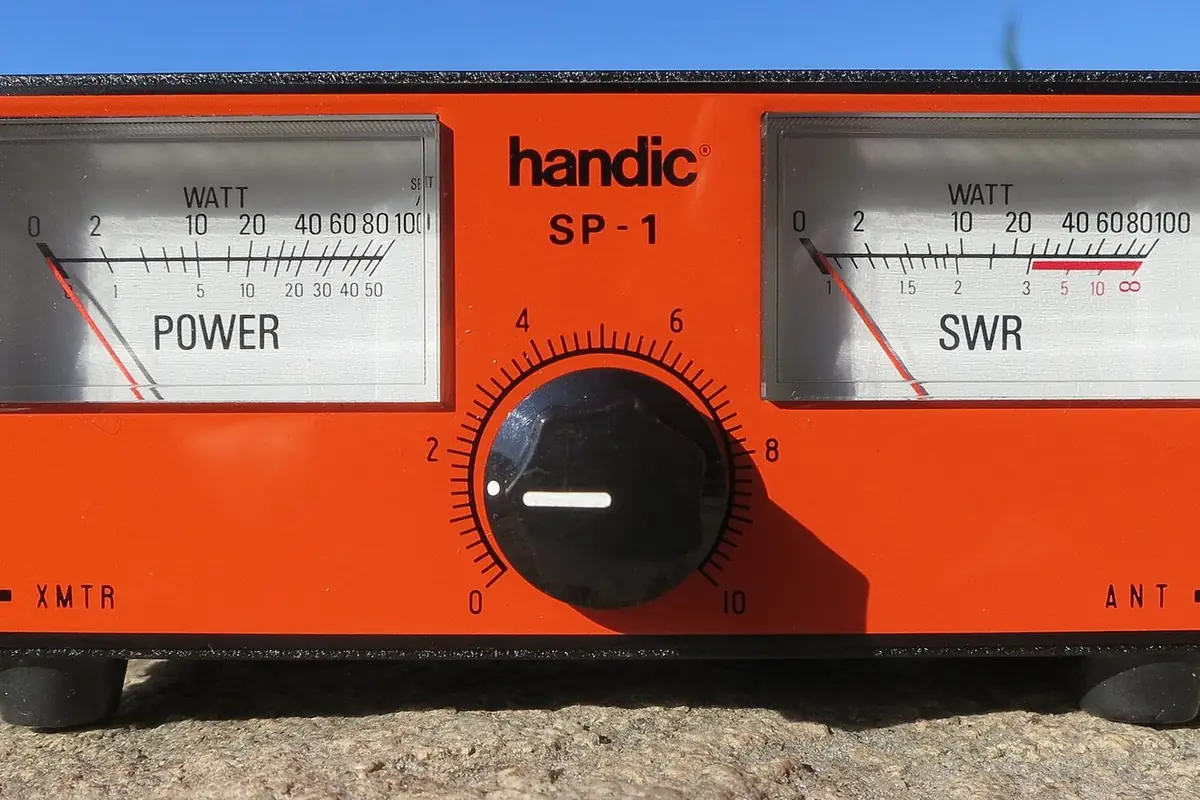
SWR and power meter — measuring antenna system parameters numbers rather than impressions
EIRP of a single antennaPlaces accessible to the public closer thanEffect
from 15 W5 ma project that may potentially have a significant impact on the environment
§ 3(1)(8) of the Regulation of the Council of Ministers of 10.09.2019
from 100 W20 m
from 500 W40 m
from 1000 W70 m
from 2000 W100 ma project that is always likely to have a significant impact
§ 2(1)(7) of that Regulation
from 5000 W150 m
i

Results of electromagnetic field measurements in Poland are publicly available in the SI2PEM system (si2pem.gov.pl). If there is a mobile operator’s mast nearby, it’s worth showing neighbours what levels occur there already today — your antenna usually pales into insignificance by comparison.

When the answer is “no”

A refusal is not the end of the matter

The board’s position is not a judgment. The right to make joint use of the common property flows directly from the statute and can be enforced — precisely so that it doesn’t depend on someone’s mood.

step one

Notice with a deadline

Before you go to court, send a notice: ask them to indicate the specific circumstances that justify the refusal, and the conditions upon which consent will be granted. Set a realistic deadline — 14 or 30 days.

This letter does two things at once. Some boards simply give way because they have nothing to put in the ‘reason’ box. And if they don’t — you have it on paper that the refusal had no substantive justification, and that is the best possible evidence in any further proceedings.

step two

Civil action

The legal basis for the claim is art. 12(1) of the Act on Ownership of Premises (ustawa o własności lokali) in conjunction with art. 206 of the Civil Code (Kodeks cywilny) — allowing joint use of the common property to the extent corresponding to your share and the property’s intended purpose.

Also helpful is art. 5 of the Civil Code (k.c.) — the prohibition on exercising a right contrary to its socio‑economic purpose and the principles of social coexistence. A refusal whose only aim is to hinder a neighbour’s lawful activity falls into this category.

!

Collect evidence from day one: delivery confirmations of letters, correspondence with the board and the administrator, notes from conversations, photos of other antennas and devices already mounted on the same roof. These are often the strongest — they show you were held to a different standard.

Downloads

Template letter to the housing association

An application for consent with legal justification. You fill in the details, print it, and submit it with proof of receipt.

What’s inside

  • Application — details of the flat owner, description of the installation, a demand for the board’s written consent within a specified time limit
  • Technical specification — a table to fill in: model, height, weight, mounting, bands, power, EIRP
  • Legal basis — the Building Law (Prawo budowlane), the Act on Ownership of Premises (ustawa o własności lokali), the Civil Code (Kodeks cywilny), the Constitution, the ECHR together with Strasbourg case law
  • The ordinary management argument — five points showing that the decision falls within the independent competences of the board (art. 22(1) uwl), without a meeting and without a vote
  • Applicant’s undertakings — non‑invasive installation, authorised installer, public liability insurance, repair of damage, removal for the duration of renovations, reinstatement
  • Notice — on the consequences of failing to consider the application (art. 12(1) uwl in conjunction with art. 206 k.c.)

The letter is firm but not combative — the aim is written consent, not a court case. If the association has its own application form, treat this document as an attachment providing the justification.

Morse key on the desk — a symbol of the operator’s craft paperwork first, then PTT
Sources

Legal grounds and case law

A complete set of references worth having to hand when speaking with the board — and which the template letter quotes verbatim.

Building Law 29.4.3
An antenna installation not exceeding 3 m in height on a building — no permit and no notification required
Building Law 29.3.3
The same installation above 3 m — requires notification under art. 30
Building Law 29.7
A site entered in the register of monuments — notification plus a permit from the provincial heritage conservator
Act on Ownership of Premises 3.2
Common property: the land and the parts of the building and equipment that are not for the exclusive use of flat owners
Act on Ownership of Premises 12.1
A flat owner’s right to share in the use of the common property in line with its intended purpose
Act on Ownership of Premises 12.2
Profits and income from the common property — the basis for any possible charge for use
Act on Ownership of Premises 22.1
The board carries out acts of ordinary management on its own
Act on Ownership of Premises 22.3
A list of matters exceeding ordinary management — antenna installation is not among them
Civil Code 201
Small association: for acts of ordinary management, the consent of a majority of co‑owners is sufficient
Civil Code 206
Co‑possession and use of the common property to the extent that can be reconciled with the rights of the others
Civil Code 5
Prohibition on exercising a right contrary to its purpose and to the principles of social coexistence
Constitution 49
Freedom and protection of the secrecy of communications
Constitution 54
Freedom to obtain and disseminate information
ECHR art. 10
Freedom to receive and impart information — also covers the technical means of reception
ECtHR 23883/06
Khurshid Mustafa and Tarzibachi v Sweden, judgment of 16.12.2008 — eviction for refusing to remove a satellite dish violated art. 10 of the Convention
ECtHR 12726/87
Autronic AG v Switzerland, judgment of 22.05.1990 — protection under art. 10 covers the means of receiving a transmission, including the antenna
Reg. of the Council of Ministers 2019
Journal of Laws 2019 item 1839 — EIRP thresholds that qualify radiocommunication installations as projects affecting the environment
Reg. of the Minister of Health 2019
Regulation of the Minister of Health of 17.12.2019 — permissible levels of electromagnetic fields in the environment
Electronic Communications Law 2024
Act of 12.07.2024 — the Electronic Communications Law (Prawo komunikacji elektronicznej) — the legal basis for radio licences in the amateur service issued by the President of UKE (the Polish Office of Electronic Communications)
ITU Radio Regulations
The amateur radiocommunication service is an official radiocommunication service, not merely hobby use of equipment

?

One note about being fair in your argument: there’s a claim online that the housing association has no say in the matter. That’s shorthand. The roof is communal, so the management can set conditions for installation and the location — however, any refusal must have objective grounds. A letter based on this accurate version is much harder to knock down than one that relies on a non-existent ban on refusal.

Disclaimer

This is not legal advice

This material is for information and comes from a radio amateur’s perspective, not a law firm’s.

Regulations do change, and every housing association has its own agreement, rules and history — some even have the management of the common property regulated differently from the statutory rules. Before taking the matter to court, check the current wording of the provisions cited and — if the stakes are higher — have a lawyer review your letter. Legal position as at August 2026.

If you’ve gone through this process yourself and something worked differently from how I’ve described it here — drop me a line. I’ll be happy to update the guide with experiences from real cases. 73!