Home  /  Guide  /  VHF/UHF contests

Guide · VHF/UHF contests

VHF/UHF contests:
calendar and first time out

On 2 m and 70 cm, stations with big antennas head out, set up on summits and rooftops. Instead of calling into the void, you answer someone who’s actually looking for you. It’s the best way to see how far your station reaches. Below is a calendar that counts down to the next contest by itself, and everything you need for your first start.

1 km = 1 point 59 001 KO02ME SPAC on Tuesdays FM counts too EDI log
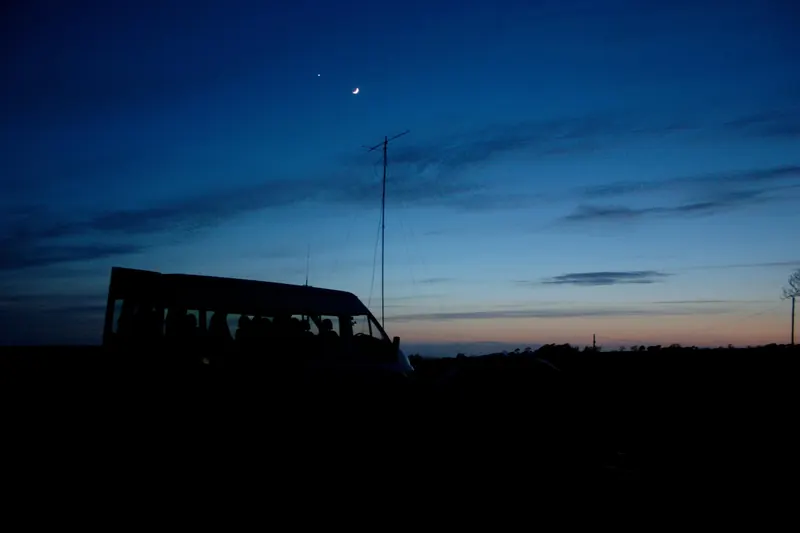
Silhouette of a van and a mast with a beam antenna against dusk, a crescent Moon high up A field station at dusk, May 2007 · photo: Dominic Cleal, CC BY‑SA 2.0
Live

Contests now and in the coming weeks

The calendar computes dates from the rules, so it rolls over to the following months on its own. Times are in Polish time, including after the clock change.

Calculating…

Checking the calendar

The calendar works in a browser with JavaScript enabled. You’ll also find fixed dates below, in the contest descriptions.

Sources of dates: the PK‑UKF calendar, organisers’ rules and IARU R1. Dates for 2027 are computed from the rules.

to start–Polish time
Next on FM– 
This month–VHF/UHF contests
Your locatorKO02MEgive it in every QSO
  1. Loading the calendar…
monthlyIARUothers
2 m70 cm23 cm and above6 m and 4 mFT8CW only
A year of VHF/UHF contests. Hover over a marker to see the name and date. The dense top row shows the monthly activity contests; together they occur almost every week.
Why it’s worth it

A band full of stations that are looking for you

Day to day, SSB and CW on 2 m can be quiet. In contests it’s different: for the September IARU 2 m contest in 2024 about 1,900 logs were submitted, including about 270 from Poland.

Every contact means points for both sides

In contests, every contact gives both stations points, so a big hilltop station has a reason to answer a call from a Warsaw rooftop. In a single evening you’ll check how far your antenna reaches, which direction is heard best and whether your coax is eating the signal.

You don’t have to wait for the big weekends. SPAC runs on the first four Tuesdays of the month, from 19:00 to 23:00 Polish time: the first on 2 m, the second on 70 cm, the third on 23 cm, the fourth on 13 cm and above. On Wednesdays FT8 Activity and ARKiI rounds run, and on the second Saturday of the month the one‑hour Lubelski Maraton UKF is FM only.

Once a year the big IARU Region 1 contests come along: in September on 2 m, in October on 70 cm and above. Then for 24 hours the whole of Europe is on the air.
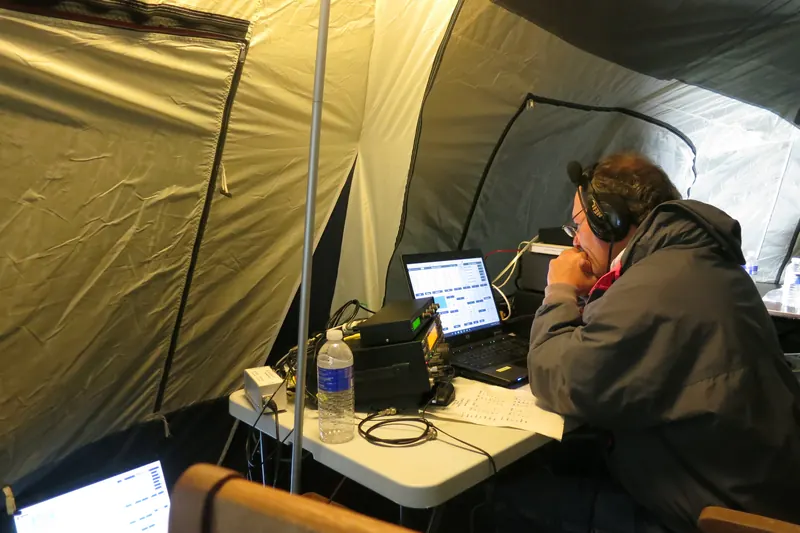
Operator wearing headphones at a radio and a laptop with the log in a field tent W2ZC’s station during ARRL Field Day 2015 in Syracuse (USA): a radio, headphones and a laptop with a logger · photo: Alex Ranaldi, CC BY‑SA 2.0
Exchange

Report, serial, locator

In contests you don’t chat about the weather. The exchange is short and always in the same order.

RS report59readability 5, strength 9; on CW the report is RST, e.g. 599
QSO serial001the first contact on the band is 001, then plus one for each QSO
locatorKO02MEsix characters: where your station stands, to an accuracy of a few kilometres

That’s the exchange in IARU contests, e.g. 59003 JO20DB. In SPAC there’s no serial: only report and locator, e.g. 539 JO80AA. In FT8 Activity the software exchanges just the callsign and a 4‑character locator.

SP6XYZ/P · Śnieżka, JO70URCalling in the contest, SP6XYZ portable, contest.
SQ5CBA · Mokotów, KO02MESQ5CBA.just the callsign, short and clear
SP6XYZ/PSQ5CBA, 59 127 JO70UR.that’s their 127th contact in the contest
SQ5CBAThanks, 59 127 JO70UR received. For you 59 001 KO02ME.it’s my first contact, so serial 001
SP6XYZ/PThanks, 73. SP6XYZ/P, contest.
The distance KO02ME – JO70UR is 403.4 km. In IARU contests it’s rounded down to whole kilometres and 1 is added, so the contact gives 404 pts to both stations. The callsign SP6XYZ/P is an example.

How it sounds on CW and FM

The PZK (the Polish Amateur Radio Union) guidelines for national contests state that on phone the call may be “contest call”, and on CW TEST SP. Some rules have their own wording, e.g. “Lubelski Maraton UKF contest call”. The exchange on CW is the same, only the report has three digits: 599 001 KO02ME.

On FM, simplex channels are used. In the Lubelski Maraton UKF these are 145.225–145.575 MHz, and repeater contacts don’t count. The same applies to IARU contests: contacts via active repeaters and EME don’t score.

In IARU contests you can work each station only once per band. In some national contests, e.g. ARKiI and Ham Spirit, you can make one contact per mode with the same station. A QSO is valid when both sides have received the callsigns and the exchange and confirmed this to the other side.

Exchange in different contests

ContestsExample from the rules
IARU, Subregional Contests59003 JO20DB
Marconi Memorial (CW)599023 JN54QL
SPAC (no serial)539 JO80AA
ARKiI LOK599 001KO02MF
Lubelski Maraton UKF59 02KO11FA
Scoring

A kilometre is a point

In most VHF/UHF contests a contact is worth as many points as the kilometres separating the two stations. That’s why every more distant correspondent counts.

Points for a contact: distance from Warsaw Map of Poland with distance rings every 100 km from SQ5CBA’s QTH in Mokotów. In VHF/UHF contests a contact is worth as many points as the kilometres between the two stations. 100 km 200 km 300 km 400 km 500 km Gdańsk 290 pts Szczecin 459 points Poznań 279 points Wrocław 302 points Kraków 249 points Lublin 149 points Białystok 181 points Rzeszów 250 points Łódź 118 points Zakopane 329 points SQ5CBA
Points from Mokotów. Points under the IARU rules for a contact with a station in the city centre. Rings every 100 km. Zakopane is 329 points, Gdańsk 290, Szczecin 459.

Rules in brief

  • IARU (except 50/70 MHz MGM) and Lubelski Maraton: 1 point per kilometre of distance.
  • ARKiI: 1 point per kilometre on CW, SSB and FM, 2 points per kilometre on RTTY and FT8.
  • SPAC: 1 point per kilometre plus 500 points for each WWL locator, i.e. a grid square such as KO02, KO11 or JO90. Ham Spirit also adds 500 points for each new four-character locator.
  • Same subsquare: in IARU, SPAC, Mining Rescue and Barbórka, a contact with a neighbour in the same subsquare, e.g. KO02ME with KO02ME, counts as 1 point. In Lubelski Maraton such a contact gives 3 points.
  • FT8 Activity: 1 point per callsign, multiplied by the number of different locators.

The logging program calculates the distance from the two stations’ locators, so the locator must be accurate. A mistake in the subsquare letter moves the station by a few kilometres, and an error in the square digit by over a hundred kilometres.

Examples from Mokotów

StationLocatorDistanceIARU points
ŁódźJO91RS117.9 km118
Łysa GóraKO00MU148.3 km149
KatowiceJO90MG254.6 km255
ŚnieżkaJO70UR403.4 km404
Ireland (auroral record)IO52AC2,099.2 km2100

IARU rules: distance between the centres of the locator squares, truncated to whole kilometres, plus 1 km.

Maidenhead locator

Your address in contests

The locator turns longitude and latitude into six characters. Two letters, two digits, two letters: from continent down to a few kilometres.

Maidenhead locators over Poland Poland divided into locator squares: fields JN, JO, KN and KO, squares measuring 2 degrees of longitude by 1 degree of latitude. Warsaw lies in square KO02, and SQ5CBA’s QTH in subsquare KO02ME. JN78 JN79 JO70 JO71 JO72 JO73 JO74 JN88 JN89 JO80 JO81 JO82 JO83 JO84 JN98 JN99 JO90 JO91 JO92 JO93 JO94 KN08 KN09 KO00 KO01 KO02 KO03 KO04 KN18 KN19 KO10 KO11 KO12 KO13 KO14 KN28 KN29 KO20 KO21 KO22 KO23 KO24 20°E 50°N Gdańsk Szczecin Poznań Wrocław Kraków Katowice Lublin Białystok Olsztyn Bydgoszcz Rzeszów Łódź Kielce Zielona Góra Koszalin Suwałki Zakopane KO02ME

KO02ME step by step

KO is a field 20° of longitude by 10° of latitude. The boundary between J and K runs along 20°E, which cuts through the centre of Poland: Warsaw is in K, Łódź and Kraków already in J. The boundary between N and O is 50°N, so just south of Kraków, Tarnów and Rzeszów JN and KN begin.

02 is a 2° by 1° square, about 135 × 111 km. KO02 covers Warsaw and the surrounding area. SPAC awards a bonus of 500 points for such squares.

ME is a subsquare 5′ by 2.5′, about 5.7 × 4.6 km. The IARU VHF Handbook describes it as about 4.6 km across. You can calculate your own locator in the locator calculator using your phone’s GPS.

On the map, the golden grid is KO02. In the same subsquare KO02ME the Polish 2 m aurora QSO record was set: on 13 March 1989 SP5SJD worked EI6AK in Ireland, 2099 km (PK‑UKF record list).

Overview

Every week, every month and once a year

VHF contests split into short evening activity rounds and big, 24‑hour weekends. To begin with, the former are best.

Tue · Thu

SPAC

PK‑UKF activity contests, always 19:00–23:00 Polish time. Tuesdays: 2 m (1st), 70 cm (2nd), 23 cm (3rd), 13 cm and up (4th). Thursdays: 6 m (2nd) and 4 m (3rd). Exchange report and locator, CW, SSB or FM, EDI log within 7 days. For the annual standings, the best 9 months count.

Wed

FT8 Activity

The Wednesday FT8 contest by the Romanian association QSO Banat: 2 m on the first Wednesday at 144.174 MHz, 70 cm on the second at 432.174 MHz, 17:00–21:00 UTC. Standard FT8 mode, not “VHF Contest”, and self‑spotting is forbidden.

1st Wed

ARKiI LOK

VHF round of the LOK Open Polish Championships: first Wednesday of the month, 19:00–20:59 Polish time, 2 m and 70 cm. FM allowed, 1 point per kilometre, and RTTY and FT8 score two points. The sample exchange in the rules is 599 001KO02MF, i.e. almost Mokotów.

2nd Sat

Lublin Marathon

An hour on 2 m FM only, on the second Saturday of the month, 16:00–16:59 UTC, simplex channels 145.225–145.575 MHz. Stations from outside the Lublin region may enter. A QSO with the same locator scores 3 points here.

The big IARU weekends

IARU Region 1 contests run for 24 hours, from Saturday 14:00 to Sunday 14:00 UTC: 145 MHz starts on the first Saturday of September, UHF/microwaves on the first Saturday of October. About 1900 logs were submitted for the 144 MHz contest in September 2024, including about 270 from Poland.

Categories: SO and MO (single or multi‑operator), SO‑LP and MO‑LP (up to 100 W PEP and one antenna system, either directional or omnidirectional) and 6H, i.e. at most 6 hours of operation in two periods. SO‑LP with an omnidirectional antenna is the category for a station like mine.

The same rules apply in the Subregional Contests (first weekend of March, May and July, microwaves in June), in the PK‑UKF SP6LB Summer Contest in August and in the Marconi Memorial Contest. The last one is run by Italy’s ARI on the first full weekend of November: 24 hours CW only on 144 MHz.

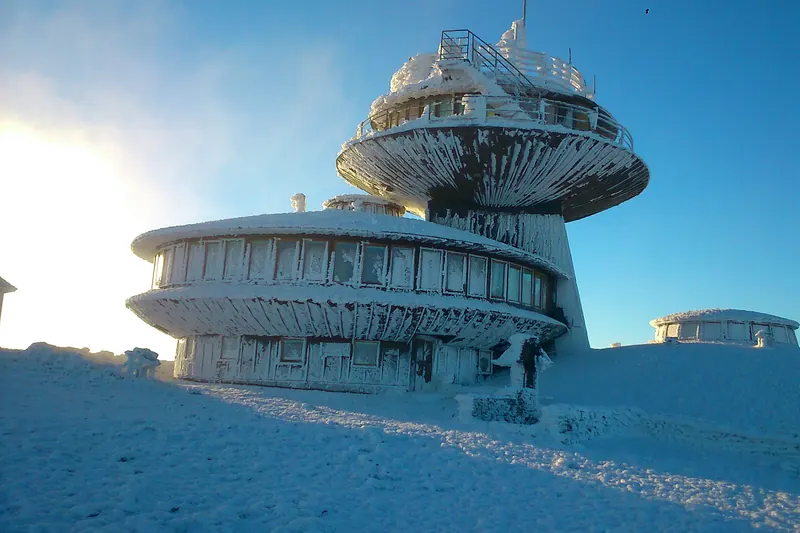
Frosted observatory buildings on the summit of Śnieżka under a blue sky, winter Śnieżka in winter, locator JO70UR. A station from this subsquare is worth 404 points to Mokotów in the IARU contest · photo: Ciacho5, CC BY‑SA 4.0
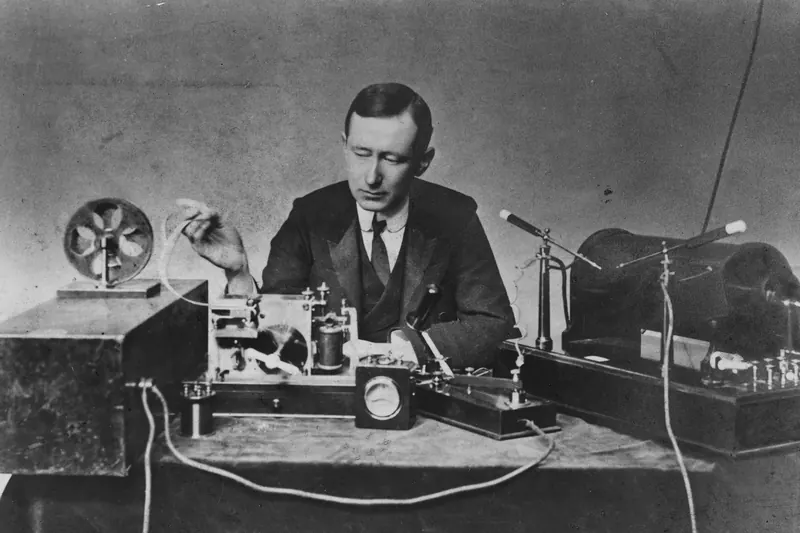
Guglielmo Marconi at a table with wireless telegraph apparatus, 1901
Guglielmo Marconi at his equipment (1901). His name is borne by the November Marconi Memorial Contest: 24 hours CW only on 144 MHz · photo: unknown, public domain
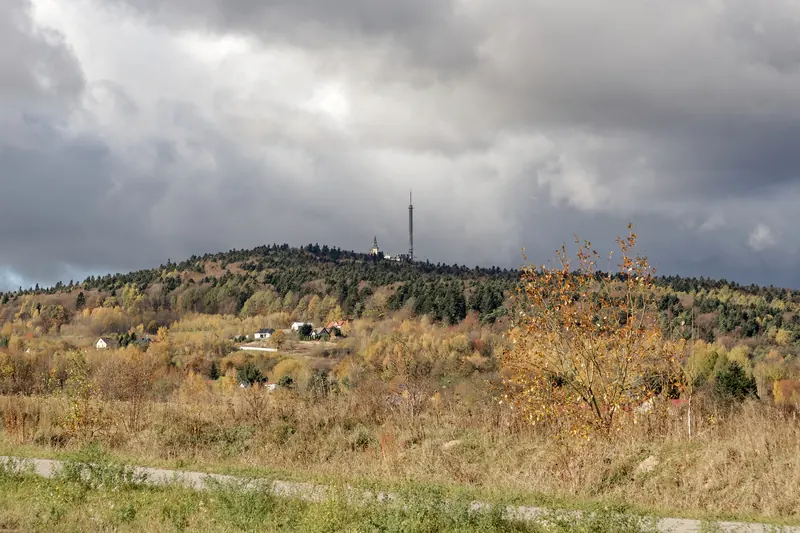
Forested ridge of Łysa Góra in the Świętokrzyskie Mountains with the RTCN tower on the summit, autumn
Łysa Góra, KO00MU. A QSO from Mokotów with a station from this subsquare is worth 149 points in the IARU contest. On the RTCN Święty Krzyż mast there is also the SR7KI repeater from my post · photo: Jakub Hałun, CC BY 4.0
FM

Only FM and a vertical antenna? You can enter the Lublin VHF Marathon, ARKiI rounds, SPAC (FM allowed) and the IARU contests (FM allowed, SO‑LP category with an omnidirectional antenna). Towards the end of the year there are also contests with a category for FM stations: PZK Mine Rescue (third Sunday of November, max 50 W) and Barbórka by the Silesian LOK with PZK (4 December). FM in the National Independence Day contest and the Ham Spirit Contest is also allowed.

At the same times as SPAC, the Nordic Activity Contest (NAC) takes place. In its Open class, stations from Poland may enter provided the log contains at least one QSO with a station from a Nordic country.

Your antenna

A vertical helps too, a horizontal wins

Contest stations on SSB and CW use horizontal polarisation. A repeater antenna is vertical and it shows in the points.

Antenna polarisation in VHF contests Top: two horizontal Yagis — the electric field oscillates horizontally, polarisation matched, full signal. Bottom: a vertical repeater antenna sends a vertically oscillating wave to a horizontal Yagi: cross‑polarised, a loss of 20 dB or more. MATCHED · both antennas horizontal field oscillates horizontally · full signal CROSSED · vertical and horizontal field oscillates vertically · loss of 20 dB or more horizontal Yagi contest station repeater antenna contest station
Loss with cross‑polarisation. When one station has a vertical antenna and the other a horizontal, you must expect a loss of 20 dB or more (ARRL Antenna Book). The IARU Region 1 VHF Handbook recommends horizontal polarisation for everything except FM channels.
FM

Start with what you have

The Lublin VHF Marathon is FM only, SPAC allows FM, and Mine Rescue and Barbórka have separate categories for FM stations. On FM a vertical antenna doesn’t lose out.

SSB

A small horizontal Yagi

A few elements turned horizontal open up SSB and CW. You’ll find ready dimensions in the article Yagi antenna 2 m / 70 cm.

FT8

Weak signals

In FT8 Activity the decoder pulls signals out from beneath the noise. It’s a good start when the antenna is modest and the radio has SSB.

km

Height and coax

On VHF, antenna height and losses in the coax are what count. Work out your feedline in the cable calculator.

IARU Region 1 bandplan

Where to find stations on 2 m and 70 cm

SSB and CW contests take place in the lower part of the 2 m band, in the narrowband segment. FM has its own simplex channels higher up.

Start of the 2 m band in the IARU Region 1 bandplan Section 144.000–144.500 MHz: satellites, telegraphy, EME, the CW/SSB segment with the SSB centre of activity 144.300 MHz, and beacons 144.400–144.490 MHz. satellites CW only CW and MGM · EME CW, SSB and digital modes (up to 2700 Hz) beacons 144.000 144.100 144.200 144.300 144.400 144.500 CW 144.050 CW centre FT8 144.174 convention, not bandplan SSB 144.300 SSB centre of activity CW only to 144.110 MHz · do not transmit below 144.0025 MHz · do not interfere with beacons FM outside the diagram: calling frequency 145.500 MHz, simplex 145.206–145.5625 MHz
The start of the 2 m band per the IARU Region 1 VHF Handbook (version 10.03, February 2026). In the bandplan 145.500 MHz is the FM calling frequency, and 144.300 MHz is the SSB centre of activity. The handbook asks that you only call on the calling frequencies, and move off them for the QSO itself. The MS segment 144.195–144.205, which still appears on some older sites, is not present in the current bandplan.
BandCWSSBFM (calling frequency)FM simplexBeacons
2 m144.050144.300145.500145.206–145.5625144.400–144.490
70 cm432.050432.200433.500433.400–433.5875432.400–432.490

Frequencies in MHz. CW and SSB have centres of activity; FT8 Activity runs on 144.174 and 432.174 MHz. In the Lublin VHF Marathon the 145.225–145.575 MHz channels are used.

Step by step

First time out in seven steps

You don’t have to make a hundred QSOs. In the September SPAC on 2 m even a station with a single QSO at 58 km was included in the results.

1

Pick a short contest

To start, SPAC on 2 m: Tuesday, four hours, report and locator. With a vertical antenna choose the Lublin VHF Marathon or a round of ARKiI, where FM is fully accepted.

you can check the date in the calendar at the top of the page
2

Read the rules

Times, exchange, bands, modes and the log deadline differ between contests. A link to the rules is next to each calendar entry.

3

UTC time and locator

Logs use UTC, and the locator must have six characters. Calculate it in the locator calculator and write it on a note by the radio.

SQ5CBA · KO02ME · Polish time in winter = UTC + 1 h, in summer UTC + 2 h
4

Logging software

On macOS: RUMlogNG (EDI export in the Contest menu) or Tucnak built from source. On Windows: N1MM Logger+ or QARTest, both free. In Poland DQR_Log by SP7DQR is also popular. Without a program the PK‑UKF EDI generator in the browser can help; it’s currently in testing.

5

Start by answering

Tune across the band and answer stations calling in the contest. The beginner’s guide advises having report, serial and locator ready — in that order. On the calling frequency only call, then move off it for the QSO.

6

Then call

On phone, a “contest call”; on CW TEST SP, as recommended by PZK guidelines. Call briefly, give your callsign clearly, and listen for replies on your frequency.

7

Submit your log

SPAC: EDI file via the contest website within 7 days. IARU: a separate EDI file for each band by the first Wednesday after the contest, 23:59 UTC, to iaru.oevsv.at and to the PK‑UKF robot (vhfcontests.pk‑ukf.pl). FT8 Activity: ADIF within 5 days.

a late log in IARU counts as a checklog
REG1TEST format

This is what an EDI file looks like

EDI is a plain text file defined in the IARU VHF Handbook. At the top a header with station details; below, one line per QSO.

[REG1TEST;1]
TName=IARU R1 145 MHz
TDate=20270904;20270905
PCall=SQ5CBA
PWWLo=KO02ME
PSect=SO-LP
PBand=145 MHz
RCall=SQ5CBA
RHBBS=e‑mail address
SPowe=100
SAnte=Diamond X-200N
[Remarks]
[QSORecords;2]
270904;1412;SP6XYZ/P;1;59;001;59;127;;JO70UR;404;;N;;
270904;1431;SQ7ABC;6;59;002;59;045;;KO00MU;149;;N;;

What the fields mean

The header says who, from where and in which category you’re entering. The IARU rules require at least: callsign and locator (PCall, PWWLo), section and band (PSect, PBand), operator callsigns (RCall; with multiple operators MOpe1, MOpe2), e‑mail address (RHBBS), power in watts (SPowe) and antenna (SAnte).

A QSO line is, in order: date RRMMDD, time UTC, callsign, mode code, sent report and serial, received report and serial, correspondent’s locator, points, and the “N” marker for a new locator. Mode codes: 1 SSB, 2 CW, 6 FM, 7 digital modes.

Your logging program will create the file for you. It’s still worth opening it once — a typo in a locator or a wrong time is obvious straight away. The callsigns SP6XYZ/P and SQ7ABC are examples.

Before you start

List to tick off

Your browser remembers the ticks, so the list will be there for the next contest.

Rules

Sources

Next step

First Tuesday of the month, 19:00

The easiest way is to start with SPAC on 2 m: four hours, report and locator, points per kilometre. Check the calendar for the next 2 m SPAC and listen around 144.300 MHz.