Home  /  Articles  /  Meteor scatter

Article · meteor propagation

Meteor scatter on 2 m:
contacts via shooting stars

Every day about 44 tonnes of matter from space falls to Earth. Most grains burn up about a hundred kilometres above us and leave a trail of ionised air which, for a fraction of a second, reflects 2 m waves. From Warsaw that reaches as far as Paris, London and Rome, without tropo and without a repeater. I explain how it works, what it sounds like, and how to make your first contact. Below there’s a live indicator showing what’s falling over Poland right now.

90–110 km up to about 2100 km MSK144 most in the morning Geminids 14.12
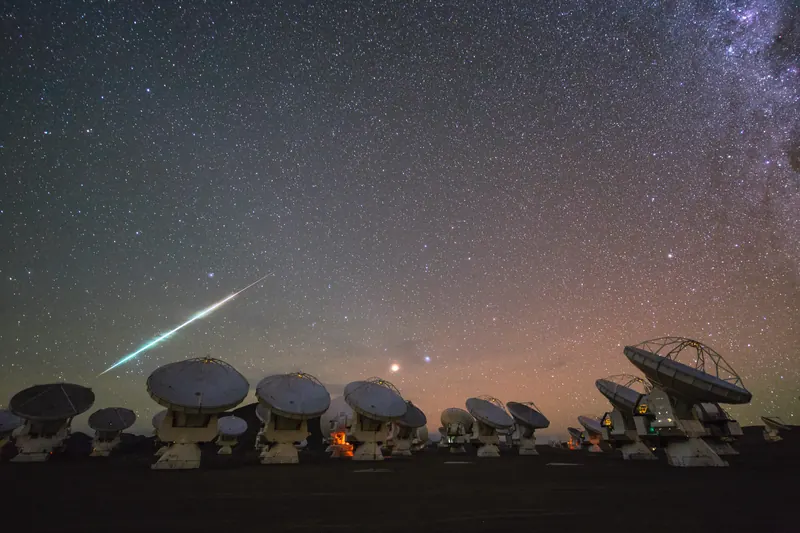
A bright bolide over the ALMA radio telescope antennas in Chile, against a starry sky Fireball over the ALMA radio telescope antennas · photo: ESO/C. Malin, CC BY 4.0
Live

Meteors over Warsaw now

The indicator calculates in your browser which side of the Earth Warsaw is on right now, which shower is active and how high its radiant is above the horizon. Shower dates are from the IMO calendar for 2026 and 2027.

Calculating…

Checking the sky over Warsaw

The indicator runs in your browser with JavaScript enabled. Below you’ll find a shower table and the rule: most meteors in the morning, fewest in the evening.

Best time: calculating…

Calculated for QTH KO02ME (Warsaw). Showers: IMO calendar · rules: ITU‑R P.843

Active shower– 
Shower radiant– 
Earth’s apex–altitude above the horizon
Next maximum– 
Earth’s apex (sporadic meteors)shower radiantnight
☾

The Moon doesn’t get in the way of radio. Full Moon can wash out faint meteors to the eye, but the ionisation trail reflects radio waves just the same by day, at night and at full Moon. Radio hears meteors through cloud and in daylight, which is why daytime showers, invisible to the naked eye, were discovered by radar.

How it works

A mirror that lives for a fraction of a second

The wave doesn’t reflect off the meteor itself, but off the streak of ionised air it leaves behind.

A grain of sand, 11–72 km/s

Meteors that can be seen with the naked eye are usually fragments ranging from a grain of sand to a small pebble, as light as cork. They enter the atmosphere at speeds from 11 to 72 km/s and usually burn up at an altitude of 80–120 km. Each one leaves behind a column of ionised air that for a moment reflects VHF waves.

Trails useful for contacts are mainly at 90–110 km. Radio hears much smaller particles than the eye: echoes from thin trails come from meteors so faint they’re invisible to the naked eye.

The reflection is specular. The IMO likens the transmitter to a light bulb and the trail to a long mirror: the receiver sees the bulb at only one point of that mirror. That’s why, even in the most favourable part of the sky, only about 5% of trails are usable for contacts — the ones that just happen to lie at a good angle.
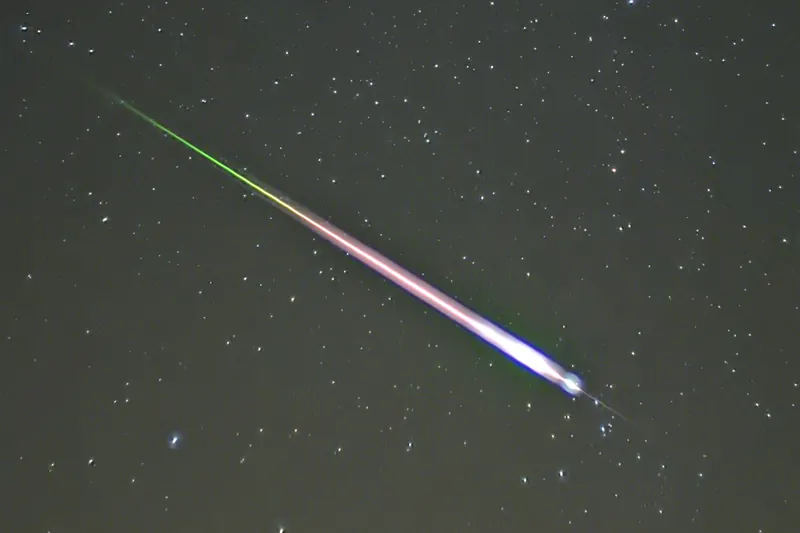
A bright Leonid meteor against the stars, with a glowing greenish trail behind the head A 2009 Leonid. A glowing trail follows the meteor head · photo: Navicore, CC BY 3.0
Cross‑section of a Warsaw–Paris meteor scatter contact Two stations 1366 km apart. A meteor burns up at about 100 km over the midpoint of the path, and the ionised trail reflects the signal from one station to the other. Vertical scale ×3. meteors burn up here about 80–120 km above Earth ionised trail acts like a mirror for a fraction of a second WarsawSQ5CBA Parisstation F 1366 km in a straight line · each antenna points about 5° above the horizon vertical scale ×3
Warsaw–Paris to scale. Distance 1366 km, reflection point halfway at 100 km, Earth with its true curvature (heights magnified threefold). This geometry means both antennas aim only about 5° above the horizon — practically horizontal.
Coverage

Easiest 1200–1500 km, usually up to about 2100

Meteor scatter works over long distances. At short range it’s weak: the shorter the path, the more nearly perpendicular the wave hits the trail, and then the echo is shorter and weaker (ITU‑R).

Meteor scatter range from Warsaw: azimuthal map of Europe Europe map in an equidistant azimuthal projection centred on Warsaw (KO02ME). Rings every 500 km, azimuths around the edge. The area where meteor scatter works on 2 m is marked. N 30° 60° E 120° 150° S 210° 240° W 300° 330° 500 km 1000 km 1500 km 2000 km easiest 1200–1500 km usually up to about 2100 km geometric limit about 2250 km Berlin 517 km Prague 516 km Vienna 553 km Budapest 542 km Copenhagen 673 km Stockholm 813 km Helsinki 918 km Oslo 1065 km Paris 1366 km London 1448 km Rome 1313 km Madrid 2288 km Bucharest 943 km Kyiv 689 km Minsk 477 km Vilnius 395 km Riga 564 km Moscow 1152 km Athens 1596 km Istanbul 1384 km Dublin 1827 km Edinburgh 1623 km Trondheim 1393 km Belgrade 826 km GRAVES143.050 MHz · 1233 km SQ5CBA · KO02ME
Azimuthal map centred on Warsaw. Distances from the centre and bearings on the rim are true, so the azimuth read off the map is the antenna heading. The lighter ring is the range the WSJT‑X manual gives for MSK144: up to about 2100 km. The golden band 1200–1500 km is what practitioners recommend for first attempts. The dotted circle is about 600 km: that’s the minimum distance the IMO gives for listening to transmitters via meteors. The circle at the rim is the geometric limit, about 2250 km.
Why the limit is about 2250 km

Horizon at 100 km altitude

  • the reflection point must be above the horizon of both stations
  • a trail at 100 km is visible up to about 1120 km, so a contact can reach about 2 × 1120 = about 2240 km
  • a trail at 110 km gives about 2350 km, at 90 km about 2130 km
  • in practice the WSJT‑X manual gives a range up to about 2100 km, and single‑meteor reflections beyond 1900 km are rare
Where to aim

At the station, but don’t obsess

  • the best reflection areas lie about 100 km either side of the path (ITU‑R)
  • so the antenna mustn’t have too narrow a beam: it needs to cover both areas
  • a plain Yagi pointed at the other station does that by itself
  • you can read the bearing off the map alongside, or from the locator calculator

Where to point the antenna from Warsaw

  1. Copenhagen673 km308°
  2. Kyiv689 km103°
  3. Stockholm813 km348°
  4. Belgrade826 km183°
  5. Helsinki918 km14°
  6. Bucharest943 km155°
  7. Oslo1065 km328°
  8. Moscow1152 km63°
  9. Rome1313 km213°
  10. Paris1366 km262°
  11. Istanbul1384 km151°
  12. Trondheim1393 km338°
  13. London1448 km275°
  14. Athens1596 km171°
  15. Edinburgh1623 km294°
  16. Dublin1827 km285°
  17. Madrid2288 km245°

Great‑circle distance and azimuth from QTH KO02ME (Mokotów), computed with the same formula as in the locator calculator. Golden: 1200–1500 km, the distance recommended for first attempts. Dimmed: beyond the usual range of about 2100 km. Cities closer than 600 km omitted.

What it sounds like

Ping, burn and MSK144

Most reflections are short ‘pings’. Every now and then a bright meteor comes along and the signal holds for a few seconds.

Ping and burn: signal strength over time Plot of signal strength from a meteor reflection. A ping from an underdense trail lasts a fraction of a second and fades quickly. A burn from a dense trail lasts a few seconds and the signal ripples. Below the ping, the 72 ms MSK144 frames are marked. 0 s 1 s 2 s 3 s 4 s signal strength threshold above which the decoder will decode anything PING thin trail · fraction of a second 2 full 72 ms MSK144 frames above threshold BURN dense trail · a few seconds, signal ripples
Two types of echo. An underdense trail gives a sudden start and exponential decay: on 2 m a ping lasts, according to the IARU, at most about 100 ms. An overdense trail from a brighter meteor reflects for seconds and the signal ripples 5–10 times per second. The IARU calls such reflections bursts; in slang we say ‘burn’. There are fewer of these echoes. In practice QSOs are made on pings, and in a short ping there’s room for one, at most two MSK144 frames.

The sounds are synthesised in the browser, they’re not recordings. I set the duration and shape according to IARU and IMO descriptions, and MSK144 has the real emission parameters: 2000 baud, tones 1000 and 2000 Hz.

6 m×8

Longer on 50 MHz

Echo duration rises with the square of wavelength. For the same geometry, on 6 m the echo lasts about 8 times longer than on 2 m. That’s why meteor scatter is easier on 6 m.

2 m0.1 s

Pings on 144 MHz

The IARU Region 1 VHF Handbook states that on 2 m a ping lasts at most about 100 ms. Longer reflections from dense trails are called bursts.

70 cm÷9

Very difficult on 432 MHz

On 70 cm the echo is about 9 times shorter than on 2 m and much weaker. Pings last at most about 13 ms. A QSO is possible, but it’s a job for bigger antennas and higher power at the other end.

Time of day and year

More in the morning, less in the evening

Even without a shower, meteors arrive around the clock. How many there are depends on whether we’re on the front or the back of the speeding Earth.

Why there are more meteors in the morning The Earth races along its orbit round the Sun. The dawn side faces the direction of motion, so it collects meteoroids like a car’s windscreen collects raindrops. The evening side is turned away from them. Sun Earth’s direction of travel approx. 30 km/s around the Sun 6:00 · dawn this side leads: meteors come in head-on 18:00 · dusk they have to catch up with this side: fewer meteors 12:00 0:00 meteoroids
The windscreen in the rain. In the morning we’re on the side of the Earth facing the direction of its motion around the orbit and we collect meteoroids head-on. In the evening they have to catch us up. Astronomers call this direction of motion the apex, and in the indicator above it’s the tile ‘Earth’s front’.
Day×4

Between morning and evening

According to the ITU, there are the most sporadic meteors at approx. 6:00 and the fewest at approx. 18:00 local time. On average the difference is fourfold. The WSJT‑X manual is explicit: in the evening a QSO takes longer.

YearII · VII

February poor, July good

According to ITU‑R, in the northern hemisphere the fewest sporadic meteors are in February and the most in July. Visual observers record the most in November and December. From May to July strong daytime showers join in, audible only by radio.

Eye4 → 17

The same with the naked eye

Visual observers log around 4–5 sporadic meteors per hour in the evening and around 16–17 before dawn. It’s the same effect as on the radio.

IMO calendar 2026 / 2027

Showers: that’s when pings are most frequent

During a shower meteors arrive from a single point in the sky, the radiant. In a strong shower, when the radiant is above the horizon, there are clearly more pings than on an ordinary day.

Meteor showers through the year Year axis from January to December. Bars show shower maxima: the higher, the more meteors per hour (ZHR). The blue ones are daytime showers, heard only by radio. Jan Feb Mar Apr May Jun Jul Aug Sep Oct Nov Dec Quadrantids · maximum 2026-01-03 · ZHR 80 Lyrids · maximum 2026-04-22 · ZHR 18 (up to 90) Eta Aquariids · maximum 2026-05-06 · ZHR 50 Arietids · maximum 2026-06-07 · ZHR 30 Zeta Perseids · maximum 2026-06-09 · ZHR n/a Beta Taurids · maximum 2026-06-25 · ZHR n/a Perseids · maximum 2026-08-13 · ZHR 100 Draconids · maximum 2026-10-09 · ZHR 5 (?) Orionids · maximum 2026-10-21 · ZHR 20+ Leonids · maximum 2026-11-17 · ZHR approx. 15 Geminids · maximum 2026-12-14 · ZHR 150 Ursids · maximum 2026-12-22 · ZHR 10 Geminids ZHR 150 Perseids ZHR 100 Quadrantids ZHR 80 Eta Aquariids ZHR 50 Arietids ☀ ZHR 30 Orionids ZHR 20+ Lyrids ZHR 18 (up to 90) Leonids ZHR approx. 15 Zeta Perseids ☀ no ZHR Beta Taurids ☀ no ZHR Ursids ZHR 10 Draconids ZHR 5 (?)
Meteor showers in 2026. The bar height grows with the number of meteors per hour (ZHR). Blue showers ☀ have their radiant close to the Sun and work in daylight: the eye hardly sees them, radio hears them without a problem. For the Zeta Perseids and Beta Taurids the IMO calendars do not give a ZHR, so their bars are hatched and have a notional height. The red line marks today’s date.

How to read ZHR

ZHR is, according to the IMO, the number of meteors that an ideal observer would see in an hour under ideally dark skies, if the radiant were at the zenith. It’s a visual figure, and radio also hears fainter meteors. It does, however, show well which shower is strong and which barely stands out from the background.

On 2 m two things matter: shower strength and radiant altitude. A shower with its radiant below the horizon yields almost nothing, because its meteors don’t reach over Poland. That’s why the indicator at the top plots the radiant altitude for the next 24 hours.

The strongest of the year are the Geminids (ZHR 150, peak on 14 December), then the Perseids and the Quadrantids. The strongest daytime shower is the Arietids in June. Their radiant lies only about 30° from the Sun, so the eye hardly sees them.

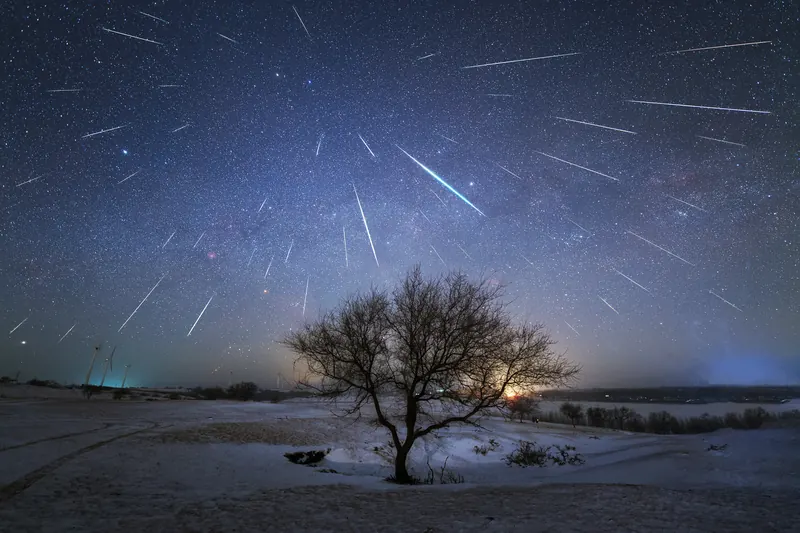
Multiple Geminid meteor trails in the winter sky above a solitary tree in the snow Geminids above a lone tree. Composite of many frames, the trails fan out from the radiant · photo: Dai Jianfeng/IAU OAE, CC BY 4.0
ShowerActivePeak (Polish time)ZHRRadiantSpeedGood to know
Draconids6 – 10 Oct9 October 2026, 03:005 (?)263° / +56°20 km/sThe radiant does not set over Poland. For 2026 the IMO does not forecast increased activity, although in 1933 and 1946 this shower produced meteor storms.
Orionids2 Oct – 7 Nov21 October 202620+95° / +16°66 km/sA shower from Halley’s Comet. Active from 2 October, with a broad maximum.
Leonids6 – 30 Nov18 November 2026, 00:45approx. 15152° / +22°71 km/sThe fastest meteors of the year, 71 km/s. In 1966 the ZHR may have reached about 15,000 — the strongest measured outburst.
Geminids4 – 20 Dec14 December 2026, 15:00150112° / +33°35 km/sThe strongest shower of the year: ZHR 100 or more for about 10–12 hours. It comes from the asteroid (3200) Phaethon, not from a comet.
Ursids17 – 26 Dec22 December 2026, 23:0010217° / +76°33 km/sA weak shower just before Christmas. The radiant lies high in the northern sky.
Quadrantids28 Dec – 12 Jan4 January 2027, 04:2580 (60–200)230° / +49°41 km/sIn 2027 the Moon is absent — ideal conditions. By radio the peak is often broader than the typical 4 hours.
Lyrids14 – 30 Apr23 April 2027, 03:4018271° / +34°49 km/sUsually weak but variable: ZHR up to 90 has been observed.
eta Aquariids19 Apr – 28 May6 May 2027, 11:0050 (40–80+)338° / −1°66 km/sThe second shower from Halley’s Comet. The radiant culminates around 08:00, so it’s a shower for morning listening.
Arietids daytime25 May – 20 Jun8 June 20273043° / +24°38 km/sThe strongest daytime shower. The radiant is only about 30° from the Sun: the eye hardly sees it, radio hears it in daylight.
zeta Perseids daytime30 May – 20 Jun10 June 2027no ZHR67° / +23°—Daytime shower, overlaps with the Arietids. Current IMO calendars do not give its ZHR; in 2020 the IMO assessed its radio activity as high.
beta Taurids daytime15 Jun – 5 Jul26 June 2027no ZHR82° / +20°—Daytime shower, probably associated with comet Encke, discovered by radar. In 2020 the IMO rated its radio activity as moderate.
Perseids17 Jul – 24 Aug13 August 2027, 10:00–12:00110+48° / +58°59 km/sThe best-known summer shower. Forecasts for 2027 suggest a ZHR of about 110–120.

Dates according to the IMO Meteor Shower Calendar 2026 and 2027 (for daytime showers see table 7, radio showers). I give the time only where the IMO does, converted to Polish time. The radiant is given in sky coordinates: right ascension and declination in degrees. Highlighting: shower active now, the red mark is the nearest maximum.

Digital mode

MSK144: a message in 72 milliseconds

A 2 m ping lasts a fraction of a second. MSK144 is designed so that at least one complete message fits into that time.

Fast, short, repeated

MSK144 is a mode in the WSJT‑X program. A single frame has 144 bits and lasts 72 ms. It is transmitted at 2000 baud, with tones at 1000 and 2000 Hz, always centred around 1500 Hz in the SSB passband. Frames go out one after another throughout the transmit period, so a ping carries as many copies of the message as will fit. A longer reflection lasting a few tenths of a second carries several copies, while the shortest 2 m pings do not even fit one.

A 0.1 s ping is usually enough to decode when the signal is at the noise level or above. The decoder can also average up to 7 frames, i.e. about half a second. When pings are shorter than about 70 ms, which on 2 m happens often, short messages (Sh) help: 20 ms, report only, RRR or 73.

The report in MSK144 is signal‑to‑noise in dB, e.g. +02. A QSO is complete when both sides have copied both callsigns, the report and the acknowledgement (R before the report or RRR). “73” is not required for that.

Joe Taylor K1JT, Nobel Prize laureate in physics, in a dinner jacket at a formal dinner Joe Taylor K1JT, author of WSJT and co‑author of MSK144, winner of the 1993 Nobel Prize in Physics · photo: Betsy Devine, CC BY‑SA 3.0
MSK144 transmit periods on 2 m Two minutes of an MSK144 QSO: 30‑second periods. The station calling CQ transmits in the second period of each minute, the correspondent in the first. During the receive periods short pings appear, from which the decoder decodes messages. :00 :30 :00 :30 :00 period 1 · 00–29 s period 2 · 30–59 s period 1 · 00–29 s period 2 · 30–59 s SQ5CBA Warsaw F4XYZ SQ5CBA +02 <F4XYZ SQ5CBA> RRR F4XYZ Paris SQ5CBA F4XYZ JN18 <SQ5CBA F4XYZ> R+03 gold field = transmit (message repeated for the whole period) · ticks = pings in the receive period
30‑second periods. On 2 m in Europe MSK144 runs in 30 s periods: this is recommended by the IARU Region 1 VHF Handbook for digital modes, and it is also the WSJT‑X default on 2 m. Each station repeats its message until it receives the next one from the correspondent. The callsign F4XYZ is just an example.
  WSJT‑X · MSK144 · 144.360 MHz · T/R 30 s
  1. 213030TX1500CQ SQ5CBA KO02
  2. 213100+011495SQ5CBA F4XYZ JN18
  3. 213130TX1500F4XYZ SQ5CBA +02
  4. 213300+041502<SQ5CBA F4XYZ> R+03
  5. 213330TX1500<F4XYZ SQ5CBA> RRR
  6. 213500+001498<SQ5CBA F4XYZ> 73
A mock‑up window modelled on the QSO example from the WSJT‑X manual. The red lines are my transmissions, the rest are decodes from pings. Angle brackets <> denote short messages in which, instead of the callsigns, their shorthand is sent.
WSJT-X waterfall strip with vertical flashes of MSK144 pings on 50 MHz
Real WSJT‑X recording. 15 seconds of MSK144 reception on 6 m (time axis at the top). Around 5.5 s a short ping, from about 10.3 s a two‑second reflection from a brighter meteor. The green line is signal strength · screenshot: Chrumps, CC0
Frame
144 bits · 72 ms
Modulation
2000 Bd · 1000 and 2000 Hz
Short message
20 ms · R+report, RRR, 73
T/R period
30 s on 2 m · 15 s on 6 m
2 m calling
144.360 MHz
Report
S/N in dB, from −50 to +49
Step by step

First QSO via meteors

Listen first, then call. It’s best to make the first attempts in the morning, and with a correspondent 1200–1500 km away.

1

Clock accurate to the second

The periods are synchronised to UTC. The IARU VHF Handbook requires the clock to be accurate to better than 1 second. Sync your computer with a time server before each session.

2

WSJT‑X in MSK144 mode

MSK144 mode, T/R period 30 s, radio in USB, frequency 144.360 MHz. To start with, decoder ‘Fast’, Rx 1500 Hz, F Tol 100. On a fast computer you can set ‘Deep’ and F Tol 200 straight away.

MSK144 · USB · 144.360 MHz · T/R 30 s · Auto Seq
3

Listen for fifteen minutes

Before you start transmitting, watch the waterfall and the decodes. Mornings are best: that’s when there are most meteors, and the WSJT‑X manual notes that in the evening a QSO takes longer. If you’re decoding anything, your receive chain is working.

4

Choose a period

The current IARU handbook recommends that stations in Central and Western Europe call CQ in the second period (seconds 30–59). For skeds an older rule is sometimes used: whoever points the antenna west or north transmits in the first. In practice the caller decides, or whatever you arranged for the sked.

in WSJT‑X ‘Tx even/1st’ = first period (00–29 s)
5

Call with an offset

Call CQ on 144.360, and conduct the QSO nearby, within 144.360–144.399 MHz. The message CQ 383 says you will listen on 144.383 MHz. This requires rig control (CAT) and Split mode.

6

Or arrange a sked

Skeds on 2 m are arranged on the ON4KST chat (room ‘144 & 432 MHz’, in English). Agree a frequency off the calling frequency, a start time, and who transmits first. On the chat you may arrange skeds, but you must not exchange QSO elements: “I still need RRR” invalidates the QSO.

7

Patience

An MS QSO on 2 m can take anything from a dozen to several dozen minutes. For a participant in the MS Sprint 2025 contest (F4EEJ) one QSO took on average about 20 minutes. The radio transmits for roughly half of that time.

Listen this evening

GRAVES radar: meteors on demand

You don’t have to wait for the other station. There’s a radar near Dijon in France whose signal, reflected off meteors, can be heard across almost all of Europe, including Poland.

Carrier 143.050 MHz round the clock

GRAVES is a French military radar for tracking satellites in low orbit. The transmitter stands at the former Broye‑lès‑Pesmes airfield, about 36 km east of Dijon, and transmits a pure carrier on 143.050 MHz round the clock. It’s about 1,230 km from Warsaw, a typical distance for meteor reflections. On the coverage map above it’s the red marker.

You can’t hear the signal directly, as the transmitter is below the horizon. What you can hear are the reflections from meteors, and at times also from aircraft and satellites. The radar beams sweep the sky south of Dijon, but the echoes reach almost all of Europe anyway.

How to listen: set the receiver to 143.049 MHz USB; you’ll hear the echoes as a tone around 1 kHz, as brief as a click, like the “Ping” button above. The European IC‑9700 won’t receive this, as it starts at 144 MHz. A cheap USB SDR dongle will do, a 2 m antenna pointed west‑south‑west (azimuth about 250°), and a program with a waterfall.

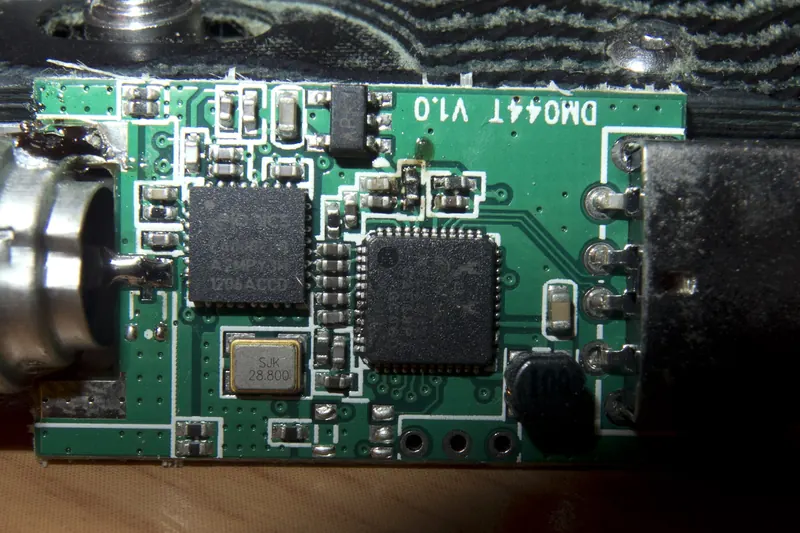
Disassembled USB SDR receiver: a green PCB with ICs next to the antenna connector USB SDR receiver without a case. This is all you need to monitor GRAVES · photo: Artem M., CC BY‑SA 2.0
143.049

USB, 1 kHz tone

Set 143.049 MHz USB. A 1 kHz offset from the radar’s carrier gives a tone about 1,000 Hz, which appears on the waterfall as a short dash.

250°

Antenna towards France

From Warsaw GRAVES lies at an azimuth of about 250°. A small Yagi will do, or even an omnidirectional antenna.

SDR

Programs

For counting echoes you can use, among others, Spectrum Lab, HROFFT and Echoes. An international database, RMOB, collects data from many stations.

PL

Polish stations

GRAVES echoes are recorded by, among others, the Astronomical Observatory of the Jagiellonian University in Kraków and station SO8OO (radiometeory.pl) in the south‑east of the country. In July 2026 Urania described a 24‑hour stream from Kraków.

Equipment

What you need to get started

For listening, whatever you have will do. For QSOs a horizontal Yagi and a hundred watts will help.

100 W and ten elements

According to QST, a good starter station for MS on 2 m is 100 W and a 10‑element Yagi. The WSJT‑X manual adds that, with patience, 100 W and a single Yagi are usually enough. Joe Taylor K1JT writes that up to about 1,600 km a well‑designed 10–12‑element Yagi is probably close to optimum. Too narrow a beam hurts, because the reflections arrive from the sides of the path.

On paths over about 1,000 km you practically don’t tilt the antenna up: the take‑off angle in MS doesn’t exceed about 15°, and on paths over 1,800 km it drops below 3°. Mounting height matters more. On shorter paths, elevation control is useful.

Polarisation. The standard on VHF/UHF outside FM channels is horizontal polarisation. In OH5IY’s tests (1995/96, paths about 1,500–1,650 km, small sample) a vertical antenna caught quite a few reflections, but horizontal worked a little better. OH5IY also writes that vertical doesn’t work on paths shorter than about 600 km. With a vertical antenna, such as my X‑200N, it’s best to start with listening: the Dutch VERON writes that even on a vertical you can decode plenty of MSK144 stations.

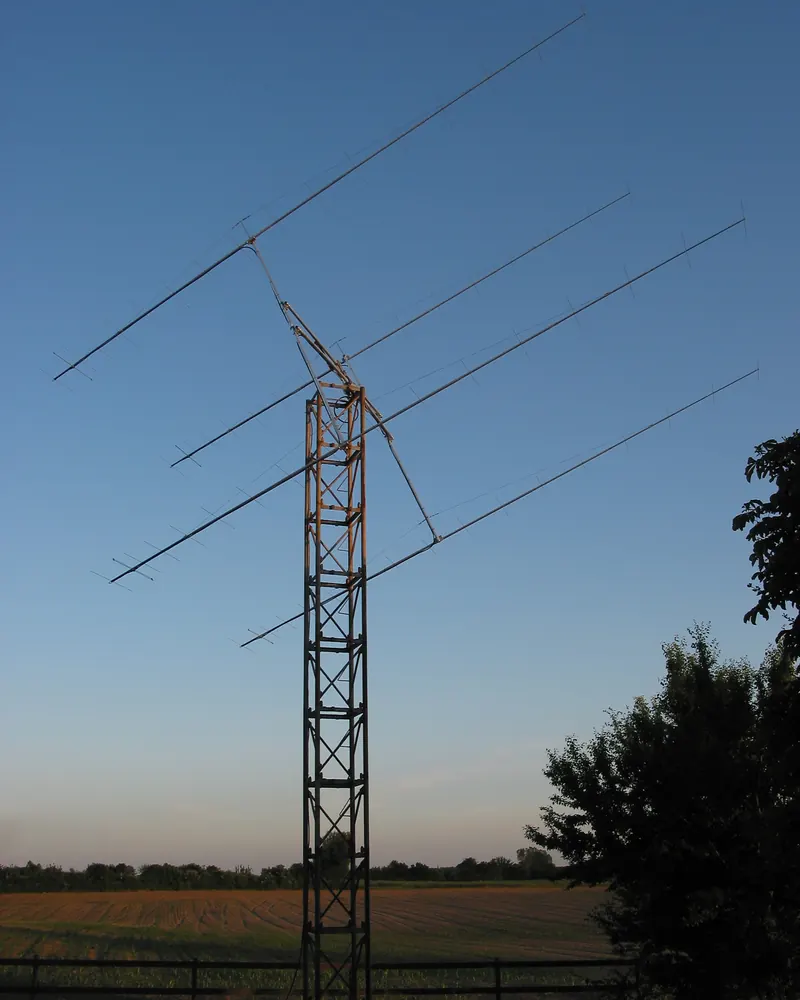
Four long 2 m Yagi antennas on a lattice mast against the evening sky DK5LA’s 4 × 17‑element array. One good Yagi is enough to start with · photo: Reinhard Kühn DK5LA, CC BY‑SA 3.0
Bearing8–16°

Off the path

Most reflections from sporadic meteors come from areas 8–16° to either side of the bearing to the other station. Both stations should aim at the same point. To begin with, pointing straight at each other is fine.

Showers90°

Side‑on to the radiant

During a shower QSOs work best when the path is about 90° (±15°) from the direction to the radiant. That’s the advice of Czech MS practitioner OK1TEH.

Radio50%

Half an hour of transmitting

In an hour of attempts the radio transmits for half the time. The radio and power supply must withstand an hour of this at full power.

History

From a military radar to WSJT‑X

At first meteor reflections were a nuisance, then they became a tool for astronomers, and finally a way to make long‑distance QSOs for radio amateurs. The Polish chapter began in Warsaw.

  1. 1929Hantaro Nagaoka of Japan is the first to suggest that meteor showers can disturb the propagation of radio waves.
  2. 1931–32Bell Labs engineers measure the ionosphere during the Leonids, and A. M. Skellett calculates that a meteor of a gram or more will ionise the air enough to affect propagation.
  3. 1944–46J. S. Hey and G. S. Stewart use military radar to study short echoes and prove they are meteor trails: the number of echoes increased during the Quadrantids and Lyrids.
  4. 1945–46In December 1945 Bernard Lovell brings a military radar to Jodrell Bank and catches the Geminids. In October 1946, during a Draconid storm, about 10,000 meteors per hour were recorded visually and by radar. That same night the 6 m band in the USA fills with signals over 200–1,200 miles.
  5. 1953QST describes meteor scatter contacts discovered by accident at Stanford University. On 22 October W4HHK and W2UK make the first 2 m meteor scatter contact, over about 1,500 km, probably with a bit of tropo helping.
  6. 1958First European MS QSO on 2 m: HB9RG from Zürich and Sweden’s SM6BTT, on the night of 13–14 December during the Geminids, about 1,200 km.
  7. 1962First Polish meteor scatter contact. On 11 August, during the Perseids, Capt. Edmund Masajada SP5SM from Warsaw, Secretary‑General of PZK (the Polish Amateur Radio Union), works English station G3LTF. The stations arranged by post to use 5‑minute periods, and transmitted in CW at about 150 characters per minute. On 11 August, after an hour and a half of attempts, reports were exchanged and the final “rrr” was sent.
  8. 1972First MS QSO on 70 cm: W2AZL and W0LER, 1,641 km. It lasted 5 hours and 4 minutes.
  9. 1980On 10 August SP6ARE and UG6AD make a 2,446 km QSO: the furthest Polish MS QSO on 2 m in the PK‑UKF (the Polish VHF Club) record list. That exceeds the geometric limit of pure meteor scatter, so another mode of propagation most likely helped.
  10. 2001Joe Taylor K1JT releases WSJT with FSK441, the first digital mode designed for the shortest pings. In the September 2001 contest, half of the 2 m QSOs took less than 13 minutes.
  11. 2018From 10 December the current version of MSK144 in WSJT‑X 2.0 took effect. That summer DJ6AG and EA8TX set the Region 1 meteor scatter record on 2 m: 3,434 km, most likely with some tropo helping.
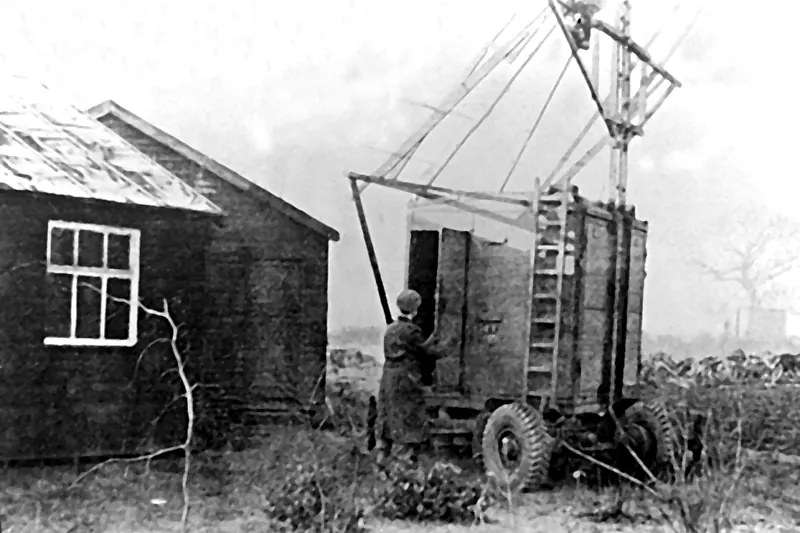
Black-and-white photo from 1945: a wooden hut and a military radar on a wheeled trailer at Jodrell Bank
Jodrell Bank, 1945. A hut and a military radar on a trailer. In December that year Bernard Lovell received echoes from the Geminids here, and that’s how meteor radar astronomy began at Jodrell Bank · photo: Jodrell Bank, University of Manchester, Attribution licence
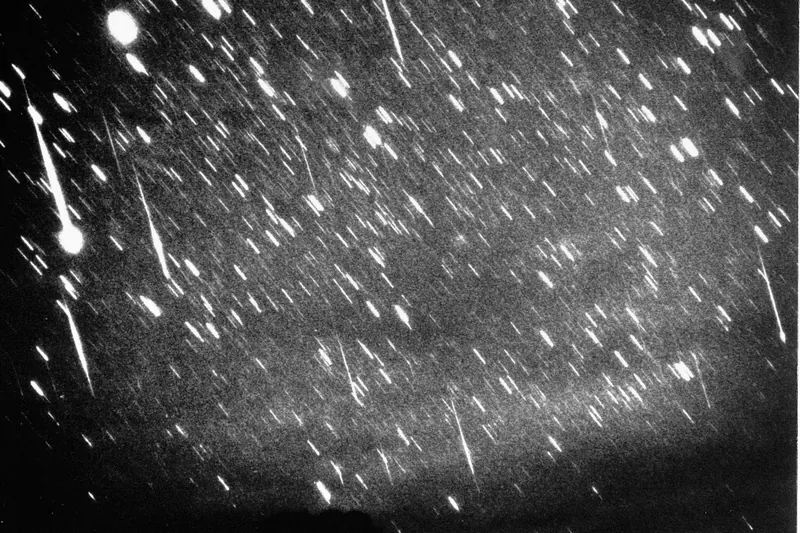
Black-and-white photo of the sky densely covered with meteor trails during the 1966 Leonid storm
Leonid storm, November 1966. One of four photos from Kitt Peak, Arizona. In 1966 the Leonids may have reached a ZHR of about 15,000 · photo: NOIRLab/NSF/AURA, CC BY 4.0
Did you know…

Six numbers from the sky

NASA44 t

Material per day

That’s how much meteoric material falls to Earth each day according to NASA scientists’ estimates: about 44,000 kilograms. The source gives 48.5 short tons; a US ton is smaller than a metric tonne.

Estimate25 million

Meteors per day

That’s how many meteors per day are bright enough to be seen with the naked eye somewhere on Earth. According to telescopic studies, several billion meteoroids enter the atmosphere each day.

Daytime shower30°

Arietids are heard, not seen

The strongest daytime shower has its radiant only about 30° from the Sun. In June the meteors fall in broad daylight and optical observations are almost impossible. Radio picks them up without trouble.

Halley’s Comet×2

Two showers from one comet

Halley’s Comet left dust in orbit that the Earth passes through twice a year: in May we see the eta Aquariids, and in October the Orionids.

Asteroid3200

Geminids aren’t from a comet

The strongest shower of the year doesn’t come from a comet, but from the asteroid (3200) Phaethon.

Leonids 196615,000

Meteor storm

In 1966 the Leonids may have reached a ZHR of about 15,000, the strongest measured meteor outburst. Another surge can be expected around 2031, when the parent comet 55P/Tempel‑Tuttle returns near the Sun.

Where these numbers come from

Sources

Next step

Start by listening, in the morning

The simplest start: WSJT‑X in MSK144 mode on 144.360 MHz and a quarter of an hour’s listening before work. When you see the first decodes, you’ll know the antenna and radio are ready for your first QSO.