Home  /  Guide  /  How to get your licence

Guide · getting started in amateur radio

How to get an amateur radio licence

From the first “I want to transmit” to your own callsign there’s one test and one application. Below is the whole path under the rules in force from 1 May 2026: which category to choose, how to learn, where it’s held and how much it costs, what to do with the certificate, and how to pick a callsign you’ll keep for 25 years.

32 questions · 75% in each section 150 PLN exam + 82 PLN licence licence for 25 years no Morse
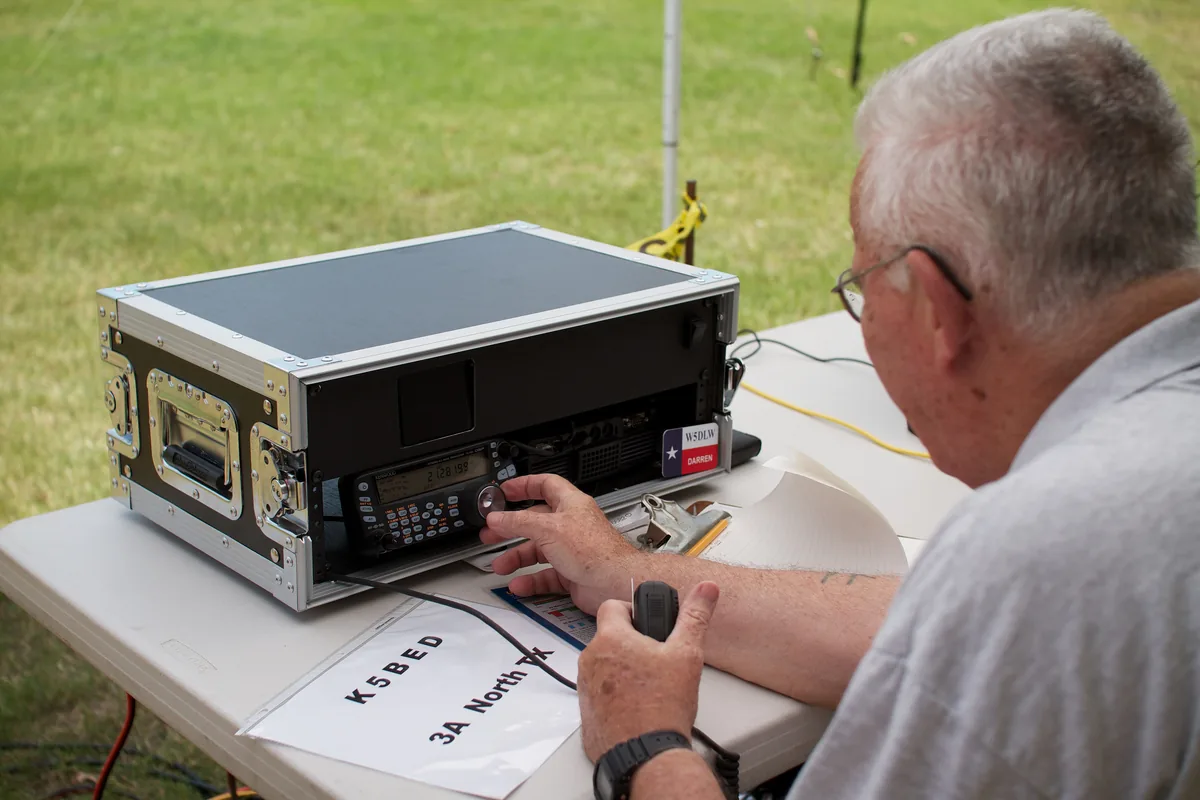
Radio amateur at a portable HF station during Field Day — hand on the tuning knob, microphone alongside
Bedford club Field Day · at K5BED’s station · photo: Greg Heartsfield, CC BY 2.0
Basics

Why have a licence at all

Listening is free for everyone. Transmitting on the amateur bands requires a radio licence — that’s what we mean by a ‘licence’.

The radio licence — your callsign

In Poland an “amateur radio licence” is formally a radio licence in the amateur radiocommunication service, issued by the President of UKE (the Polish Office of Electronic Communications). It records three things: your callsign, the category (what you may use and at what power) and the period of validity — today up to 25 years.

Without a licence you’re left with CB on 27 MHz and PMR446 handhelds — no personal callsign, no repeaters, no HF and no satellites. With a category 1 licence you have:

  • all amateur bands — from 137 kHz up to microwaves, with power up to 500 W
  • repeaters, satellites and the ISS — including contacts with astronauts, as in the photo alongside
  • a callsign recognised worldwide and entries in international databases
  • travelling without the paperwork — category 1 meets CEPT T/R 61-01, so in most of Europe you can transmit on your Polish licence

You don’t need to know Morse. The exam is a multiple-choice test from an open question bank, and passing it is realistic for anyone who sets aside a few evenings.
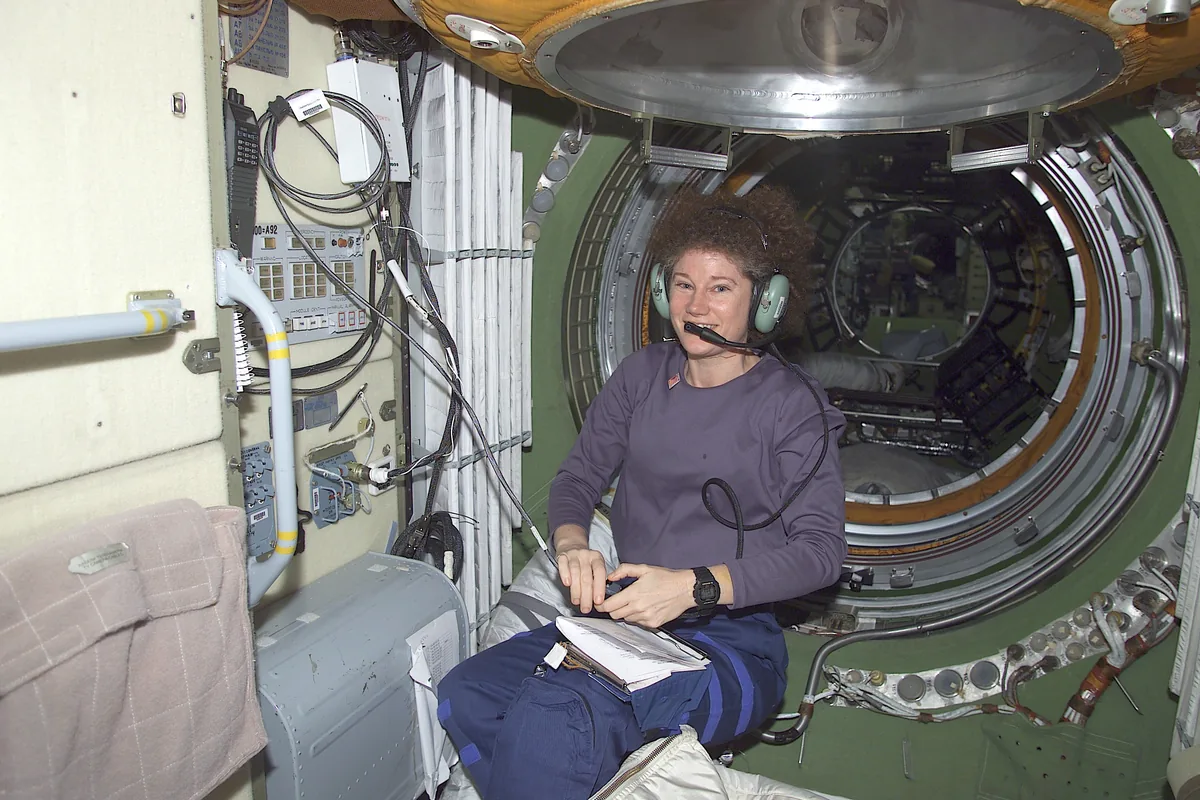
Astronaut Susan Helms wearing a headset at the amateur radio station in the Zarya module on the ISS ISS, Zarya module · amateur station in orbit · photo: NASA, Public domain
Choice

Category 1 or category 3

From 2026 there are two paths for individuals. The difference is in the privileges, not in the exam fee.

Category 1Category 3
Bandsall amateur bands12 bands: 160, 80, 40, 30, 20, 17, 15, 12 and 10 m, 2 m, 70 cm and 3 cm (10 GHz)
Transmitter powerup to 500 Wup to 100 W
Agethe 2026 regulation doesn’t set a minimum age; under 18 — a parent’s written consent is required for the exam registration and for the licence application
AbroadCEPT T/R 61-01 (HAREC) — nearly all of Europe and many countries beyondECC Recommendation (05)06 — only some countries
The examfull scope: technical, safety, procedures, regulationsnarrower scope, separate “category 3” materials
Exam fee150 PLN (75 PLN if under 18)150 PLN (75 PLN if under 18)
Licence validityup to 25 yearsup to 25 years
Old operator’s certificatesclass A or B — application without an examclass C or D — application without an exam
★

My advice: go straight for category 1. The exam costs the same, the studying is a few evenings more, and the difference in privileges stays for 25 years. Category 3 makes sense for a younger child or someone who wants a smaller study scope to start with — you can sit category 1 later.

Path

From zero to a callsign in seven steps

Everything in line with the regulation of 19 March 2026 (Dz.U. 2026 poz. 406) and UKE information. Realistic total time: from one to three months.

1

Choose your category and check age

The 2026 regulation does not set a lower age limit for categories 1 and 3. If you are under 18, you attach a parent’s or guardian’s written consent to the exam application and to the licence application, and a legal guardian may be with you at the exam itself. Have an old class A, B, C or D operator’s certificate? You skip the exam and go straight to step 7.

2

Study from the open question bank

UKE publishes supporting materials with the questions — but without answers. Here you’ll find all 521 category 1 questions with answers and explanations and a practice exam that calculates the score exactly like the exam board. An hour a day for two–four weeks is enough; someone with an electronics background will do it in a week.

521 questions = 338 technical · 40 safety · 75 procedures · 68 regulations
3

Pick a date from the schedule

For 2026 UKE has scheduled 235 sessions in 16 cities — in Warsaw and in UKE’s regional offices in Kraków, Poznań, Wrocław, Gdynia, Łódź, Szczecin, Lublin, Białystok, Olsztyn, Rzeszów, Kielce, Opole, Bydgoszcz, Zielona Góra and Siemianowice Śląskie. Most cities have a session once or twice a month, and you can sign up in any city — there are no regional restrictions. Schedule for the whole year (PDF) is published by UKE by 31 December.

4

Pay for the exam

150 PLN (75 PLN if you are under 18 on the day of application) to UKE’s revenue account 75 1010 1010 0060 4422 3100 0000, with the title “Full name for the amateur radio exam”. Keep the confirmation — you’ll need it in the next step.

5

Register at egzaminy.uke.gov.pl

Submit your application via the egzaminy.uke.gov.pl service no later than 7 days before the session, attaching a scan of the payment confirmation (and parental consent, if applicable). If the system won’t let you sign up, it means there are no places left or there are fewer than 7 days until the session. Change of plans? You can cancel up to 14 days before the exam, and the fee is refunded on application within 30 days. Technical issues with registration: egzaminy@uke.gov.pl.

6

Take the test

The exam is written and single-stage — from 1 May 2026 there is no oral part. In practice it’s 32 test questions, 8 from each of four sections, and a pass requires at least 75% in each section separately (6 out of 8). Questions are single-answer multiple-choice with three options, and you have at most 8 minutes per section. You’ll learn your result right after marking. Failed, but passed at least one section? You’re entitled to one resit (75 PLN; under 18: 35 PLN) only for the failed sections, until the end of the next calendar year.

the regulation allows 5–20 questions per section and a remote mode — UKE says remote sign-ups will come “at a later date”
7

Certificate → licence application → callsign

After passing the exam UKE automatically issues a certificate (since 12 November 2024 operator’s certificates are no longer issued). The certificate by itself does not allow you to transmit — you file form RA-1-i (category 1) or RA-3-i (category 3) with up to three proposed callsigns, pay 82 PLN stamp duty to the account of the City of Warsaw 21 1030 1508 0000 0005 5000 0070 (title “Issue of an amateur radio licence”) and submit the application electronically via e-Doręczenia with an electronic signature, or on paper with a handwritten signature — by post to ul. Giełdowa 7/9, 01-211 Warsaw, or in person at UKE and its regional offices. You’ll receive the licence within 6 weeks of submitting a complete application. From that moment you may transmit.

forms: amateur licences — BIP UKE
Test

What the exam looks like

Four exam sections, each marked separately. Twenty points out of thirty-two may not be enough if you fail one section.

⚡

Technical

Technical knowledge and practical skills in radio electronics. Current, waves, antennas, feed lines, modulations, transmitter and receiver design. The largest section — 338 questions in the pool.

🛡

Safety

Safety when working with electrical and radio equipment. Power supplies, high voltages, working at height, electromagnetic fields, compatibility with neighbours’ equipment. 40 questions.

📻

Procedures

Operating procedures and rules. Phonetic alphabet, Q-codes, RST report and abbreviations, how to call, how to answer, what you may say on the air. 75 questions.

§

Regulations

Regulations for the amateur radio service. The Electronic Communications Law (Prawo komunikacji elektronicznej), the regulation on licences, band plan, CEPT and the ITU Radio Regulations. 68 questions.

What you get after the exam

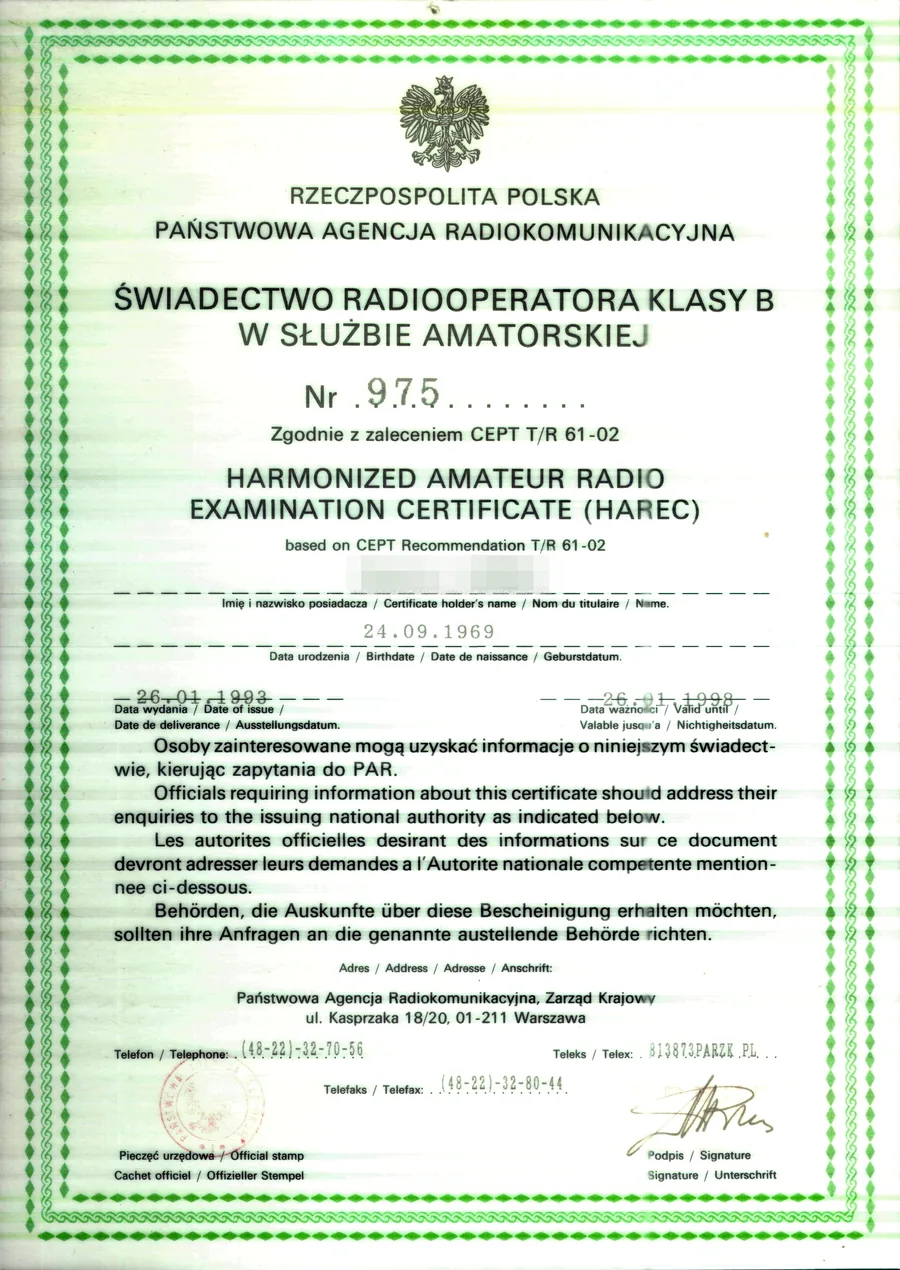
Until November 2024 candidates received an operator's certificate — a document like the one alongside, issued back in 1993 by the State Radiocommunications Agency, with a HAREC imprint. Today this has been replaced by a certificate of a positive exam result, which UKE issues without delay and ex officio (art. 143 ust. 2 Prawa komunikacji elektronicznej).

The pass certificate is only a gateway to the application. The document that gives you the right to transmit and that you show to an inspector or to an authority abroad is the radio licence with your callsign. Old class A–D certificates remain valid and also allow you to apply.

Bring a valid photo ID to the exam — the committee verifies your identity before the test.

Class B operator’s certificate in the amateur service, issued by PAR in 1993, bearing HAREC class B certificate from 1993 — the predecessor of today’s pass certificate · photo: Zalasem1, CC BY-SA 4.0
!

Most common pitfall: someone has 26 points out of 32, but only 5 out of 8 in “regulations” — and the exam is failed. So study evenly; the trainer shows progress separately for each section and picks more often what you get wrong.

Money

What it costs

One-off. The licence has no annual fees, and the callsign is yours for the entire validity period.

ItemAdultUnder 18
The exam150 PLN75 PLN
Resit exam (only if needed)75 PLN35 PLN
Stamp duty for the licence82 PLN82 PLN
Total to start (without a resit)232 PLN157 PLN
Duplicate licence · power of attorney24 PLN · 17 PLN24 PLN · 17 PLN
Validity of category 1 and 3 licencesup to 25 years
Identity

Your callsign

You choose it once — and it stays with you for the whole term of the licence. It’s worth giving it some thought.

Prefix, number, suffix

A callsign consists of a prefix (SP, SQ, SO, HF, SN or 3Z; SR is reserved for unattended stations, i.e. repeaters), a digit 0–9 and up to four characters, the last of which must be a letter. The digit traditionally corresponds to the call area: 5 is Mazowsze, 9 — Małopolska and Śląsk, 1 — Pomorze Zachodnie, 4 — Warmia, Mazury and Podlasie.

  • Check availability in the list at amator.uke.gov.pl — you can enter up to three options on the application
  • Ease of spelling — you’ll dictate your callsign hundreds of times: Sierra Quebec Five Charlie Bravo Alfa. Avoid clusters that sound alike on phone
  • Short suffixes (two-letter) are in high demand; three-letter ones are easy to get straight away
  • No reservations and no changes — UKE (the Polish Office of Electronic Communications) does not reserve callsigns before you apply, and you cannot change an assigned callsign for the whole term of the licence (changing other data on the RA-zm form is free of charge)

Abroad, in CEPT countries, you use your callsign with the country prefix: in Germany DL/SQ5CBA, in Croatia 9A/SQ5CBA.

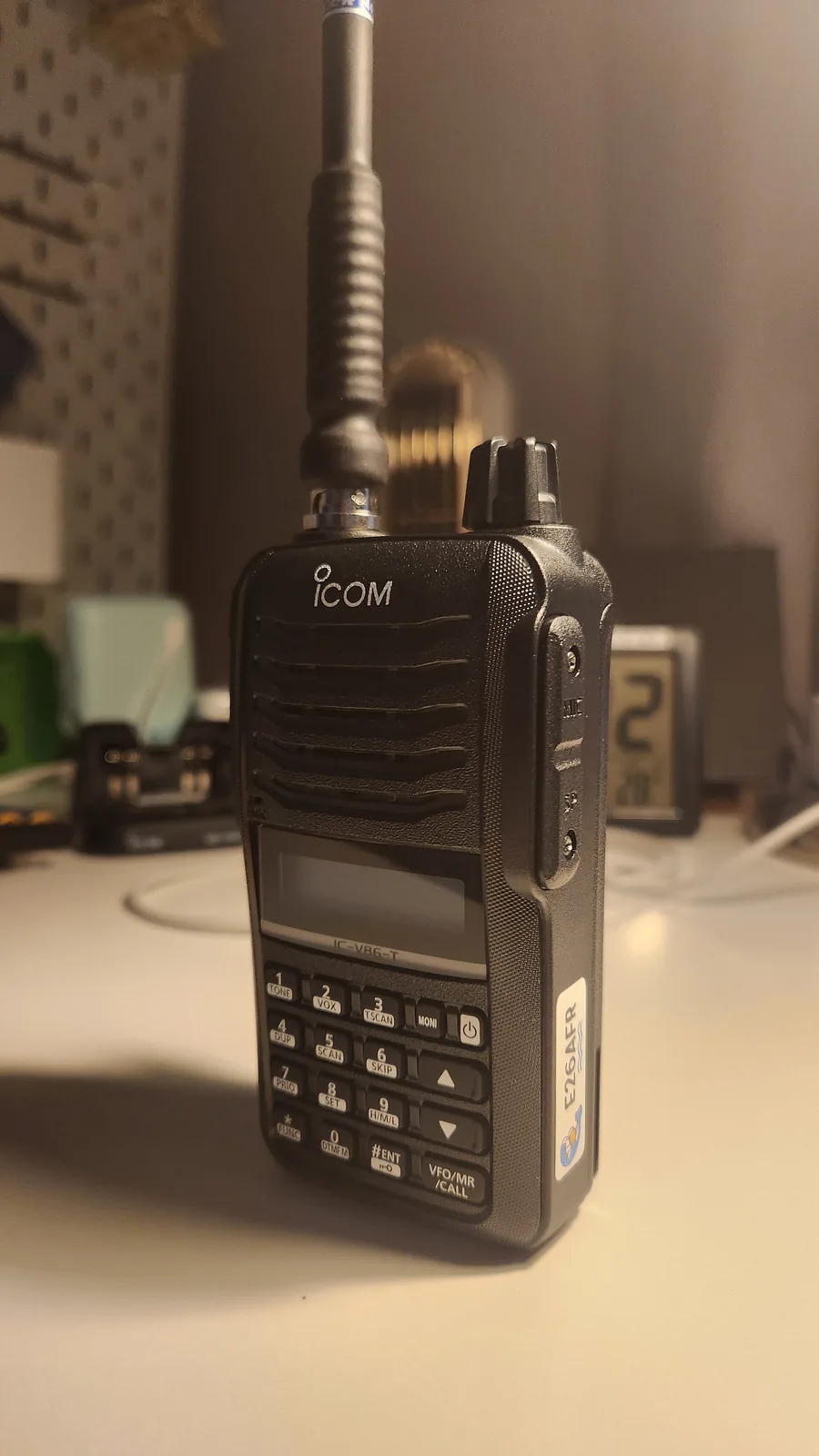
Icom IC-V86 handheld with a callsign sticker on the case callsign on the case — the first thing a new operator does · photo: Game11454, CC BY-SA 4.0
Start

You’ve got your licence. What next

The first weeks decide whether the hobby will stick. A few things that make getting started easier.

📡

First radio

A handheld dual-band 2 m / 70 cm transceiver for 200–600 PLN is enough for repeaters and local QSOs. Before you buy, read the guide to the 2 m and 70 cm bands and work out your range in the antenna calculator.

🗼

Repeaters

Find the nearest one on the map of 438 active repeaters, set the offset and CTCSS, listen for a few days, then give a call.

👥

Club and PZK

A club gives you a mentor, a roof antenna and a fully equipped club station. The Polish Amateur Radio Union (PZK) has branches in every region.

🌍

Trips

With category 1 you can transmit in CEPT countries on your Polish licence. All you need is the country prefix before your callsign and the local band plan.

Cheat sheet

Most common questions

Do I need to know Morse code?
No. Telegraphy isn’t required for any category — you only learn it if you want to, e.g. in the CW trainer.
Is the exam difficult?
The question pool is public and finite. Anyone who works through it with explanations passes first time. It’s uneven study that trips people up, not lack of ability.
Can I sit it remotely?
The 2026 regulation provides for a remote mode with identity verification over the internet, but UKE has not yet opened remote registration — information will appear at a later date. For now all sessions are in person.
I have an old class A or C certificate
You don’t retake the exam. A and B certificates give you a category 1 licence, C and D — category 3. You file the application yourself and pay 82 PLN.
How long does the whole process take?
Study 2–4 weeks, register at least 7 days before the session, licence up to 6 weeks from application. In practice: one to three months.
How much power do I get?
Category 1 — 500 W, category 3 — 100 W. For contests you can apply for an additional permit up to 1500 W, valid for 12 months.
A 25‑year licence — what then?
Submit a new application before it expires. You don’t retake the exam.
Where to ask if something doesn’t work?
Issues with exam registration: egzaminy@uke.gov.pl. Licences, changes and callsigns: wml@uke.gov.pl. Legal status of this page: September 2026 (verified against the regulation and the UKE BIP).
Next step

Check how much you already know

The trainer takes you through all 521 questions, tracks each section separately and generates a mock exam exactly as the exam board does — 8 questions from each requirement.