Home  /  Articles  /  Aurora on 2 m and 6 m

Article · auroral propagation

Aurora on 2 m and 6 m:
how to hear the aurora from Poland

When aurora lights up over Scandinavia, the 2 m band changes beyond recognition. Stations hundreds of kilometres away are heard from the north, regardless of where they actually are, and instead of a clean CW tone you get a raspy hiss out of the speaker. I explain where this comes from, how to tell it’s starting, and how to make your first auroral QSO. Just below there’s a live gauge showing the chance of aurora right now.

Kp ≥ 5 antenna north report 55A CW 144.050 MHz equinox 23.09
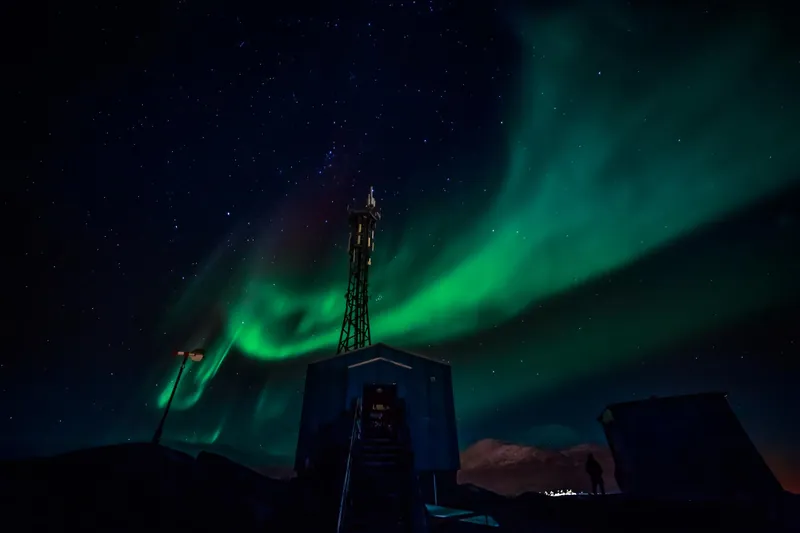
A green band of aurora across a starry sky above a lattice communications mast and a small service building Aurora over a communications mast in Nuuk, Greenland · photo: vadim.nefedov / Freepik
Live

Aurora chance now

The pointer shows the planetary Kp index from the latest reading, and the assessment beside it says what that means for a station in Warsaw. Data from HamQSL (NOAA and DX-Robot); the page refreshes itself every 10 minutes.

Kp index dial from 0 to 9 0 1 2 3 4 5 6 7 8 9 – KP
Loading data…

Checking the magnetic field

In a moment the current Kp index and an assessment of the chances of an auroral QSO will appear.

Kp index–scale 0–9
A index–daily average
Magnetic field– 
Aurora on VHF–DX-Robot
What now: waiting for data…

Source: HamQSL · NOAA SWPC

☉

The season is starting. The autumn equinox falls this year on 23 September at 00:05 UTC, i.e. at 02:05 Polish time. Around the equinox geomagnetic storms are more frequent than in summer and winter, so over the next few weeks it’s worth checking here more often. Why that is, I explain below.

How it works

A mirror a hundred kilometres above the Baltic

Aurora is not just light. The same ionised region that glows in the sky scatters VHF waves back towards Earth.

A glowing curtain that reflects radio waves

During a geomagnetic storm, charged particles plunge into the atmosphere in a ring around the pole and ionise it at an altitude of about 100–120 km. In a strong storm that ring expands southwards, over Scandinavia and the Baltic. The ionised “curtain” scatters 6 m and 2 m waves back down, so two stations that normally wouldn’t hear each other can make a contact.

That mirror isn’t smooth. The curtain ripples, shifts and trembles, so each patch reflects the signal at a slightly different frequency. Hence the characteristic hiss I describe below, and hence the fact that through aurora we work CW and SSB, not FM.

Ranges on 2 m are usually a few hundred kilometres; in good aurora, clearly more. In a write‑up on auroral contacts on the SP2PZH club website (Gdańsk University of Technology) the author describes his record in these conditions: almost 1500 km (locator LO02) on a Yagi.
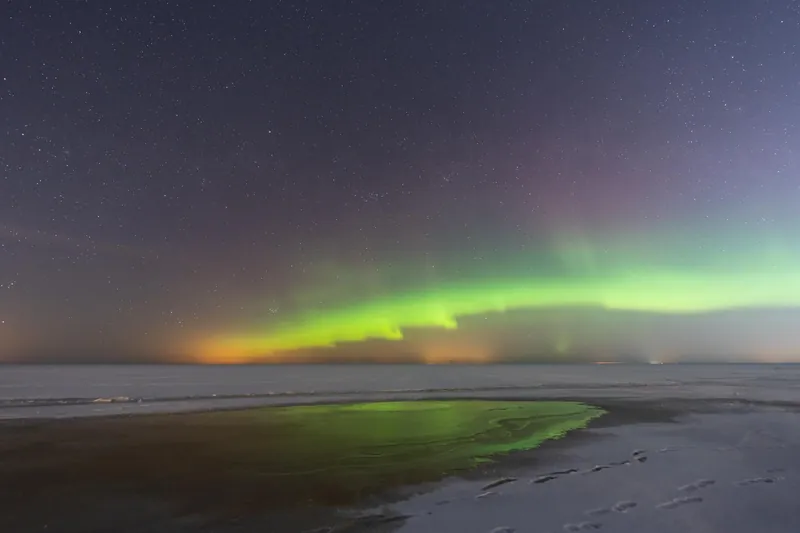
A green arc of aurora low over the horizon, reflected in a puddle on a frozen, snow‑covered seashore Aurora over the frozen Baltic shore, Estonia · photo dmiiva1987 / Freepik
Cross-section: auroral contact Two stations south of the aurora point their antennas north, at the auroral curtain at an altitude of about 100–120 km. The signal reflects from the curtain and returns to the other station. Baltic Sea Sweden SQ5CBAWarsaw the other stationalso to the south ~100 km auroral curtain · 100–120 km SN both antennas point north, not at each other vertical scale greatly exaggerated
Illustrative cross-section. Both stations are south of the aurora and both aim at the same curtain. The signal doesn’t travel along the ground to the other station, but up, to the north, and only from there is it scattered back down, also to the other station.
The oddest rule

Antenna north, not at the other station

Want to make a contact with Berlin? You turn the antenna north. With Vilnius? North again. In aurora what matters is where the reflecting curtain hangs, not where the other station actually is.

Overview map: auroral limits at different Kp values The lines show from where, for a given Kp, you can see aurora above the northern horizon: Kp 5 Edinburgh and Gothenburg; Kp 6 Dublin, Hamburg and Moscow; Kp 7 London, Cologne and Warsaw; Kp 8 Paris, Munich and Vienna. Antennas from Warsaw and Berlin aim north, at the reflection area over the Baltic. 50°N55°N60°N65°N70°N0°E10°E20°E30°E the signal reflects here (e.g. at Kp 6–7) Kp 4 Kp 5 · G1 Kp 6 · G2 Kp 7 · G3 Kp 8 · G4 Tromsø Gothenburg Edinburgh Dublin Hamburg London Cologne Paris Munich Vienna Stockholm Helsinki Gdańsk Moscow Berlin SQ5CBA where the aurora is visible at a given Kpantenna beam · reflection area N
Overview map. The coloured lines show where, for a given Kp, the aurora is visible above the northern horizon (according to SpaceWeatherLive): at Kp 7 it reaches the London–Cologne–Warsaw line. Radio reaches farther than the eye, because the reflection occurs over the aurora itself, hundreds of kilometres to our north. That’s why you usually hear the aurora first, and only afterwards see it.

How to aim when you can’t see the target

  • Start east of north. The SP2PZH write-up says that at the start of an aurora you set the antenna with an easterly offset, and as it goes on the azimuth moves through north towards the west. The offset from north can reach 60°.
  • Hunt for the peak, not true north. Turn the antenna by a few degrees at a time and stay where the hiss of signals and beacons is loudest. The curtain moves, so re-check from time to time.
  • The other station is doing the same. They’re also looking north. You both hit the same curtain, and that’s the only reason you can hear each other.
  • Horizontal polarisation. CW and SSB on 2 m and 6 m are worked on horizontal antennas. A vertical FM antenna on the roof is of little use for aurora.
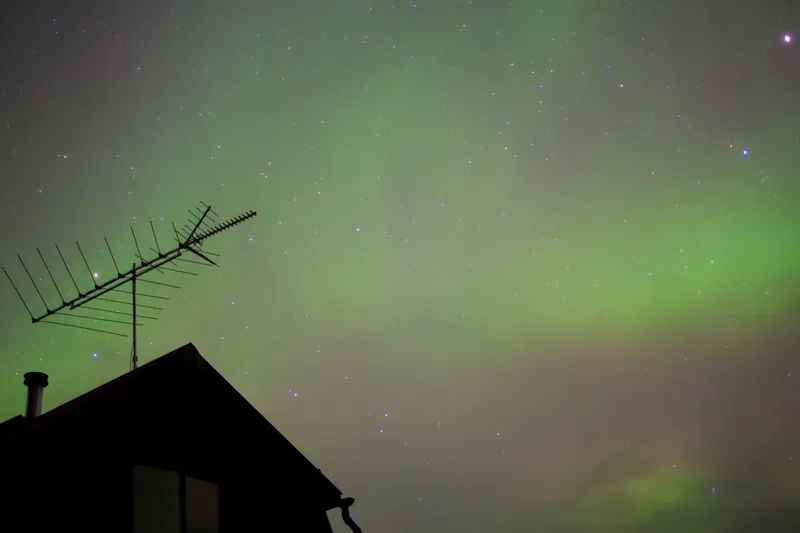
The silhouette of a roof with a multi‑element beam antenna against a greenish auroral glow and stars Directional antenna against the aurora · photo: Aetb / Freepik
Listen

Hiss instead of a tone

A signal reflected from the aurora doesn’t sound like normal radio. A pure CW note smears into noise hundreds of hertz wide, and SSB speech sounds like a hoarse whisper. Click and compare.

Spectrum of a clean CW toneA single narrow line at 700 Hz. clean tone · tropo 0 Hz 500 1000 1500 2000 one narrow line clear tone, e.g. 599 Spectrum of a signal via auroraA broad, ragged hump smeared over hundreds of hertz and offset from the expected frequency. via aurora · Au 0 Hz 500 1000 1500 2000 it should be here offset smearing: hundreds of Hz

The audio is synthetic: “CQ A SQ5CBA” in CW at 18 words per minute. The aurora tone is noise filtered around 700 Hz with rapid flutter, just as operators describe it. Turn on your speaker.

Report with the letter A

In the RST report the third digit describes the tone. With aurora there is no tone, so you put the letter A instead. You also add A to your call: in CW CQ A, on voice “CQ aurora”.

599clean signal, e.g. via the troposphere
59Avery strong signal via aurora
55Atypical report: readable, medium strength
58aexample from the IARU Region 1 recommendation (Vienna 2010)

The Vienna recommendation added letters a (aurora), s (scatter) and m (multipath) to the tone scale. And the very standardisation of auroral reports was adopted by the IARU Region 1 conference in… Warsaw, in 1975.

CW

Most reliable mode

Morse is the foundation for working via aurora. The narrow signal punches through the hiss, and the smeared dashes and dots can still be distinguished.

SSB

Doable, with practice

Speech sounds like a rasping whisper. On 6 m it’s much easier than on 2 m, because distortion increases with frequency. On 70 cm auroral QSOs are rare.

FM

Doesn’t work

An FM demodulator will turn a wide, ragged signal into plain noise. You won’t raise a distant FM repeater via aurora, even when the SSB band is alive.

Hz

The signal is often offset: on 145 MHz by around 0.5 kHz on average. Don’t assume your correspondent is exactly on their frequency. Tune to the centre of the hiss and don’t narrow the CW filter to the minimum, because an auroral signal is wide.

Calendar

When to listen

Three clocks: the Kp index says whether there’s anything to hope for at all, the time of day tells you when to call your mates, and the season hints when to keep the radio to hand.

Scroll the table sideways →

KpNOAA scaleAuroral boundaryAurora visible from e.g.What it means on 2 m from Poland
4——Tromsø, ReykjavíkAurora is present, but far to the north. From Poland it’s quiet.
5G1 · minor storm56.3°Edinburgh, GothenburgThreshold: according to the SP2PZH write-up, K rising above 4 is a sign of possible auroral radio. Listen in the north of the country.
6G2 · moderate54.2°Dublin, Hamburg, MoscowA good chance also from the centre of the country. Antenna north, 144.050 MHz.
7G3 · strong52.2°London, Cologne, WarsawAurora is visible from Warsaw, the 2 m band should be alive.
8G4 · severe50.1°Paris, Munich, ViennaThat’s how it was on 10–11 October 2024.
9G5 · extreme48° and belowfurther southThat’s how it was on 10–11 May 2024.

The auroral boundary is geomagnetic latitude, and the cities come from SpaceWeatherLive’s table. The G scale follows NOAA SWPC. The last column is my practical interpretation, not a law of physics.

The UTC day with two auroral windows: 13–18 and 21–24 UTC 0 3 6 9 12 15 18 21 UTC

Time of day: two windows

For Poland we assume two maxima of radio aurora (following the write‑up on the SP2PZH club’s website):

13–18 UTC21–24 UTC

In summer that’s 15–20 and 23–2 Polish time, in winter 14–19 and 22–1. The afternoon window is convenient because plenty of stations are at the radio then. The evening one can be stronger.

It is now – UTC.

Season⇄

The Russell–McPherron effect

Geomagnetic storms occur more often around the equinoxes. Christopher Russell and Robert McPherron described it in 1973: at the equinox the Earth’s magnetic field is oriented relative to the field carried by the solar wind in a way that lets energy couple more easily into the magnetosphere.

Solar cycle25

Declining but lively

NASA and NOAA announced on 15 October 2024 that the Sun had entered its maximum. The cycle is now declining. In this phase storms are driven mainly by high‑speed solar wind streams from coronal holes, which return roughly every 27 days with the Sun’s rotation.

Warning15 h

From eruption to storm

A coronal mass ejection (CME) takes from 15–18 hours (the fastest) to a few days to reach Earth. When NOAA announces an incoming CME, you’ve got time to get the antenna ready for the following evenings.

27

A simple trick: if there was an aurora, mark the date 27 days ahead in your calendar. The coronal hole that caused it may come round with the Sun’s next rotation, and with it another storm.

IARU Region 1 bandplan

Where to spin the dial

Aurora doesn’t have its own spot in the bandplan. We operate in the CW and SSB segments, and activity clusters around the centres of activity.

Scroll the table sideways →

Frequency [MHz]What the bandplan saysWith aurora
6 m band · 50 MHz
50.000–50.100CW only (the lower 30 kHz reserved for the synchronised beacons project)CW via aurora
50.090CW centre of activity for intercontinental QSOsDon’t linger here with local QSOs
50.100–50.130Intercontinental window, no local contactsCall European stations higher up
50.130–50.200International section, centre of activity 50.150SSB via aurora
2 m band · 144 MHz
144.025–144.100CW, centre of activity 144.050This is where to look for auroral CQ A in CW
144.100–144.150CW and digital modes (MGM), 144.110–144.160 is for EMEAvoid – EME stations are listening here
144.150–144.400CW, SSB and MGM, SSB centre of activity 144.300SSB via aurora, spread out from 144.300
144.400–144.490Beacons onlyBest indicator: northern beacons start to hiss

According to the IARU Region 1 VHF Handbook (50 and 144 MHz bandplans). Don’t block the calling frequencies: once you’ve made contact, QSY nearby.

MODE

CW or USB

On 6 m and 2 m, SSB is upper sideband. Turn FM off – it won’t carry through aurora.

FIL

Filter not too narrow

The signal is hundreds of hertz wide. A very narrow CW filter will cut away most of its energy.

RIT

Fine‑tune

Your correspondent may be offset by a few hundred hertz. Find the middle of the hiss, not the ‘zero’.

H

Horizontal polarisation

A horizontal Yagi on a rotator. On 2 m the SP2PZH write‑up recommends, to start with, 9 elements and 50–80 W.

Step by step

Your first QSO via aurora

Sometimes the aurora lasts an hour, sometimes all evening. It’s worth having a plan before it starts.

1

Catch a signal from space

Watch Kp: the indicator at the top of this page, the propagation conditions, or NOAA SWPC. When Kp reaches 5 and the DX‑Robot reports aurora at mid‑latitudes (MID LAT AUR), it’s time to head for the radio.

Kp ≥ 5 · MID LAT AUR · 13–18 or 21–24 UTC
2

Point the antenna north

Start slightly east of north and slowly swing through north to the west. Stay where the hiss is loudest.

azimuth: up to 60° off north, depending on the aurora’s phase
3

Listen first

Sweep 144.025–144.100 MHz in CW and around 144.300 MHz in SSB. Check the beacon segment 144.400–144.490 MHz: if the northern beacons give hiss instead of a tone, the aurora is on.

4

Call CQ A

On CW send CQ A and your callsign; on phone, ‘CQ aurora’. Smeared characters are easier to copy when they’re clearly spaced, so don’t send faster than usual.

CQ A CQ A DE SQ5CBA SQ5CBA K
5

Report with the letter A and the locator

On VHF you exchange callsign, report and locator. Use A instead of the tone digit. Keep it short, no chit‑chat — the aurora can vanish mid‑sentence.

SP2XYZ DE SQ5CBA 55A KO02ME
6

Log as AUR

The ADIF standard has a propagation mode field: AUR is aurora, AUE is aurora‑E. It’s worth entering it in the log — years later it’s obvious which path the contact took. I explain how confirmations work in the QRZ Logbook guide.

PROP_MODE: AUR
After the aurora

A northern cousin: aurora‑E

Another kind of propagation often opens on 6 m, and sometimes on 2 m, before, during or after a strong aurora. Signals are much cleaner and the paths longer.

Au · classic aurora

Backscatter

  • both antennas to the north, at the curtain
  • hiss instead of tone, report with the letter A
  • CW and SSB, FM doesn’t work
  • typically a few hundred km, records up to about 1,500 km
Au-E · aurora‑E

Like an E‑layer reflection

  • reflection from the sporadic E layer in the auroral zone
  • signals much cleaner than with classic aurora
  • on 144 MHz, QSOs have been reported out to 1,947 km
  • in Scandinavia most often from May to August, typically 06–10 and 20–24 UTC
Over Poland

May and October 2024: aurora at the zenith

Twice in 2024 the aurora was visible across all of Poland: not just over the horizon, but high up in the sky. That’s what Kp 9 and Kp 8 look like.

Aurora at the zenith: rays of green, pink and violet radiating from a single point in the sky
10/11 May 2024, Lipa near Szamocin. G5 storm, the first extreme since October 2003, with Kp 9. · photo: Aneta p, CC BY 4.0, Wikimedia Commons
Red and green vertical auroral bands over flat fields and a road at night, village lights on the horizon
11 October 2024, approx. 1:30, Lucim near Bydgoszcz. G4 storm after a solar flare. · photo: Aneta p, CC BY 4.0, Wikimedia Commons
G5

The May 2024 storm was the strongest since the famous Halloween 2003 storms. The same storm that gave aurora over Kraków knocked out the shortwaves: in such strong storms HF is often dead, but aurora can open on 6 m and 2 m. When 20 m suddenly goes quiet, have a look at VHF.

Station

Gear: less than you think

You don’t need a cover‑photo system for aurora. A radio with CW and SSB on 2 m or 6 m and a horizontal beam will do.

Where to start

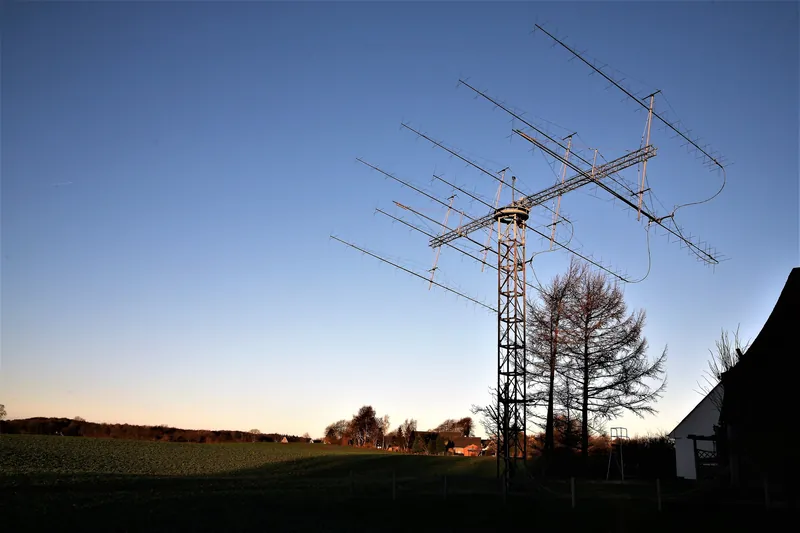
The photo shows DK5LA’s EME setup: 256 elements on a single mast. You don’t need anything like that for aurora. A write‑up on the SP2PZH club’s site suggests starting with 50–80 W and a horizontal 9‑element Yagi — enough to get your ear in with this kind of propagation. The further south you are, the more a longer antenna helps, ideally with a flat vertical pattern, as the scatter region sits low over the horizon.

  • All‑mode radio with CW and SSB on 2 m or 6 m. Mine is an Icom IC‑9700 on 2 m, and a Yaesu FT‑710 on 6 m.
  • Horizontal Yagi on a rotator. Without a rotator you won’t be able to track the moving curtain.
  • Power 50–100 W and good coax. We lose a lot of signal through the aurora along the way.
  • Headphones. It’s much easier to pick out a weak auroral hiss on headphones than from a loudspeaker.

Honestly: my Diamond X‑200N on the chimney is a vertical for FM and repeaters. It’s not much use for aurora. You need a horizontal Yagi on a rotator.

A large array of many Yagi antennas on a lattice mast at dusk, with trees and an outbuilding alongside EME system on 144 MHz at DK5LA, Sörup · photo: Reinhard Kuehn, CC BY-SA 4.0
Alerts

Where to track

Radio aurora can be short‑lived, so it’s worth getting the heads‑up early, not from a mate after the fact.

This pageLIVEThe indicator at the top of the article and the propagation conditions page: Kp, A index, geomagnetic field status and VHF aurora reports, updated automatically.
NOAA SWPCSOURCEPlanetary K index every 3 hours and the 30–90 minute aurora forecast from the OVATION model, updated every 5 minutes.
HamQSLVHFN0NBH conditions bar shows the “VHF Aurora” field from the DX Robot: Band Closed, High LAT AUR (aurora above 60°N) or MID LAT AUR (aurora between 30 and 60°N, i.e. our latitudes).
Clusters and DXMapsBANDSpots tagged “Au” or “aurora” on the DX cluster and on DXMaps are the surest sign that someone is already working via aurora. Check where those stations are and on which band.
SpaceWeatherLiveMAPAuroral oval maps and Kp index in an accessible form, with a table showing from which Kp the aurora is visible in a given city.
Next step

Before the storm arrives, get to know the band

It’s easiest to recognise aurora when you know what 2 m sounds like on an ordinary evening. Start with the guide and with the propagation conditions.