QRV · licence active

SQ5CBA

Filip

Private amateur radio station. QSOs on 2 m, 70 cm and 23 cm — most often via the SR5W “Wanda” (2 m, 145.750) and SR5RR “Iberyjska” (70 cm, 439.275) repeaters — plus my own Morse code trainer you can run in your browser.

2 m and 70 cm repeater map 438 repeaters · CTCSS · nearest to you · CHIRP file New Classifieds for hams free ads · sell, buy, swap or give away gear
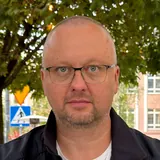
Filip, operator of amateur radio station SQ5CBA
SQ5CBA seal — sq5cba.pl
On-air calendar · live countdown

Next up on the air

Full calendar with descriptions →
New write-up · 4 October 2026

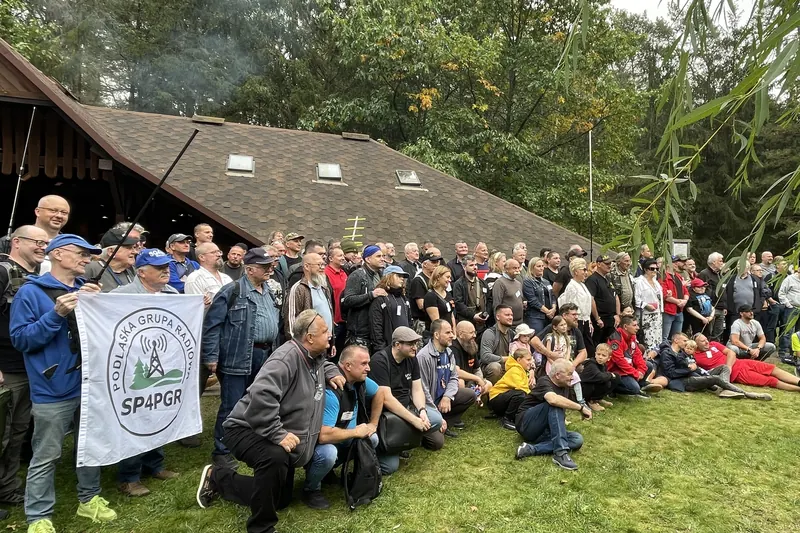
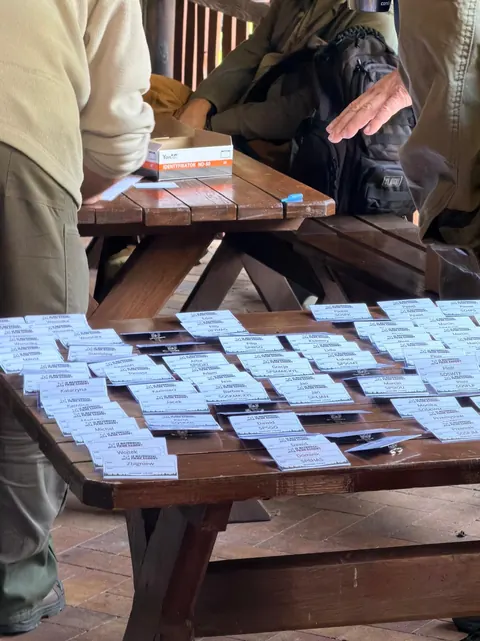
9th Masovian Radio Picnic in Celestynów

About two hundred radio amateurs, a campfire, barbecue, sausages and a stratospheric balloon with a DVB-S2 TV transmitter. The Wanda regulars — SP5MAK, SQ5PIT, SQ5DAN, SP5XVS and SP5MOR — Marian SQ4MN and me, souvenir badges and mushrooms from the nearby woods. And the riddle of the day: why did Marian stand on the bench?

Filip SQ5CBA — portrait Filip SQ5CBAwrite-up and photos · Forest Education Centre
Celestynów · KO02RBapprox. 200 peopleDVB-S2 balloon8 programme items
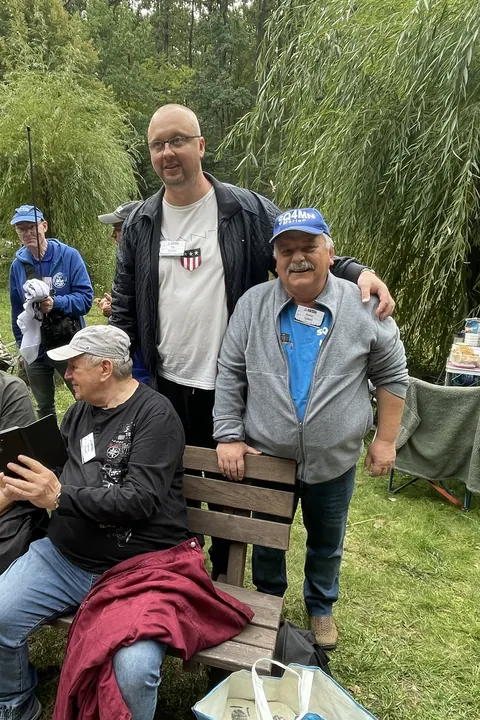
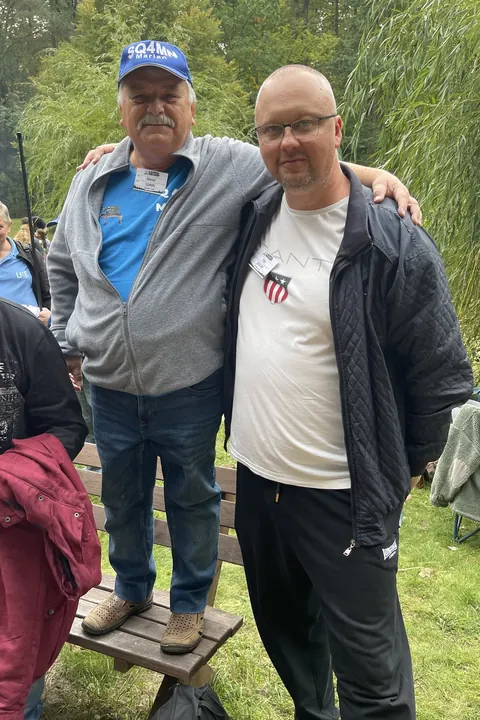
Filip SQ5CBA has his arm around Marian SQ4MN, who is standing on the grass and is clearly shorterBEFORE13:25:00 Marian SQ4MN is standing on a bench and has his arm around Filip SQ5CBA — now he’s tallerAFTER13:25:41
Live propagation – SFI  ·  K –  ·  checking… See conditions →
Tropo map · 2 m and 70 cm calculating conditions… Open map →
Guestbook

Latest entries from the station’s guests

Been here? Leave your callsign and a few words — like an entry in a paper logbook. Every entry gets a date and time.

Sign the book →
  1. Loading entries…
Articles and guides

Latest on the site

Antenna construction, propagation, emergency communications and operating practice on the bands. The latest article appears first; use the arrows to scroll through the older articles.

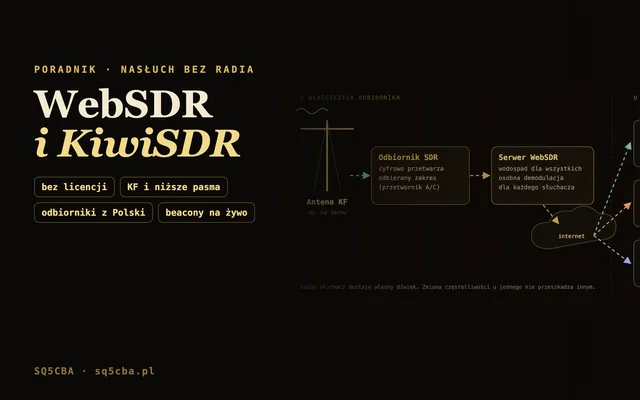
Graphic: diagram of a WebSDR receiver used by many listeners in their browsers to listen to various bands, next to the text “WebSDR and KiwiSDR” 0–30 MHz · in the browser · no licence required graphic: SQ5CBA
Guide · listening · new

WebSDR and KiwiSDR: listen to the bands without a radio

Shortwave receivers in your browser: how they work, twelve tried‑and‑tested receivers with their distance from you, what’s worth listening to at the start, and the NCDXF beacon indicator that shows who’s transmitting this second.

Receivers nearbyLive beaconsWhat to listen toNo licence required
Read the article →
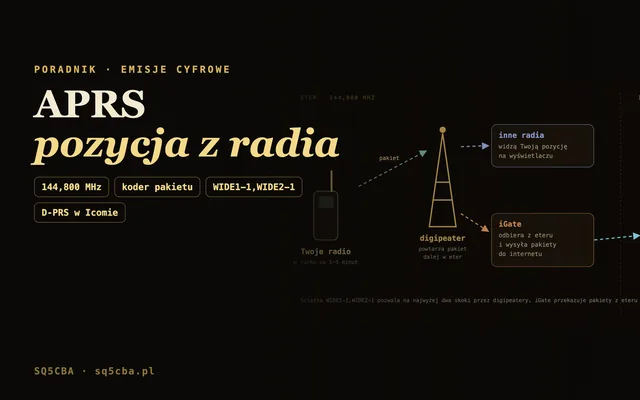
Graphic: diagram of the path of an APRS packet from a radio via a digipeater and an iGate to a map, next to the text APRS 144.800 MHz · AX.25 · WIDE1-1,WIDE2-1 graphic: SQ5CBA
Guide · digital modes · new

APRS: position and messages from the radio

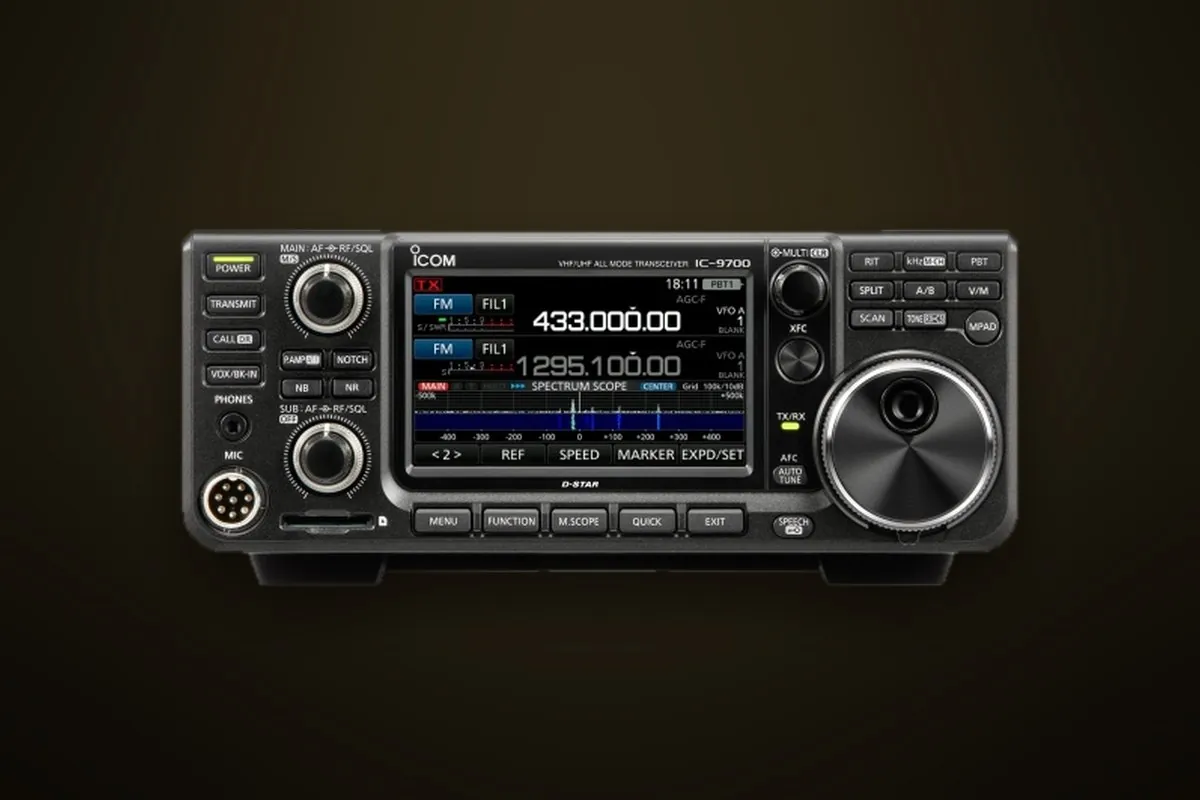
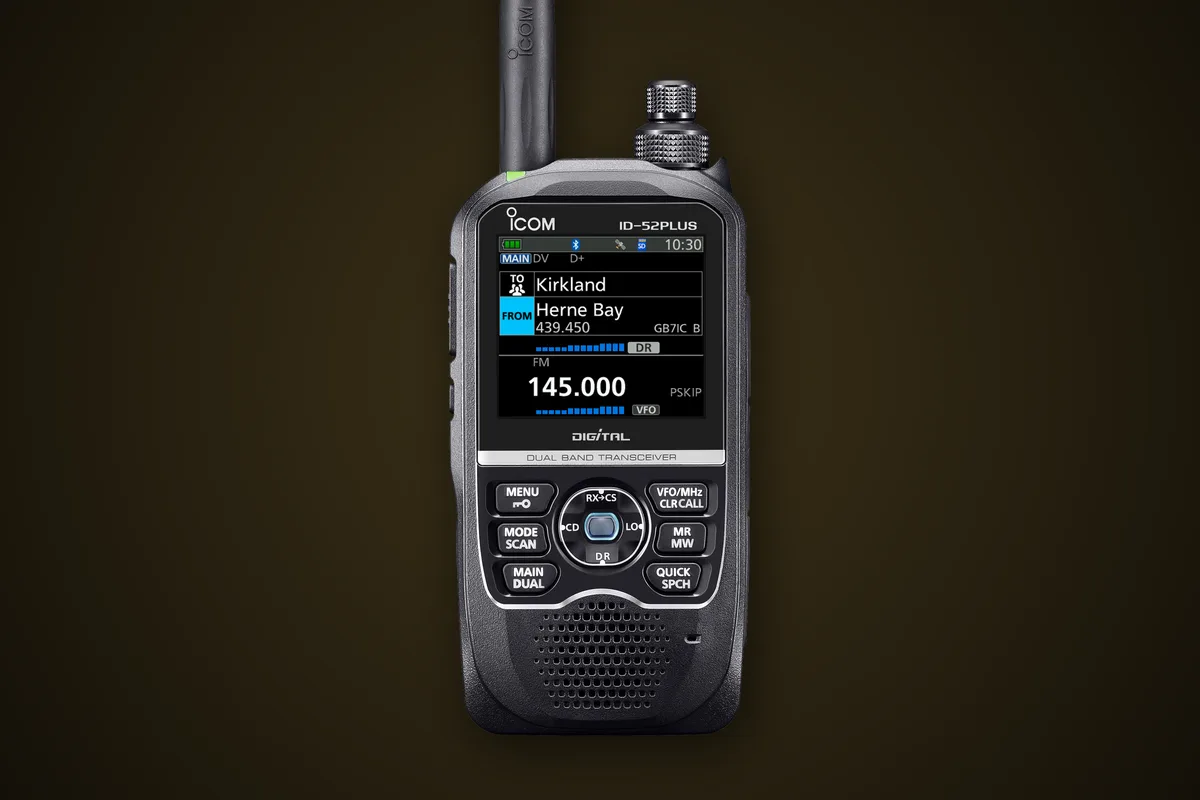
The path of a packet from the radio via digipeaters and an iGate to aprs.fi, a position packet encoder with a character-by-character breakdown, frequencies, APRS messages, and how it looks with the ID‑52E PLUS and IC‑9700 (D‑PRS).

Packet encoderAPRS networkD‑PRS on Icom radiosAPRS in Poland
Read the article →
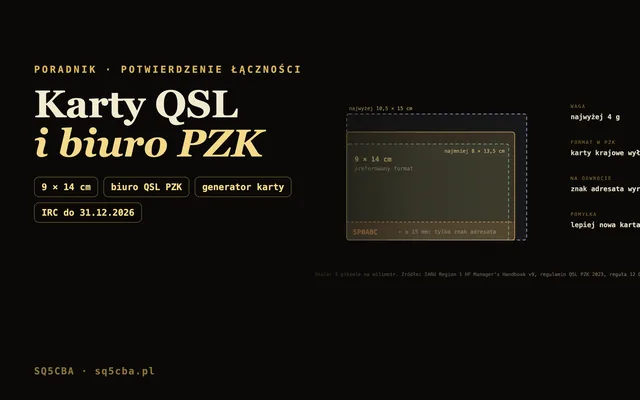
Graphic: the text ‘QSL cards and the PZK bureau’ next to a diagram of a 9 by 14 cm card with a strip for the addressee’s callsign 9 × 14 cm · PZK QSL bureau · Czarnowo graphic: SQ5CBA
Guide · QSO confirmation · new

QSL cards: how to send and receive a paper confirmation

What has to be on the card, how the PZK QSL bureau works from branch to Czarnowo, how much it costs and how long a card takes to arrive, direct and the disappearing IRCs, LoTW and eQSL, plus a downloadable generator for your own card.

Card generatorBureau routeIARU dimensionsDXCC and LoTW
Read the article →
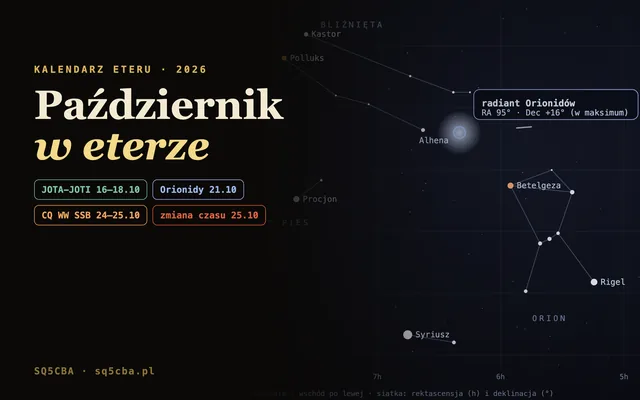
Graphic: the words October on the air against a sky map with Orion and the Orionid radiant, four dates: JOTA‑JOTI, Orionids, CQ WW SSB, clock change 16–25.10 · JOTA · Orionids · CQ WW graphic: SQ5CBA
Curiosities · calendar · new

October on the air: scouts, meteors, contests and the clock change

Four events in ten days: JOTA‑JOTI, the Orionid maximum, 48 hours of CQ WW DX SSB and a clock change in the middle of the contest. Live countdown, sky map with the radiant, CQ WW scoring from Poland and UTC/PL clocks.

Live countdownOrionid radiantCQ WW scoringUTC/PL clocks
Read the article →
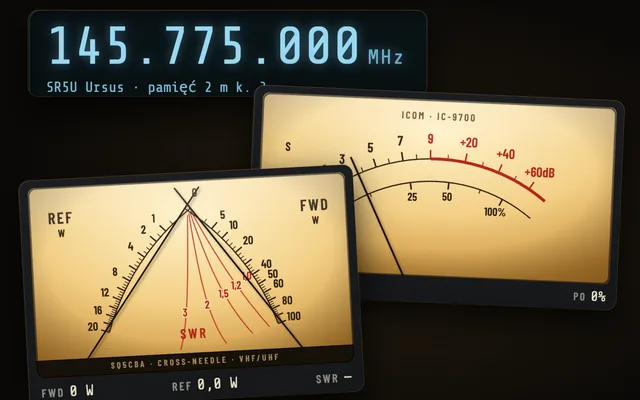
IC‑9700 panel in a browser: display showing 145.775 MHz, analogue S‑meter and cross‑needle power/SWR meter IC‑9700 · LAN · web panel screenshot from the actual panel
Station · software · new

Claude Code and programming the IC‑9700 and FT8

Radio panel in the browser in two evenings: analogue meters, PTT and audio through the laptop, band scope, FT8 with an AUTOMAT button and a QRZ.com logbook. How it came together, how it works, and ten pitfalls along the way.

IC‑9700 over LANFT8 AUTOMATReal screenshotsClaude Code
Read the article →
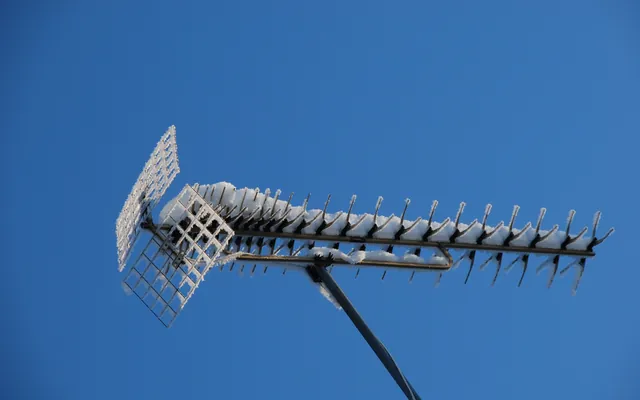
UHF directional antenna with a grid reflector covered with a thick layer of rime against a dark blue sky connector · cable · mast · SWR photo: Vestman · CC BY 2.0
Guide · new

Preparing your antenna for winter: a single-afternoon inspection

Measuring a cable with an open end (and why a wet cable can improve SWR), sealing the connector with two tapes in the correct order, drip loop, ice on the antenna, mast, earthing and a lightning arrestor. At the end, a checklist to tick off.

12 pointsWater in the cableTapes and connectorsEarthing
Read the guide →
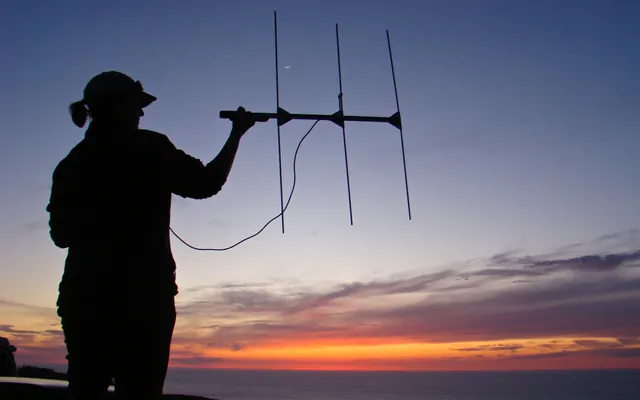
Silhouette of a person with a handheld three-element Yagi antenna against an ocean sunset 2 m · 70 cm · 50 Ω · NEC-2 photo L. Carswell / USFWS · public domain
Guide · new

Build your own 2 m / 70 cm Yagi antenna

Three projects to build yourself: a 5‑element Yagi for 2 m (10.7 dBi), 7‑element for 70 cm (12.5 dBi) and a handheld dual-band antenna for satellites. Dimensions calculated in NEC‑2, drawings, boom correction, 50 Ω feed without matching, NanoVNA tuning and mast mounting.

3 projectsDimensions to the millimetreNEC-2 modelTuning and installation
Read the guide →
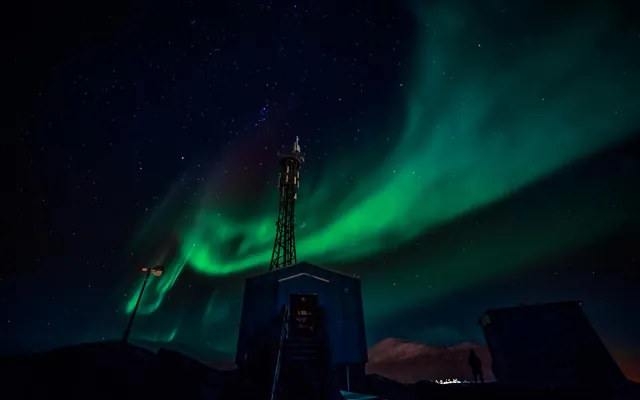
A green ribbon of aurora over a lattice communications mast against a starry sky Kp ≥ 5 · 144.050 MHz CW photo vadim.nefedov / Freepik
Propagation · new

Aurora on 2 m and 6 m: how to hear the aurora from Poland

In a geomagnetic storm the 2 m band starts to hiss from the north. Why the antenna points at the aurora, not at your correspondent; what the signal sounds like and what a 55A report means. The page has a live aurora chance indicator.

Kp ≥ 5Antenna northReport 55ALive indicator
Read the article →
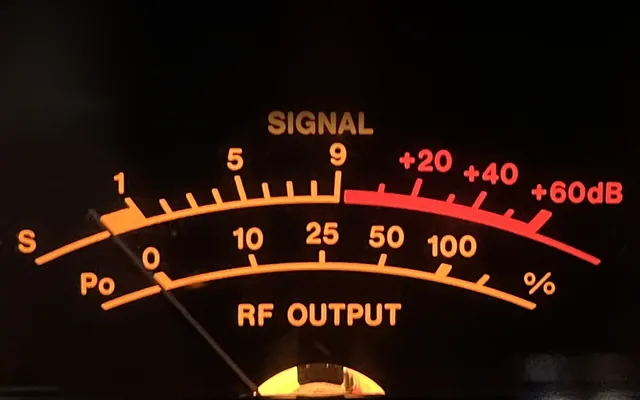
The Icom IC-732 transceiver’s S‑meter lit orange, with an S1–S9 scale and a red +20, +40, +60 dB range S1–S9 · +60 dB · 6 dB per division photo Chaz360 · CC BY-SA 4.0
Measurements · new

The S‑meter lies: dBm, S‑units and the RST report

How many microvolts is S9, why two radios show the same signal differently, and what 100 W instead of 5 W really gives you. The IARU S scale, kTB noise, an honest RST report and a calculator that converts dBm, µV, watts and S‑units.

S9 = −73 dBm1 S = 6 dBS‑meter calculatorRST report
Read the article →
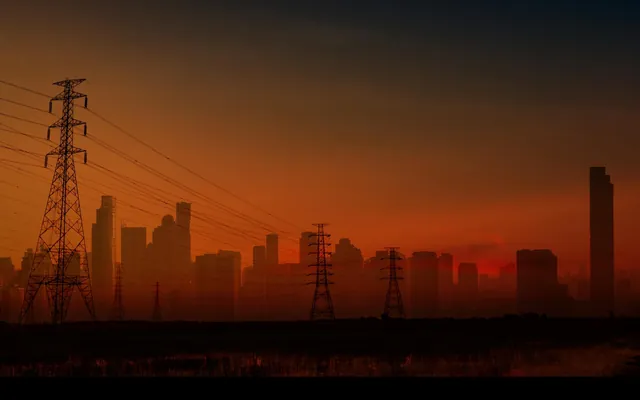
High-voltage pylons and skyscraper silhouettes against a rusty dusk sky 3760 · 7110 kHz · 145.500 MHz
Emergency comms · new

When the network goes silent: radio in reserve

During a blackout base stations run for a few hours on batteries, and the radio on its own power — as long as the battery lasts. A PACE comms plan with a printable card, IARU emergency frequencies, NVIS on 80 and 40 m, a go-box and a message according to IARU procedure.

PACE plan3760 · 7110 kHzNVIS 80/40 mPMR · CB
Read the article →
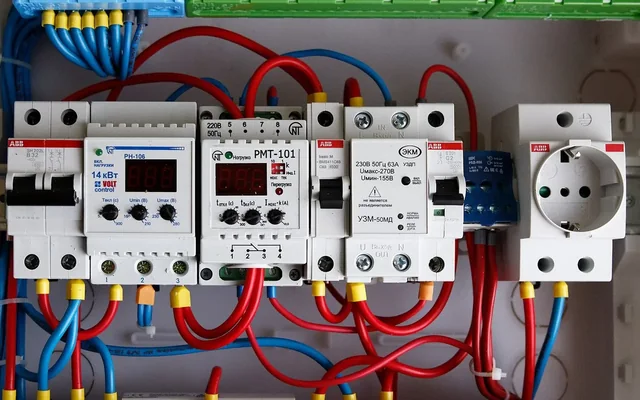
An electrical distribution board with MCBs and coloured wires — the place to start looking for interference S9 = −73 dBm · 1 S = 6 dB photo: Retired electrician · CC0
Guide

Interference: where the noise on the band comes from

Suddenly there’s S7 noise that wasn’t there yesterday. It’s almost never propagation — it’s a power supply, an inverter, an LED strip or a neighbour’s gadget. The main switch test settles it in five minutes, the sound catalogue suggests what to look for, and if the source is outside your home — there’s a route via UKE (the Polish Office of Electronic Communications).

Main switch testNoise catalogueMix 31 ferritesReport to UKE
Read the guide →
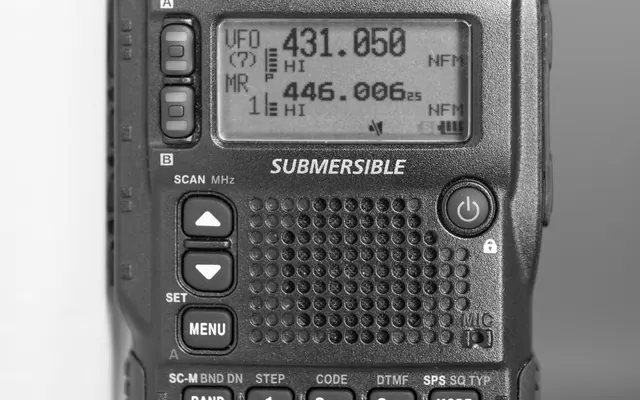
Close-up of a Yaesu VX-8 handheld: display showing 431.050 and 446.006 MHz, SCAN and MENU keys 145.750 · −0.6 MHz · 127.3 Hz photo: waiamcia · CC BY 2.0
Guide

Programming a handheld radio

To open a repeater, the radio needs four things: the frequency, the offset, the CTCSS tone and the channel number. I show it on Wanda: from a Baofeng keypad, in Yaesu and Icom menus, in CHIRP with a ready-made channel file, and with a test before your first QSO.

−600 kHz offsetCTCSSCHIRPTest before QSO
Read the guide →
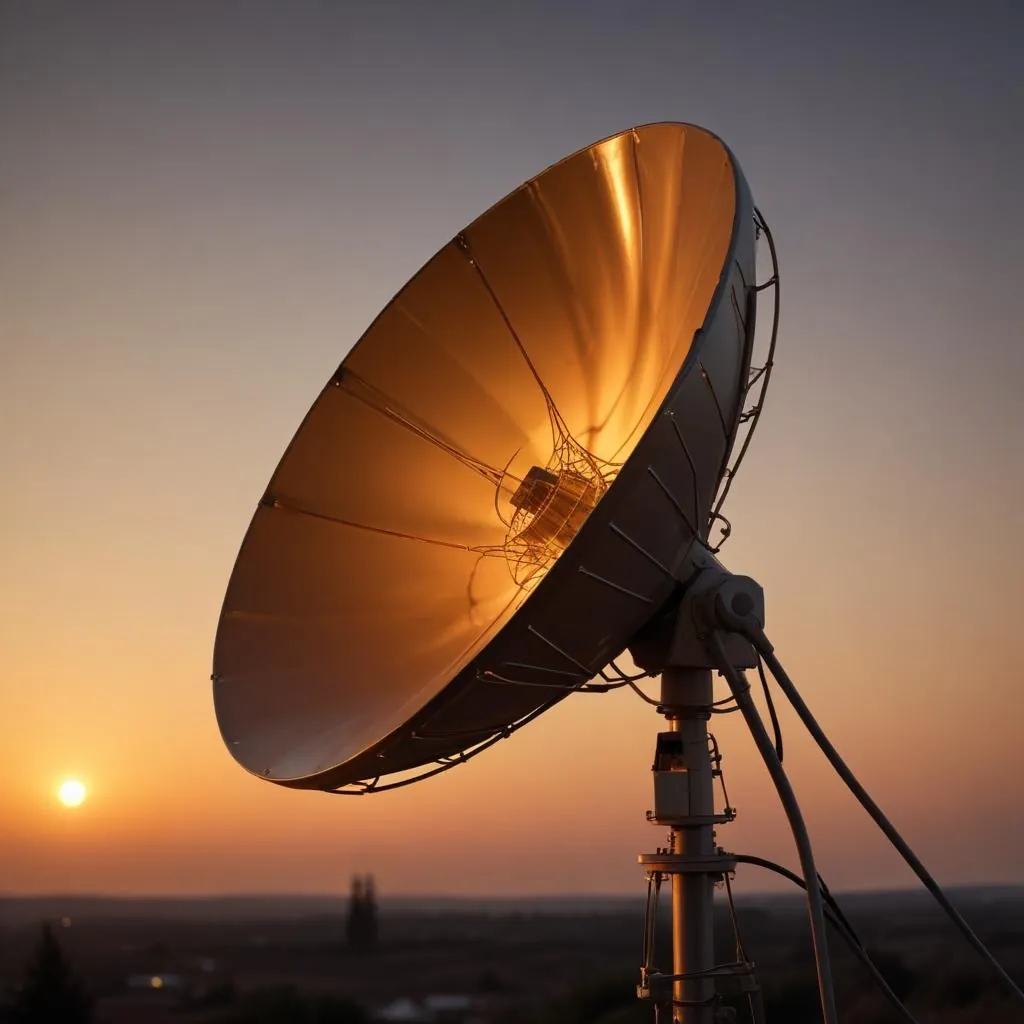
A parabolic antenna for the 23 cm (1200 MHz) band against a golden sunset 1240–1300 MHz · 23 cm
Microwaves

The 1200 MHz band

The 23 cm band is a doorway into the world of microwaves. Short wavelengths mean tiny but very directional antennas — dishes and long Yagis — working through repeaters, increasingly popular digital modes, and even ATV, i.e. amateur television. Here precision matters: a few degrees off and the signal is gone.

λ ≈ 23 cmUHF / SHFATV · DATVParabolic antennas
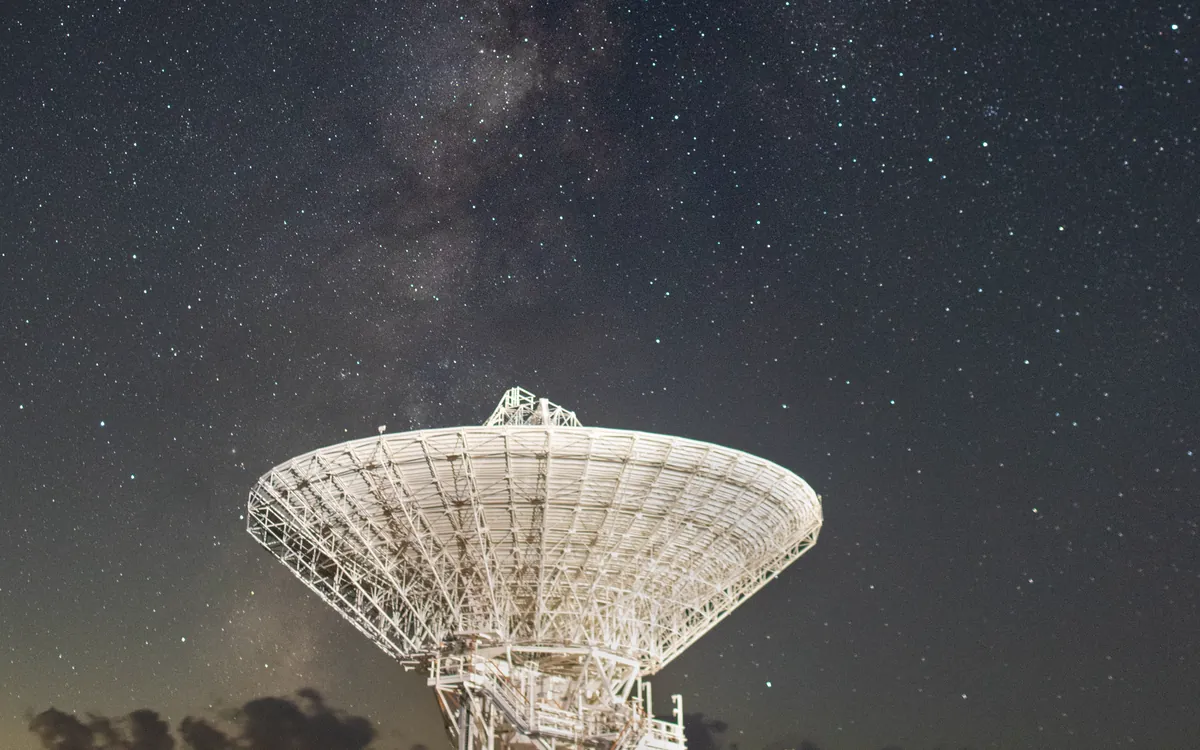
The 34‑metre Deep Space Network antenna DSS‑15 at Goldstone pointed at the night sky, with the Milky Way above it LEO · QO-100 · 145/435 MHz
Space

Satellite communication

A fleet of amateur satellites flies over our heads — from low‑orbit FM “birds” to the geostationary QO‑100, available round the clock from Brazil to Thailand. A hand‑held antenna, a dual‑band radio and knowing the pass time are enough to call a station thousands of kilometres away via a transponder in orbit.

LEO satellitesQO-100 (GEO)ISSDoppler effect
Read the full article →
01 / 20
Antenna

Diamond X-200N
above the rooftops

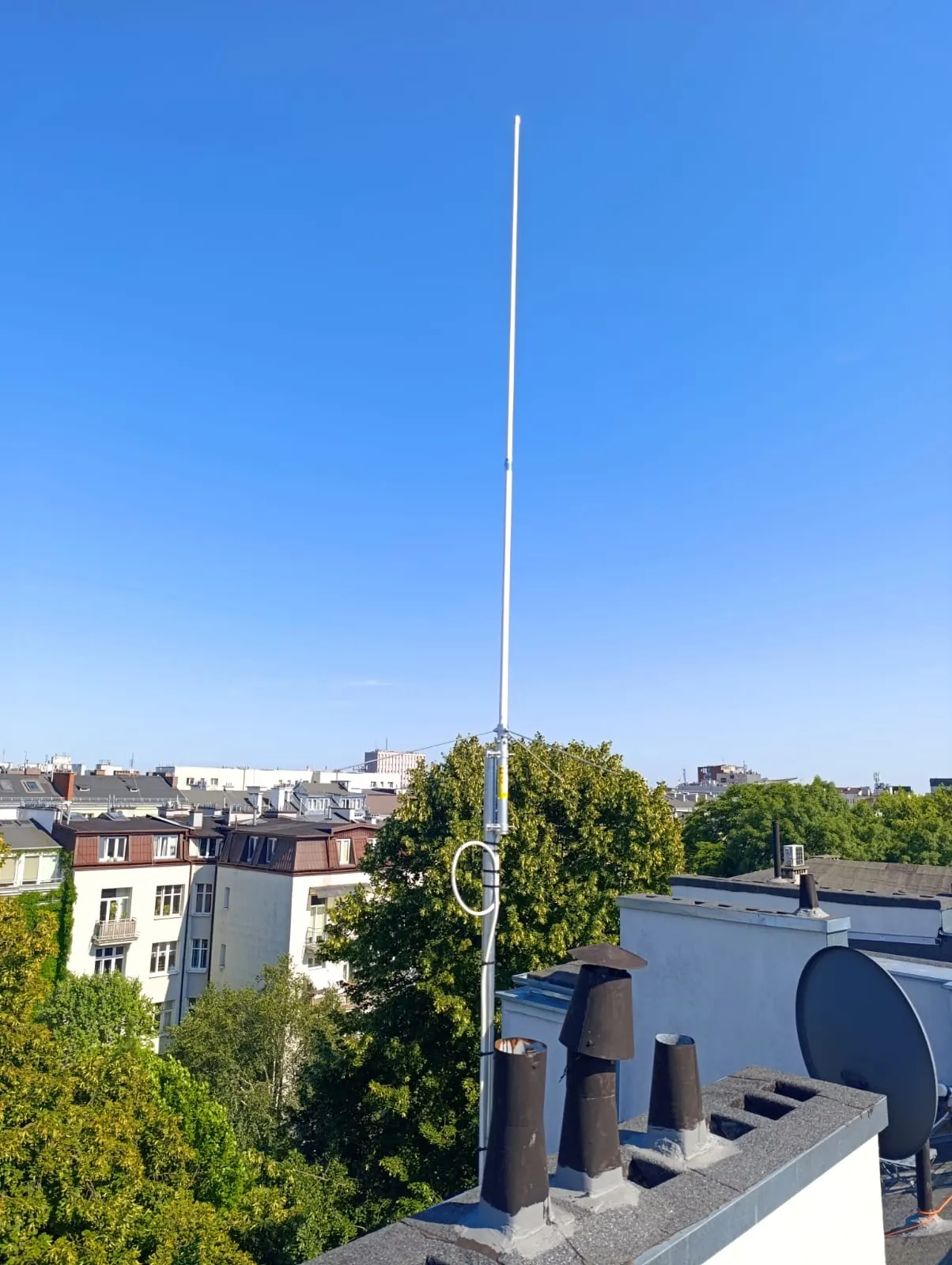
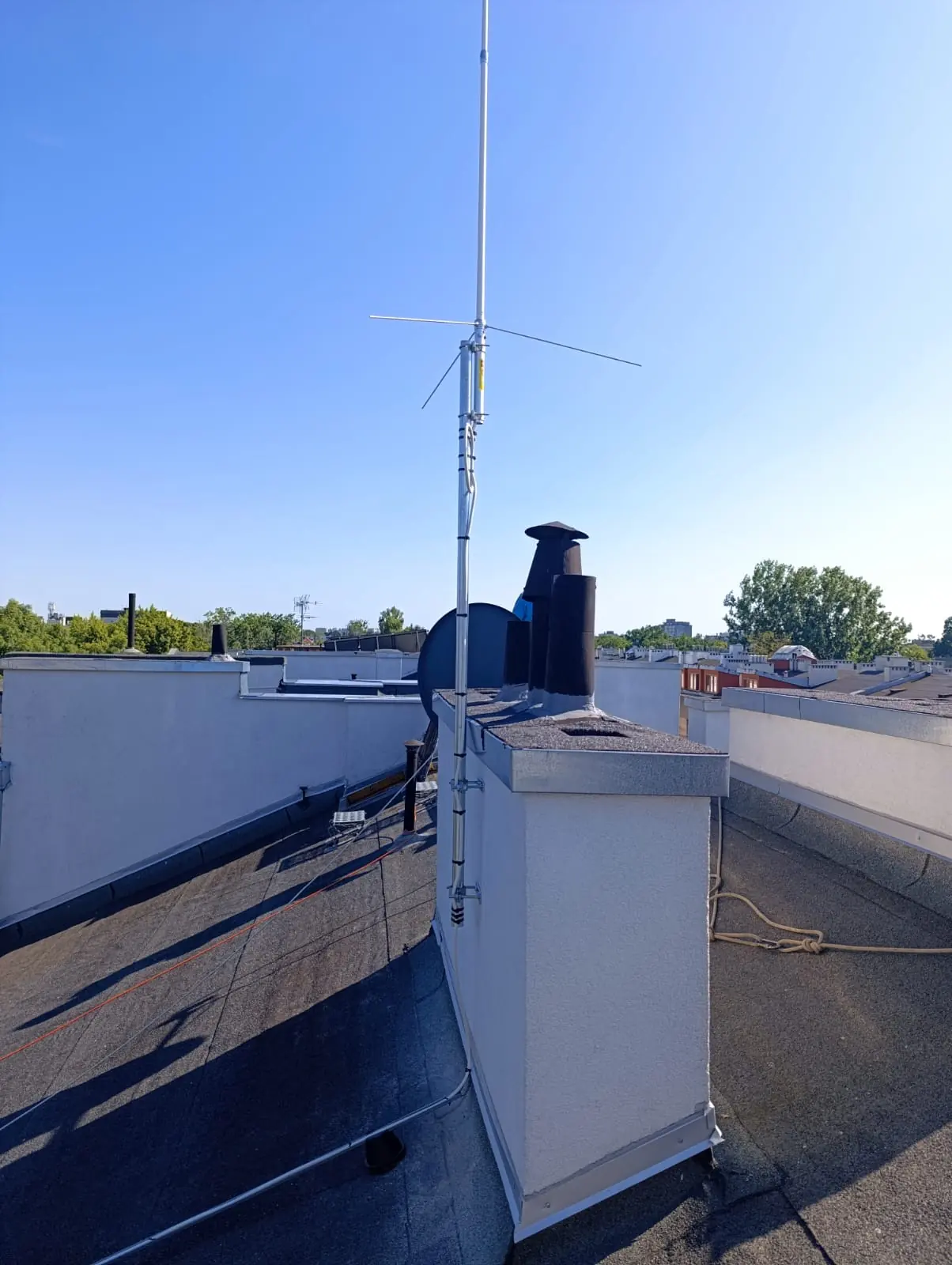
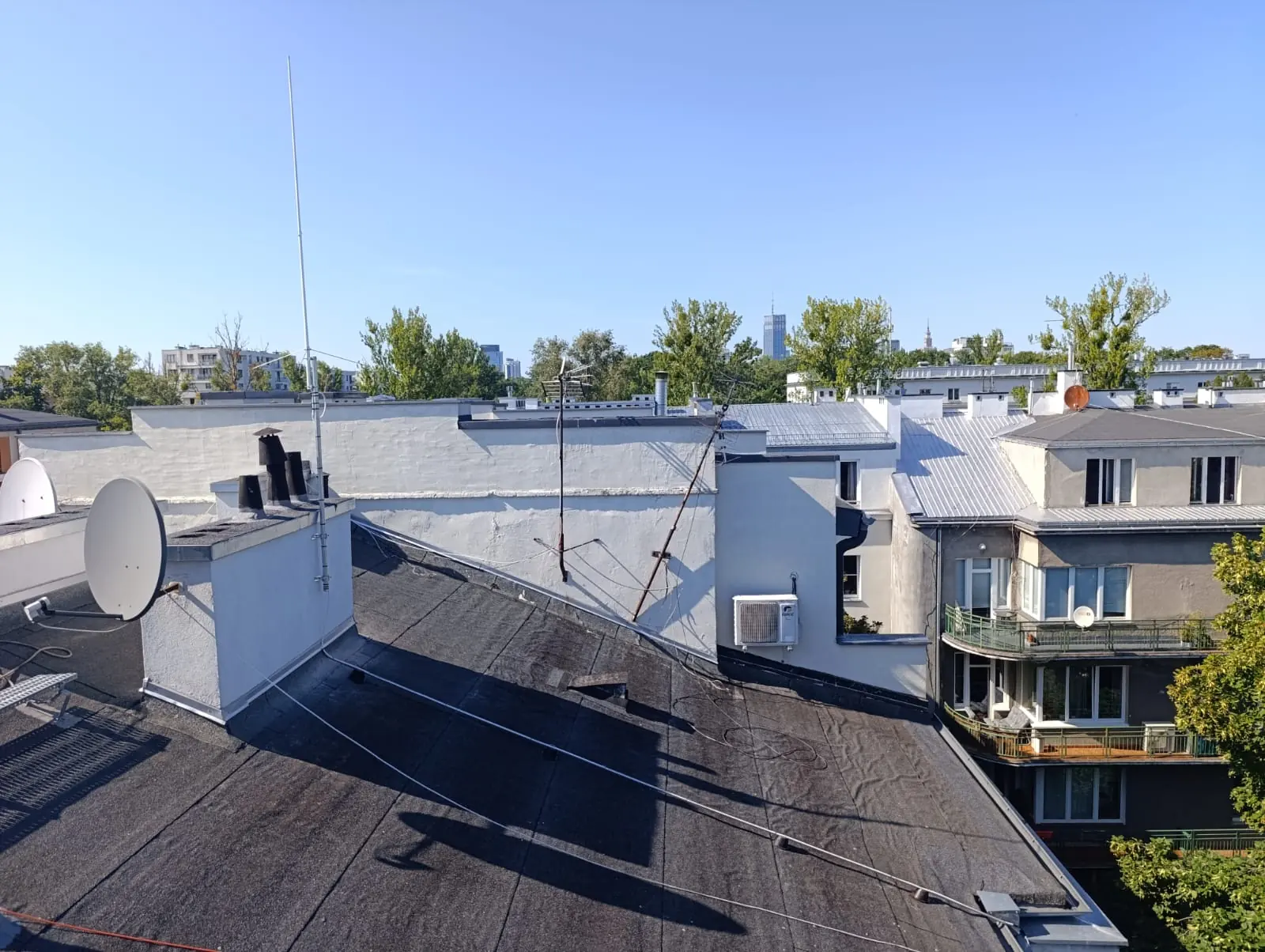
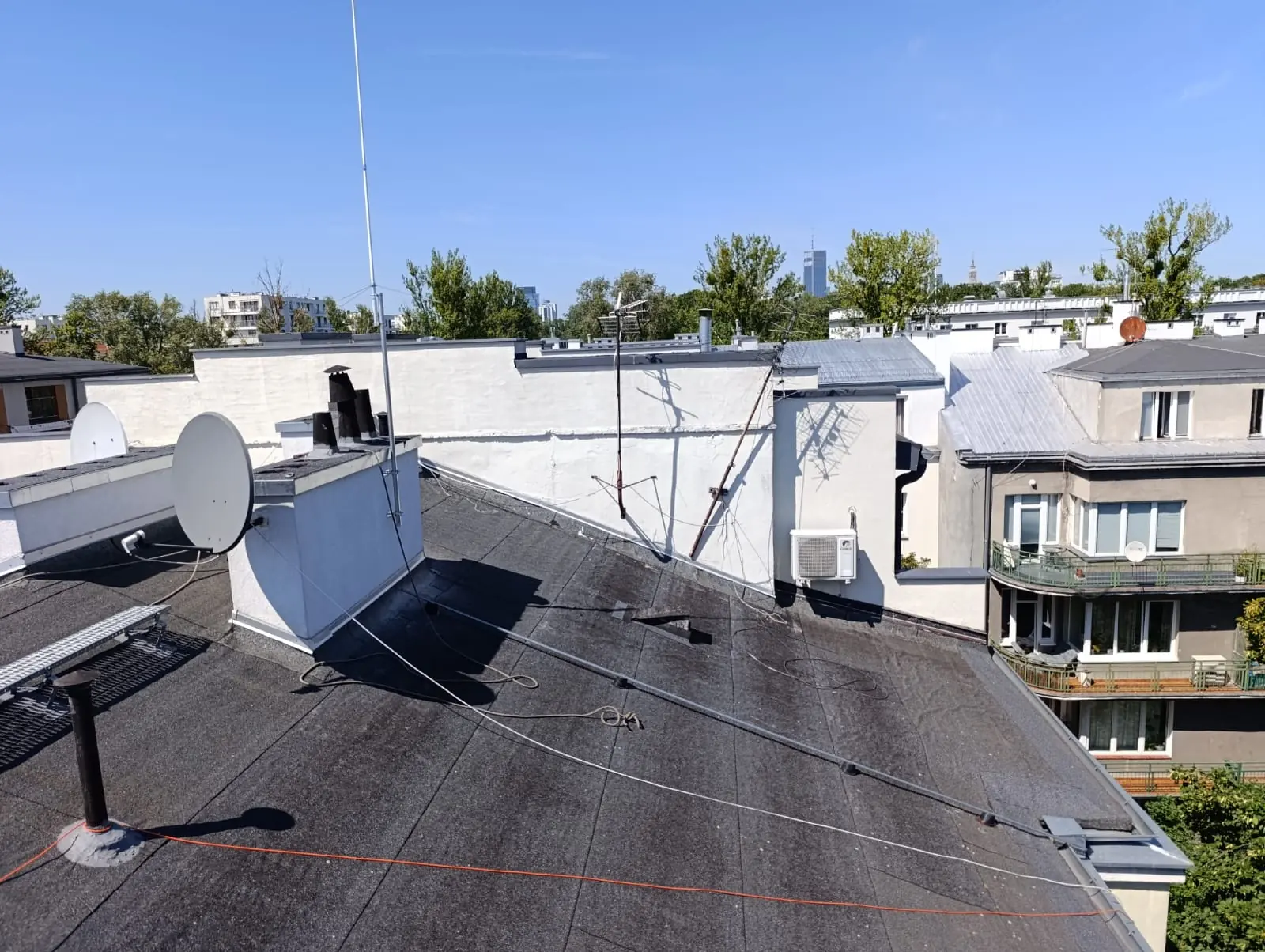
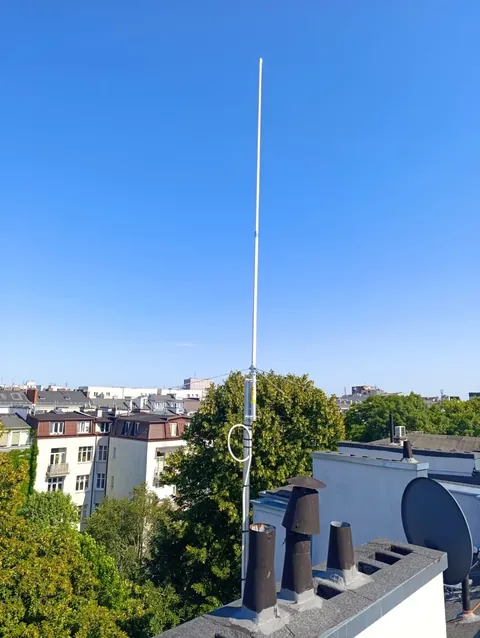
All my work on 2 m and 70 cm is on a single mast on a tenement chimney — high above the ridge and the treetops.

Diamond X-200N antenna on a tenement chimney — white vertical mast against a blue sky, with Warsaw’s rooftops in the background enlarge ⤢
Full profile of the mast · 2.5 m above the chimney
Mast with a Diamond X-200N antenna bolted to a chimney on a tenement’s felt roof, with black chimneys and a satellite dish alongside enlarge ⤢
Mounting · chimney clamps
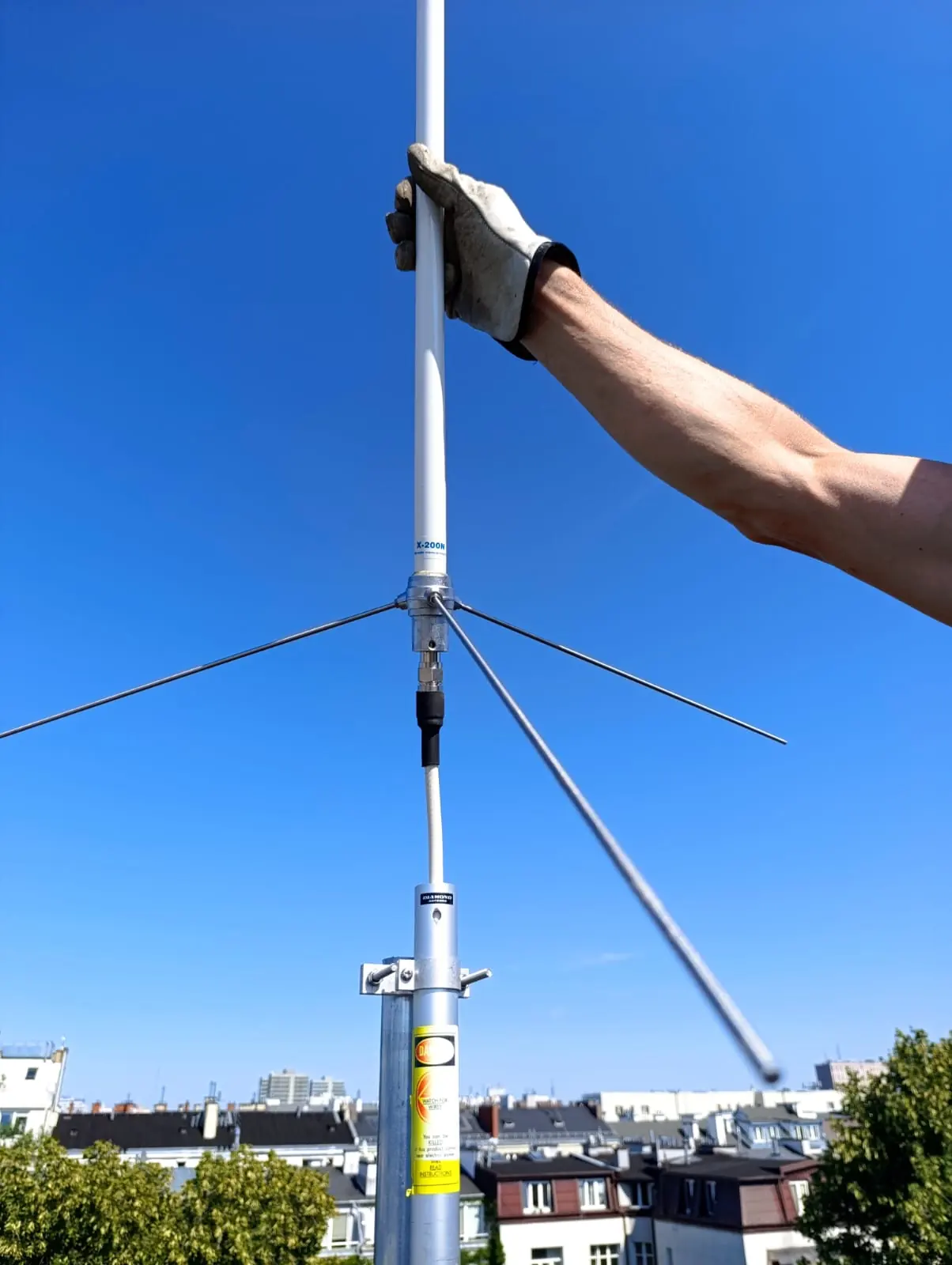
Close-up of the Diamond X-200N base with four radials and an N connector, a gloved hand holding the mast enlarge ⤢
Base · radials and N connector
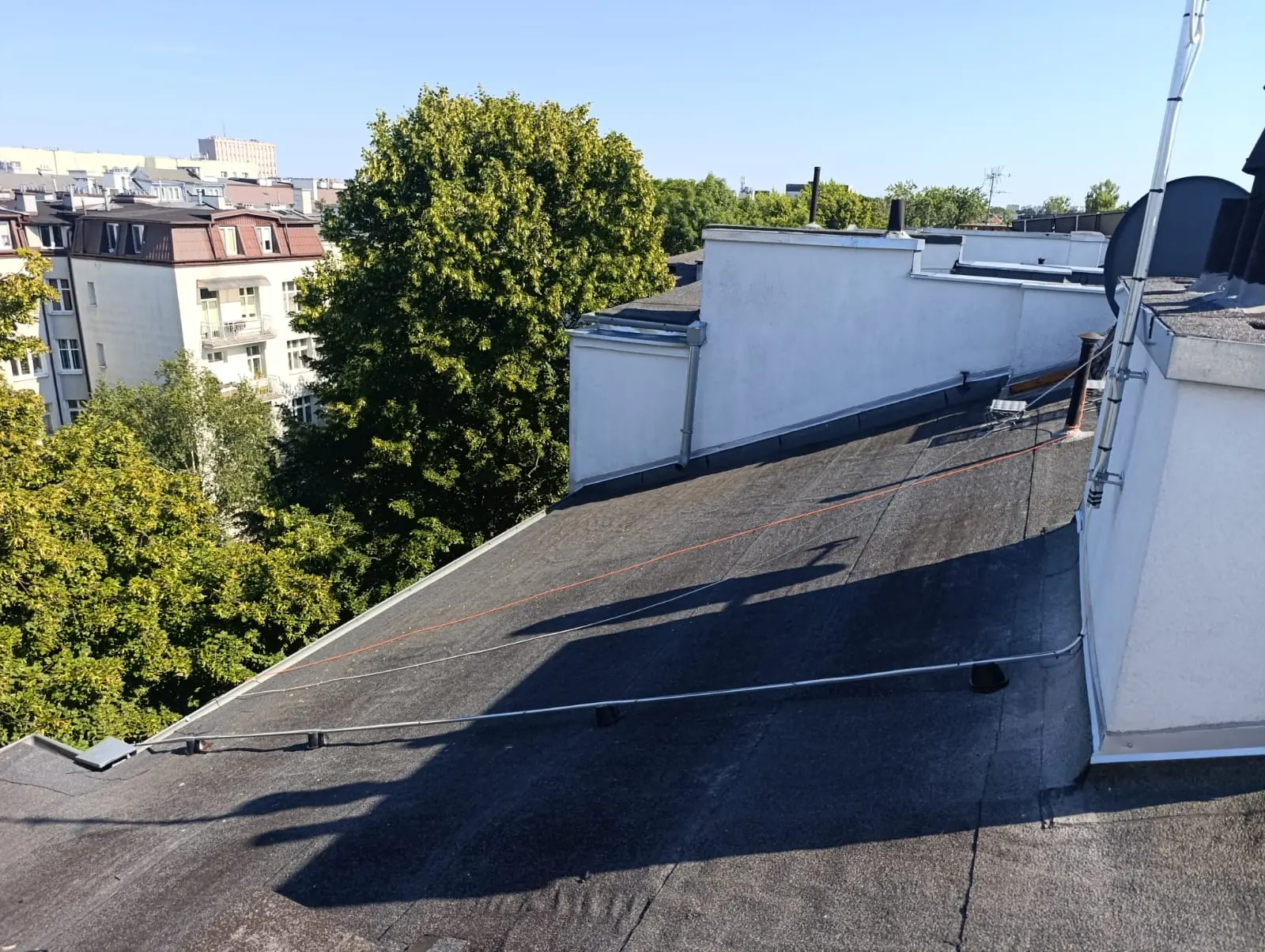
View from the tenement roof towards greenery and neighbouring tenements, with the lower part of the antenna mast on the right enlarge ⤢
Panorama of Old Mokotów rooftops with the antenna mast on the left and the skyscrapers of central Warsaw on the horizon enlarge ⤢
Panorama · central Warsaw on the horizon
Felt roof of a tenement with an antenna, a satellite dish and neighbouring tenements; Warsaw’s skyscrapers in the background enlarge ⤢
QTH · tenement roof in Mokotów
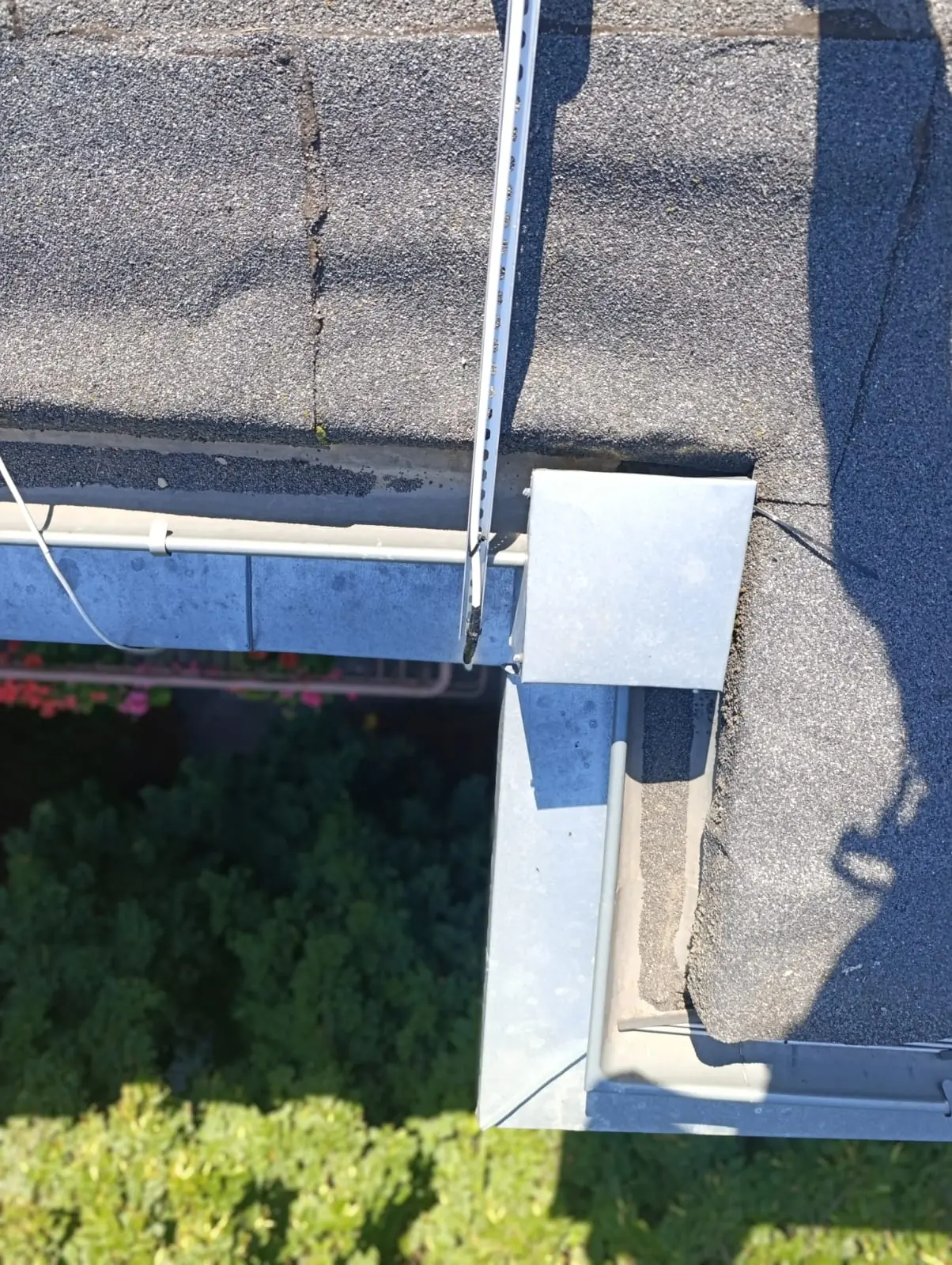
Antenna cable routed over the roof edge and through the metal flashing towards the window enlarge ⤢
Feed line · cable drop from the roof

I transmit on a Diamond X-200N — a dual-band vertical for 144 / 430 MHz, 2.5 m. Collinear: 2 × 5/8 λ on two metres and 4 × 5/8 λ on seventy centimetres. The flattened radiation pattern sends energy towards the horizon — where the repeaters and stations are.

The mast stands on a tenement chimney in Mokotów, above the ridge and treetops — here it’s not just gain that counts, but mounting height. The run to the radio is 28 m of HyperFlex 10 Sahara FT8 cable: about 1.3 and 2.4 dB of loss.

144 / 430 MHz6.0 / 8.0 dBi2.5 m · 200 WN-type socket
More about the antenna and the feed line
About the station

Technique, antenna
and patient listening

For me, amateur radio is a blend of engineering and operating practice — and the joy of every successful QSO.

My name is Filip. I was born in Mokotów and I’ve lived here all my life — and it’s from here that I work the amateur bands under the callsign SQ5CBA. I’ve been drawn to radio for a long time; I obtained my radio licence in 2026, so I’m a new operator on the bands — all the more hungry for the airwaves.

I’m into radio contacts, CW telegraphy, building and tuning antennas, and everything that happens between the transmitter and the ionosphere. Day to day I operate on the amateur VHF and UHF bands — from analogue FM via repeaters to the digital modes C4FM and D-STAR — and I also venture into the microwave 23 cm band.

This site is my radio calling card and a place for projects — including my own Morse code trainer that I use to learn and reinforce CW characters. I’m open to new friendships and continuous learning — if you hear me on the band, don’t hesitate to call. See you on the air, 73!

Radio licence number DC.WML.5101.3925.2026.2
LIC.
RADIO
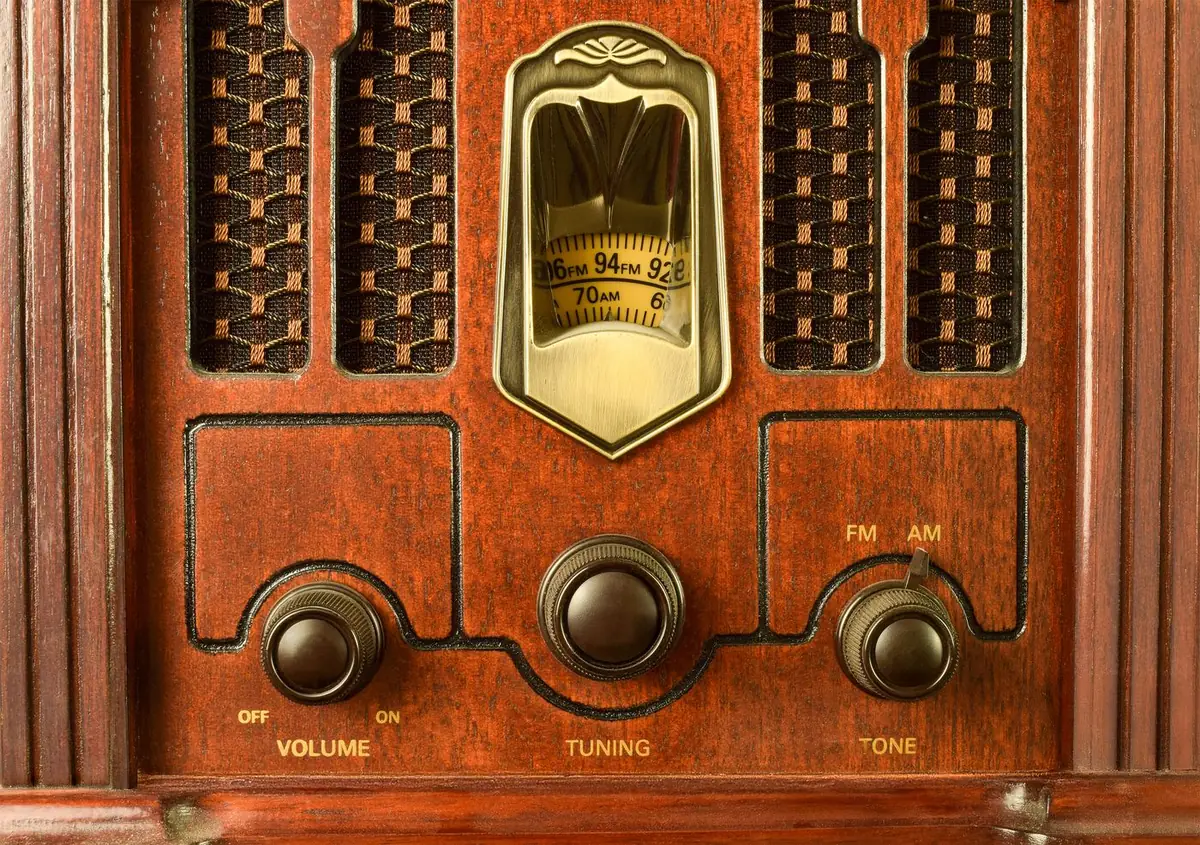
Antique radio receiver in a wooden cabinet with a brass tuning scale
receiver · tuning scale
Fun facts

Why it’s so addictive

A few brief points that capture the magic of amateur radio.

01
Propagation

The ionosphere carries the signal a long way

In good conditions waves reflect off atmospheric layers and reach hundreds or thousands of kilometres away.

02
QRP

Low power is often enough

With a good antenna and the right moment, even a few watts can make an interesting long-distance contact.

03
Morse

CW still makes practical sense

CW is readable with weak signals and occupies a very narrow bandwidth — ideal in difficult conditions.

04
Callsign

A callsign is your radio signature

It identifies the station and operator during a contact. My callsign on the amateur bands is SQ5CBA.

05
Antennas

The antenna changes everything

A dipole, a vertical or a Yagi can completely transform your range and how you work the band.

06
Ethics

Listen first, then transmit

Good operating practice means keeping the frequency clear and respecting other stations on the band.

News

Recently on the air

The picnic in Celestynów, QSOs via repeaters, Marian SQ4MN’s antennas and a meet-up on the bridge: 7 latest posts in one place. Choose a tab, the newest post opens first.

Filip SQ5CBA · Forest Education Centre, Celestynów · KO02RB
Meet-ups · 4 October 2026

9th Masovian Radio Picnic in Celestynów

Filip SQ5CBA — portrait
Filip SQ5CBAwrite-up · full post →
Marian SQ4MN — portrait
Marian SQ4MNbench hero · investigation →

About two hundred radio amateurs in the woods of the Forest Education Centre: a campfire, barbecue, sausages, coffee and tea, talks in the shelter and a stratospheric balloon with a DVB-S2 TV transmitter. The Wanda crew — SP5MAK, SQ5PIT, SQ5DAN, SP5XVS, SP5MOR — Marian SQ4MN, souvenir badges and mushrooms from the nearby woods.

On a separate page: the programme, photos and the bench investigation — 41 seconds that changed the balance of power in the shot. Full write-up →

CelestynówKO02RB145.500 MHzDVB-S2 balloon~200 peopleSQ4MN
Filip SQ5CBA · QTH Stary Mokotów · SR7KI repeater on Łysa Góra
Repeaters · 18 September 2026

From Stary Mokotów to Łysa Góra

Filip SQ5CBA — portrait
Filip SQ5CBAQSO · full post →
Icom IC-9700
Icom IC-9700radio used for this QSO · up to 75 W

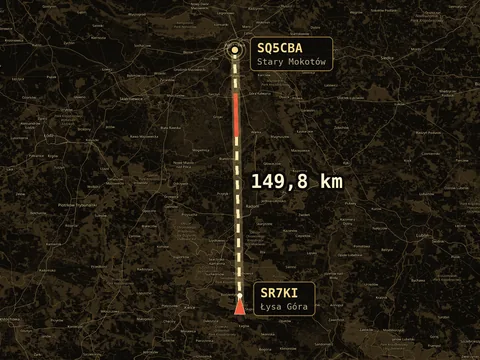
From my QTH in Stary Mokotów I can get into the SR7KI repeater on Łysa Góra. In a straight line it’s 149.8 km due south, and SR7KI’s antenna is 120 m above the summit, on the RTCN Święty Krzyż tower. There’s no line of sight: for 25 km the path is beyond the horizon, and the signal still gets through as it diffracts over the horizon’s edge.

On a separate page you’ll find the route map, a terrain profile with link budget, trivia about Łysa Góra (night-time Warsaw was once photographed from the boulder field) and ready-to-use SR7KI settings: 438.725 MHz, narrow FM, CTCSS 88.5 Hz, FM-LINK network. Full post →

70 cm438.725 MHzCTCSS 88.5 Hz149.8 kmIC-9700FM-LINK
Filip SQ5CBA · a field near Łęczyca · SR7KU repeater in Kutno
Repeaters · 12 September 2026

From a field near Łęczyca to Kutno

Filip SQ5CBA — portrait
Filip SQ5CBAQSO and photos · full post →
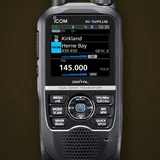
Icom ID-52E PLUS
Icom ID-52E PLUSradio used for this QSO · 5 W

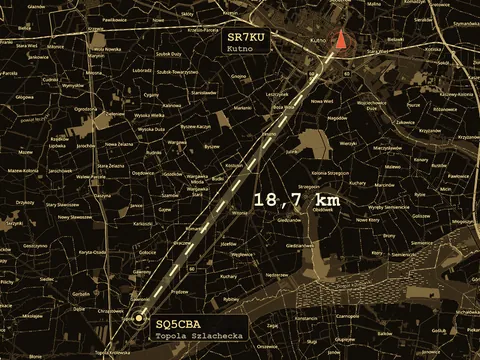
On 12 September, before sunset, in a field by Topola Szlachecka in the Łęczyca commune I made a QSO via the repeater SR7KU in Kutno using a handheld Icom ID-52E PLUS. In a straight line it’s 18.7 km to the north‑east, almost exactly the radio horizon for a handheld and a repeater antenna 12 metres above ground.

SR7KU operates FM on 70 cm: receive on 438.925 MHz, transmit on 431.325 MHz with CTCSS 82.5 Hz. On a separate page there’s a route map, a terrain cross‑section with Earth’s curvature and the Fresnel zone, repeater details and ready‑made radio settings with a CHIRP file. Full post →

70 cm438.925 MHzCTCSS 82.5 Hz18.7 kmID-52E PLUSSQ5CBA
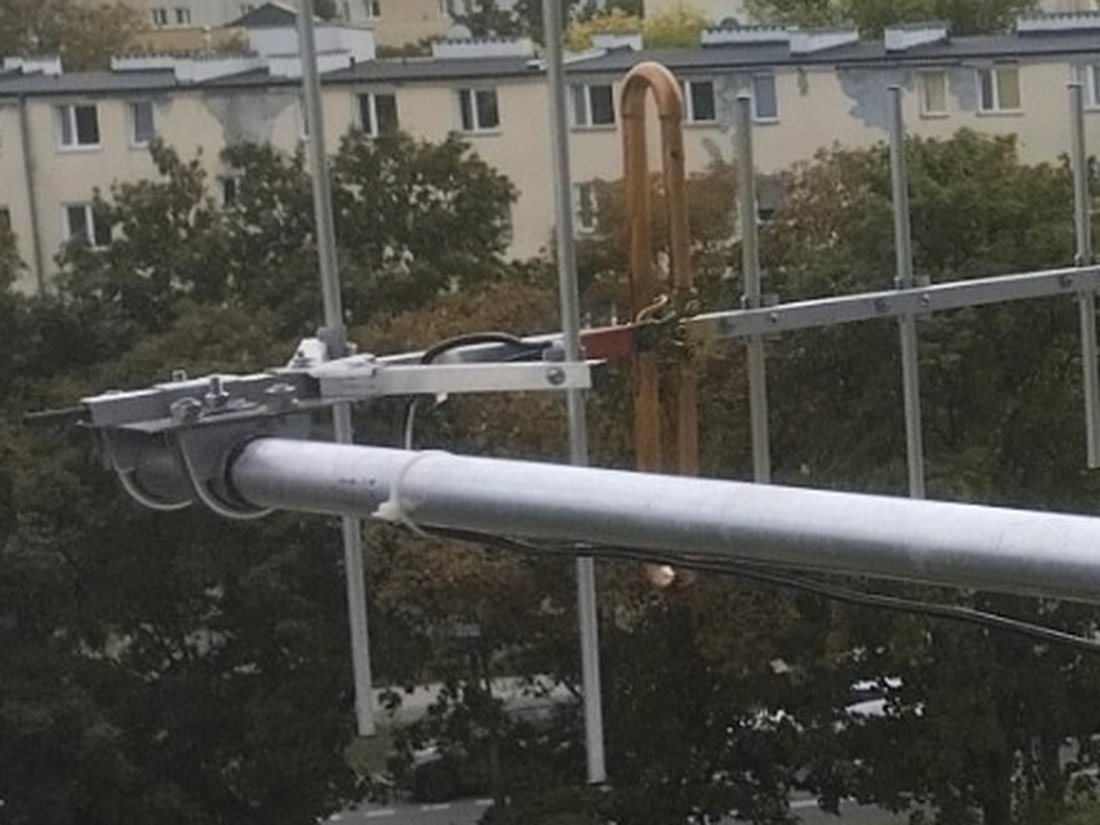
Marian SQ4MN · antenna for 2 m and 70 cm · between the elements a copper folded dipole
Antennas · 11 September 2026

An antenna you won’t find in any book

Marian SQ4MN — portrait
Marian SQ4MNdesign and photo · full post on a separate page →

Marian SQ4MN built an antenna for two bands at once, 2 m and 70 cm, from elements left over after building two earlier antennas. The aluminium rods, instead of waiting for “someday”, got a common boom, and between them stands a gleaming folded dipole made from copper tube. In the background, as usual with Marian, the skyscrapers of central Warsaw.

“It works superbly” — writes Marian. He won’t give any numbers though: “I don’t publish parameters, as it would be taken for cheating on my part. You won’t find it anywhere in the literature, because it was created in my head.” He considers the dipole the most interesting element: the loop made of copper tube is his own design, which he also uses in other antennas. “I don’t like open dipoles” — he adds.

Two curiosities to finish. A folded dipole has four times the impedance of a regular one (about 290 Ω instead of 73 Ω), and the parasitic elements of a Yagi bring it down to around 50–75 Ω. And 3 × 145 MHz = 435 MHz, the centre of the 70 cm band. More physics, the history of the Yagi antenna and the “classified” data sheet await on the separate page. Full post →

2 m + 70 cmYagi · vertical polarisationCu folded dipoleSQ4MN
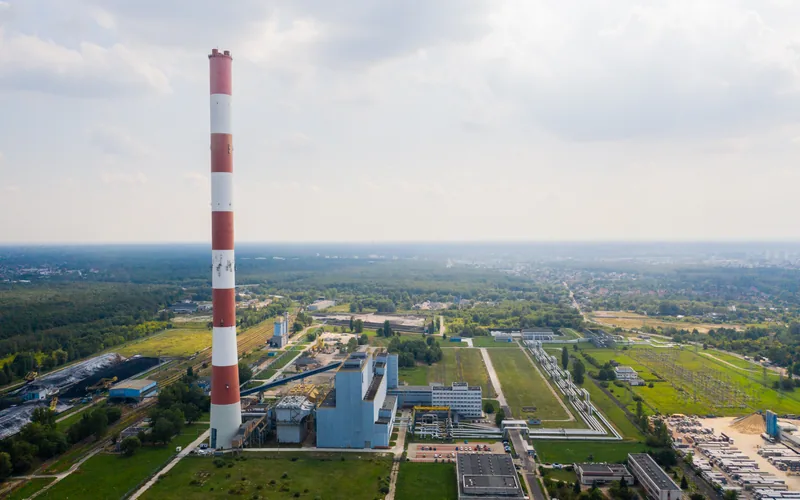
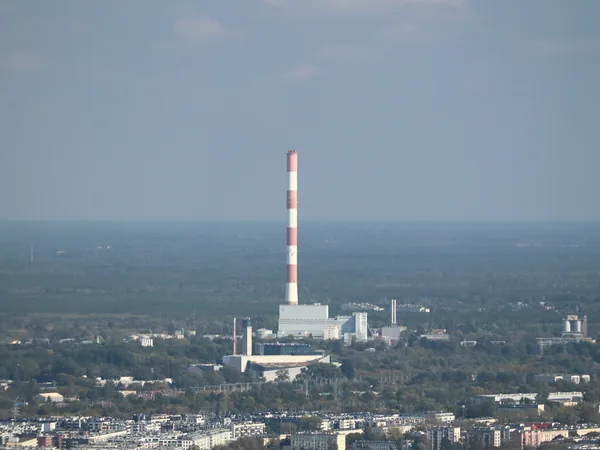
The Kawęczyn Heat Plant chimney · photo: ELEKTROCIEPŁOWNIE (CC BY-SA 4.0) and Cybularny (CC0), Wikimedia Commons
Repeaters · 5 September 2026

Wanda: 305 metres above Warsaw

The most‑used 2 m repeater in Warsaw has its own page. SR5W “Wanda” transmits on 145.750 MHz from an antenna on the top of the 300-metre Kawęczyn Heat Plant chimney, so five watts from a handheld is heard across half of Mazovia. On the page: ready‑made FM and DMR settings with a “copy” button and a CHIRP file, a radio horizon map with distances to towns, an animated diagram of how the repeater works and operating etiquette.

There’s also a history documented in public listings: Wanda appears on the PZK (the Polish Amateur Radio Union) list from 2008, in 2010 it was silent while the licence was being renewed, and from 2025 it has a new licence to 2030 and operates in mixed mode FM + DMR. Photos of the chimney come from Wikimedia Commons under free licences. Wanda’s full page →

2 m145.750 MHzFM + DMRWOT PZK
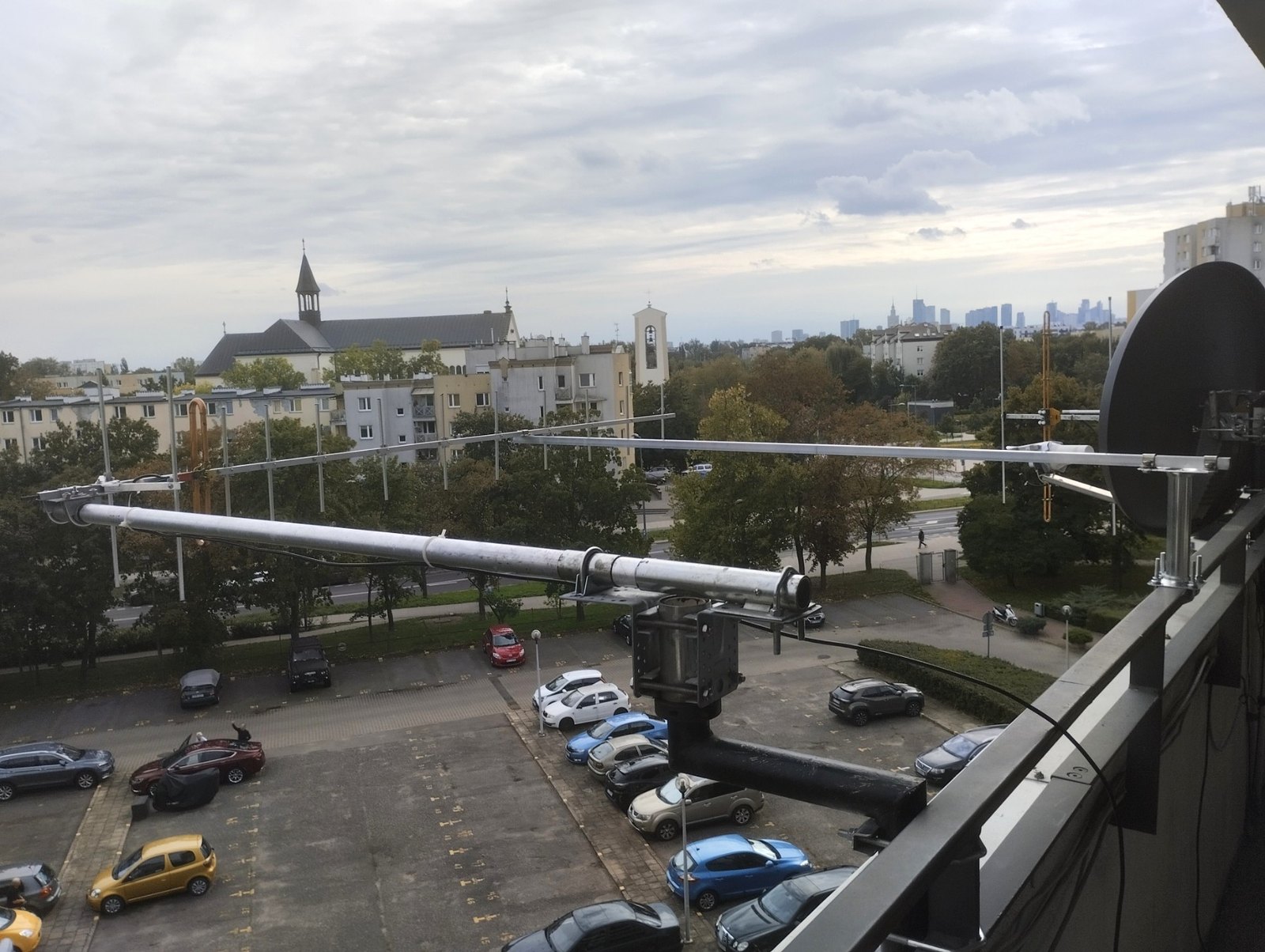
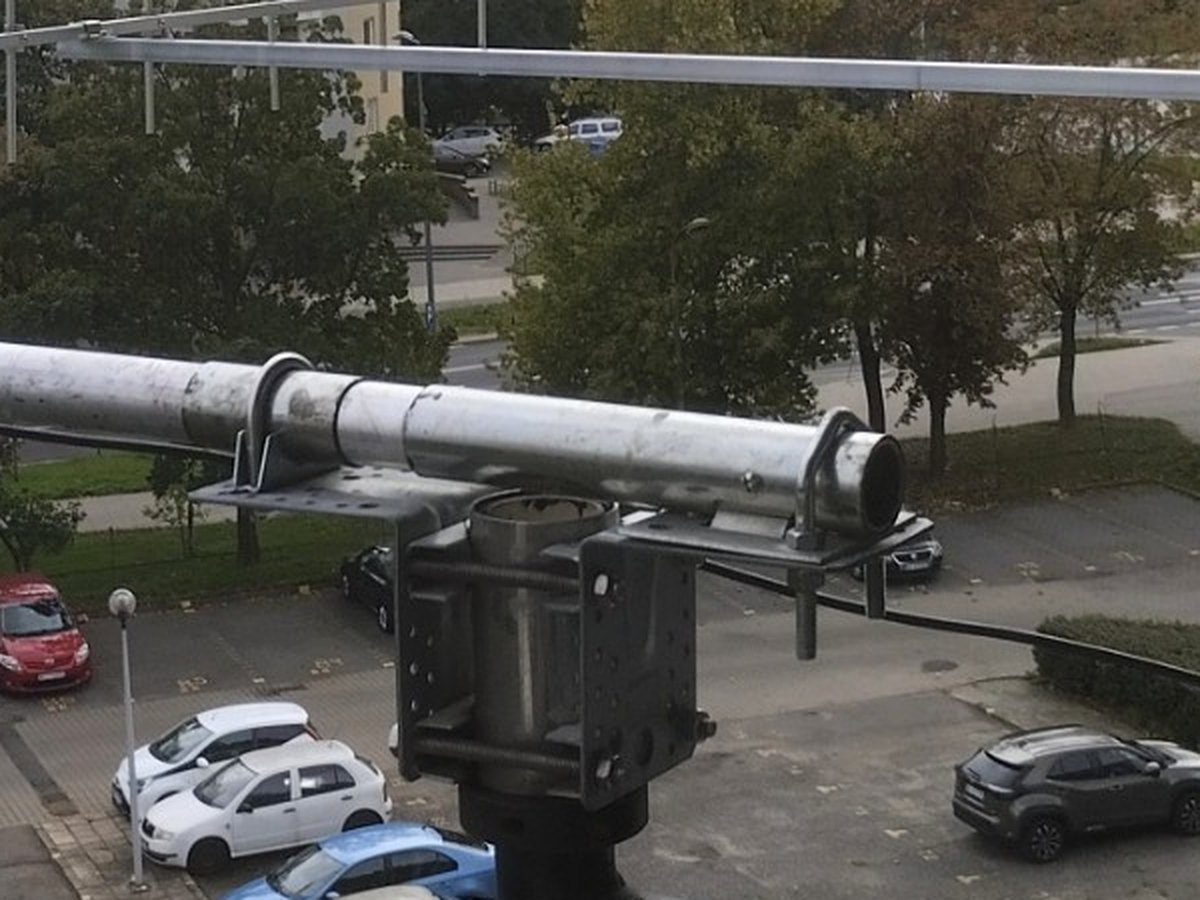
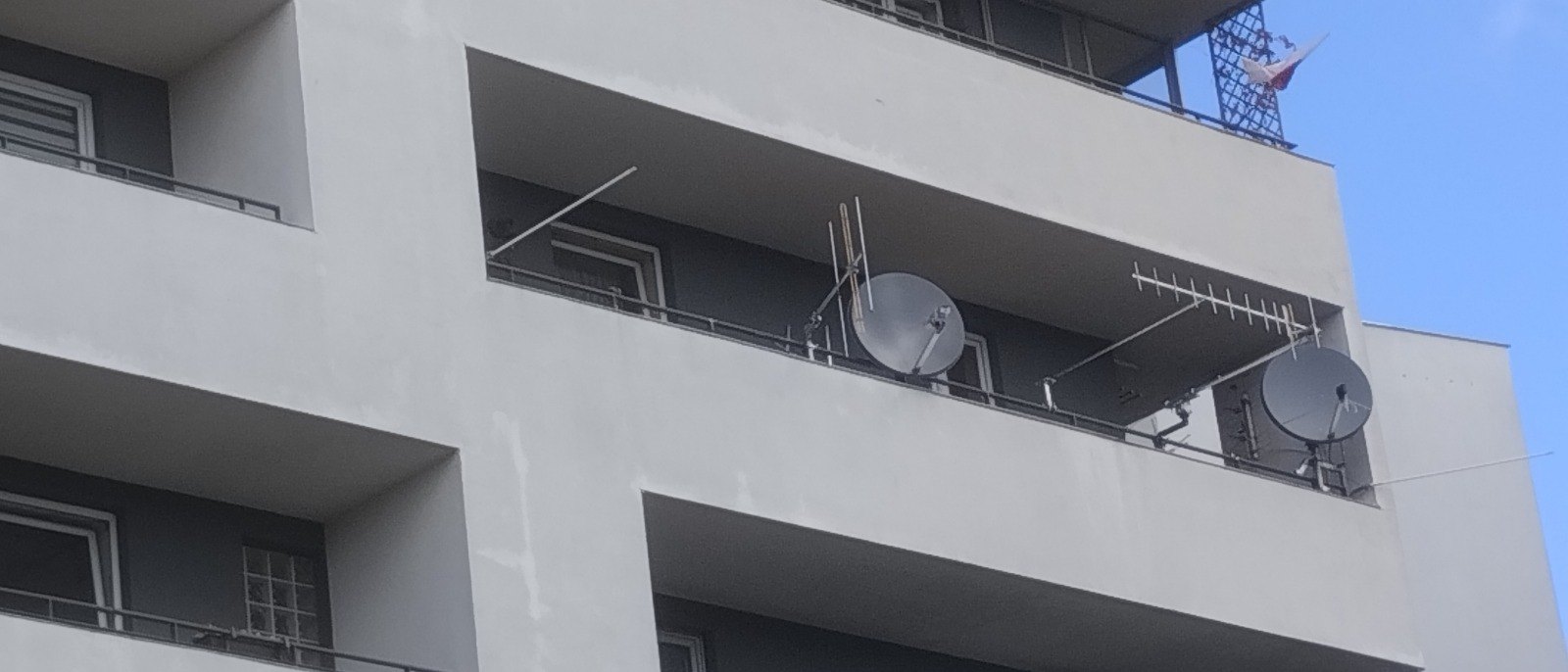
Marian SQ4MN · 70 cm Yagi from the balcony · middle: support clamp and boom end · bottom: the same antenna from the street
Antennas · 4 September 2026

A boom that stopped dancing in the wind

Marian SQ4MN — portrait
Marian SQ4MNantenna and photos · full post on a separate page →

Marian SQ4MN sent a photo of his antenna’s new incarnation on 70 cm: a long Yagi with vertical elements hangs on an upper‑floor balcony, and on the horizon you can see the high‑rises of central Warsaw. The novelty is under the boom — there’s a second, thicker tube running along there, anchored in a heavy clamp on a steel bracket and reaching all the way to the reflector. Instead of an antenna hanging on a single mast mount we now have a rigid frame with two support points.

The difference is bigger than it looks. Cantilever deflection grows with the cube of length, and wind load with the square of speed: twice the wind speed means four times the force at the boom tip. The second strut knocks the deflection down by an order of magnitude, the clamps stop taking the strain, and the cable no longer chafes on the edges.

“I haven’t noticed any deterioration in the parameters,” writes Marian. And rightly so: the tube parallel to the boom lies perpendicular to the elements, so to a vertically polarised wave it’s almost transparent — just like the boom itself. The pattern and SWR stayed where they were.

A day later there was a shot from the street. From the pavement you can see the whole scene: the Yagi projects well beyond the balcony line and sits next to two satellite dishes, and one storey up a white‑and‑red flag flutters — as if someone were already testing a wind indicator. Good news for the contest: the ribbon will be visible from street level.

Contest · ribbon

SQ5PIT suggested hanging a ribbon on the antenna — a ham‑radio wind indicator, like a telltale on a yacht’s shrouds. Marian announces a contest: where should it go? On the reflector so it flutters like a comet’s tail? On the last director, like a pennant on the bow? Or perhaps on the new strut — so you can see whether anything is moving at all? Post your answers in the guestbook.

70 cmYagi · vertical polarisationSQ4MNContest

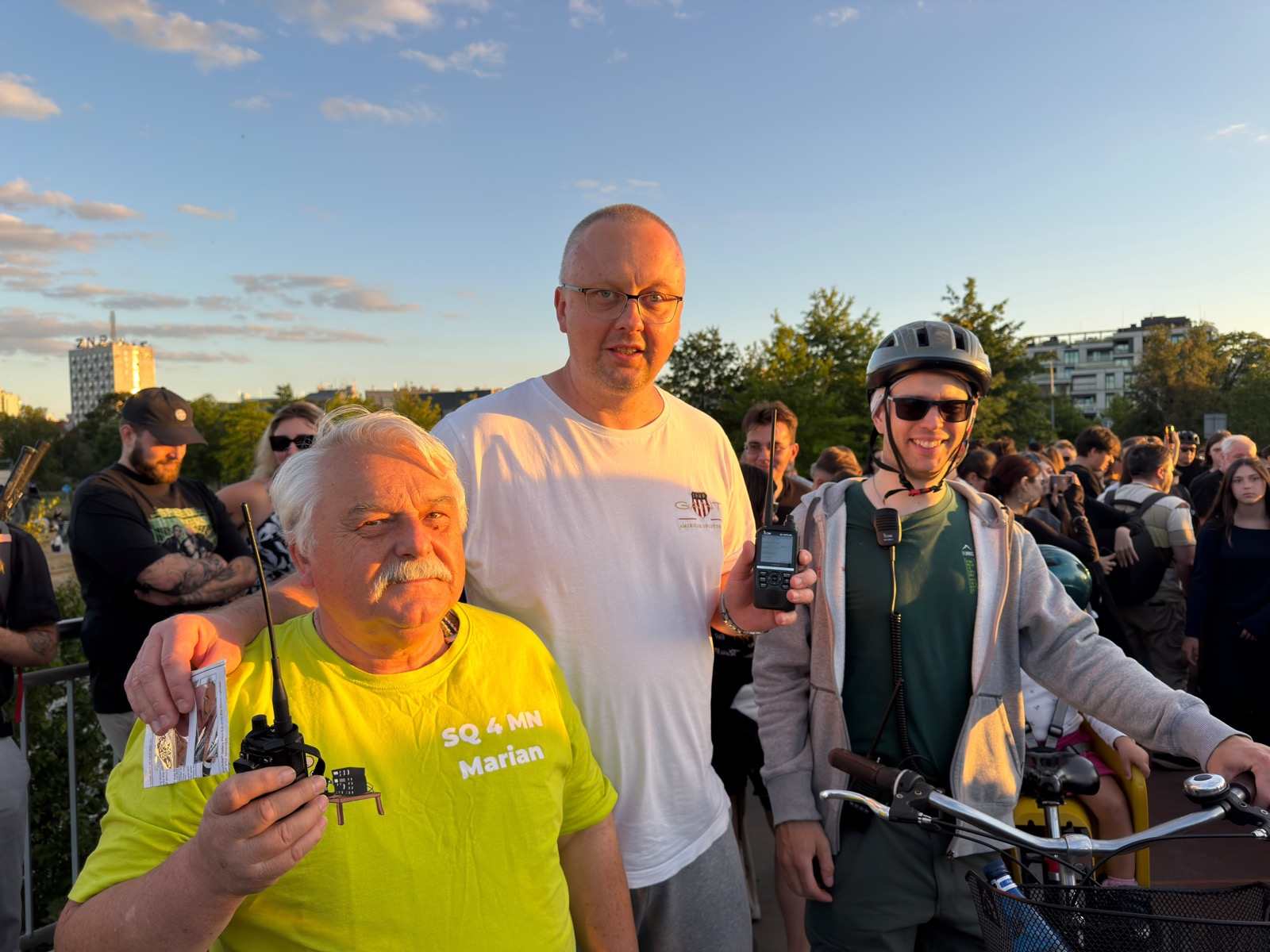
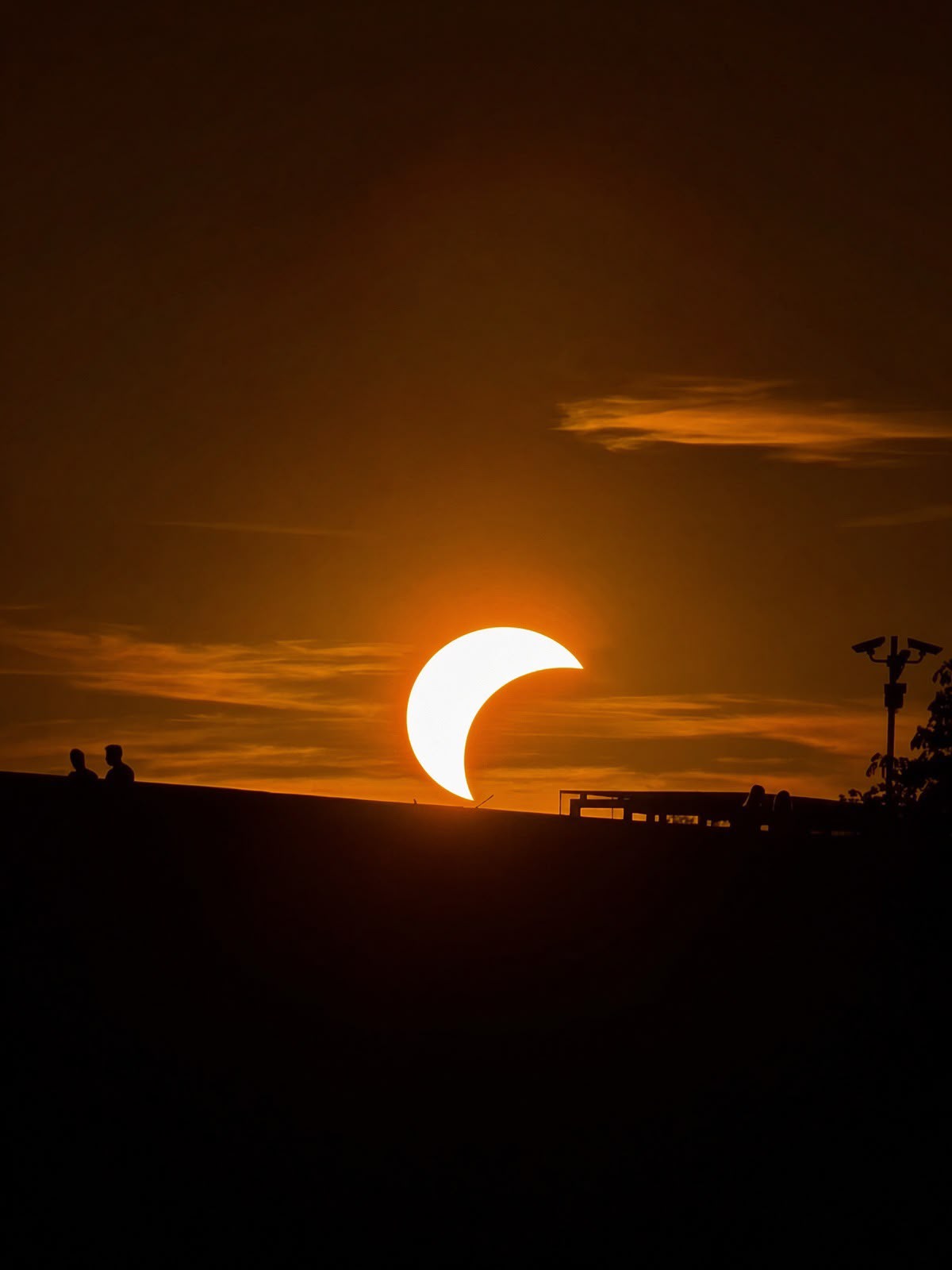
From left: Marian SQ4MN, Filip SQ5CBA, Mikołaj SP5MAK · next: the Sun just above the horizon
Eyeball QSO · 12 August 2026

Three callsigns, one bridge

We three met on the Świętokrzyski Bridge — a classic eyeball QSO, that is, a face‑to‑face contact. The reason for the crowd around us: a partial solar eclipse, which in Poland happened exactly at sunset — the disc slipped below the horizon with a clearly ‘bitten’ edge. The path of totality ran that day over Greenland, Iceland and northern Spain.

The bridge also turned out to be a decent QTH: a dozen or so metres above the water and an open horizon both ways along the river — on 2 m and 70 cm that kind of ‘free height’ does more than the best preamplifier.

2 m · 70 cmEyeball QSOKO02MFPartial eclipse
01
Eclipse

The ionosphere nods off briefly

The Moon’s shadow locally weakens the ionisation of the ionosphere, so band propagation starts to behave as it does at night. During major eclipses, large-scale measurements are organised — such as the Solar Eclipse QSO Party by the HamSCI project.

02
Perseids

You can hear meteors

The Perseid peak falls in mid‑August. A meteor’s ionised trail reflects signals on 2 m and 6 m, giving contacts over more than a thousand kilometres that last a fraction of a second — the MSK144 mode is used to catch them.

03
Callsigns

The number in the callsign is the call area

In Polish callsigns the digit indicates the call area: SQ4MN is north‑eastern Poland, while SQ5CBA and SP5MAK are Mazowsze. The main difference between the SP and SQ prefixes is when the callsign was issued.
01 / 07
My contacts

25 QSOs, one starting point

Each line starts at my QTH in Mokotów and ends at the locator of the station I worked. Several contacts to the same place share one line — hover or tap to see the callsigns.

Full map and complete log →
QSOs
25
stations
22
locators
15
furthest
808 km
Poland
Map of Poland: SQ5CBA’s contacts from Warsaw SA0PRJ · Stockholm808 km · off the map ↑ GdańskSP2LMG · 290 km Łysa GóraSR7KI · 150 km PuławySP8X · 111 km Rawa Maz.SQ7LB · 73 km 5 Skierniewice4 stations · 65 km NasielskSQ5SJT · 46 km Warsaw · 13 QSOclose-up alongside →
Warsaw close-up · up to 25 km
  • Stockholm, Sweden808 km · 1 QSO
    SA0PRJ14.08 · 70 cm
  • Gdańsk area290 km · 1 QSO
    SP2LMG05.08 · 70 cm
  • Łysa Góra · SR7KI repeater150 km · 1 QSO
    SR7KIrepeater · 70 cm QSO details →
  • Puławy area111 km · 1 QSO
    SP8X13.09 · 70 cm
  • Rawa Mazowiecka area73 km · 1 QSO
    SQ7LB31.08 · 70 cm
  • Skierniewice area65 km · 5 QSO
    SP7RS13.09 · 70 cmSP7RS31.08 · 70 cmSP7MJX05.08 · 70 cmSQ7DMS04.08 · 2 mSQ7OCJ31.07 · 70 cm
  • Nasielsk area46 km · 1 QSO
    SQ5SJT29.07 · 2 m
  • near Warsaw · KO02pd21 km · 1 QSO
    SQ5EBM10.07 · 2 m
  • near Warsaw · KO02og16 km · 1 QSO
    SP5VYS24.07 · 70 cm
  • near Warsaw · KO02nh14 km · 1 QSO
    SP5TIR31.08 · 70 cm
  • Warsaw · KO02lg7.8 km · 1 QSO
    SP5AH13.09 · 70 cm
  • Warsaw · KO02mg7.5 km · 4 QSO
    SP5OSW05.09 · 70 cmSP5HACK01.09 · 2 mSP5MOR04.08 · 2 mSP2RCL29.07 · 2 m
  • Warsaw · KO02lf4.1 km · 4 QSO
    SQ5FJM31.08 · 2 mSQ5E02.08 · 2 mSQ5JRQ12.07 · 2 mSQ5E07.07 · 2 m
  • Warsaw · KO02mf3.5 km · 1 QSO
    SQ5PIT01.08 · 2 m
  • no locator in the logoff the map
    SQ5OLO07.07 · 70 cm

Data from my QRZ log (07.07.2026 – 13.09.2026, 2 m and 70 cm FM). A dot marks the centre of a 6-character locator (a square approx. 6 × 5 km), and the line shows straight-line distance, not the signal path — some contacts went via the SR5W “Wanda” and SR5RR “Iberyjska” repeaters with an EchoLink gateway. Warsaw boundary and the Wisła © OpenStreetMap contributors.

Awards

Confirmed on paper

Commemorative awards earned during activity on the bands — each is a series of confirmed contacts.

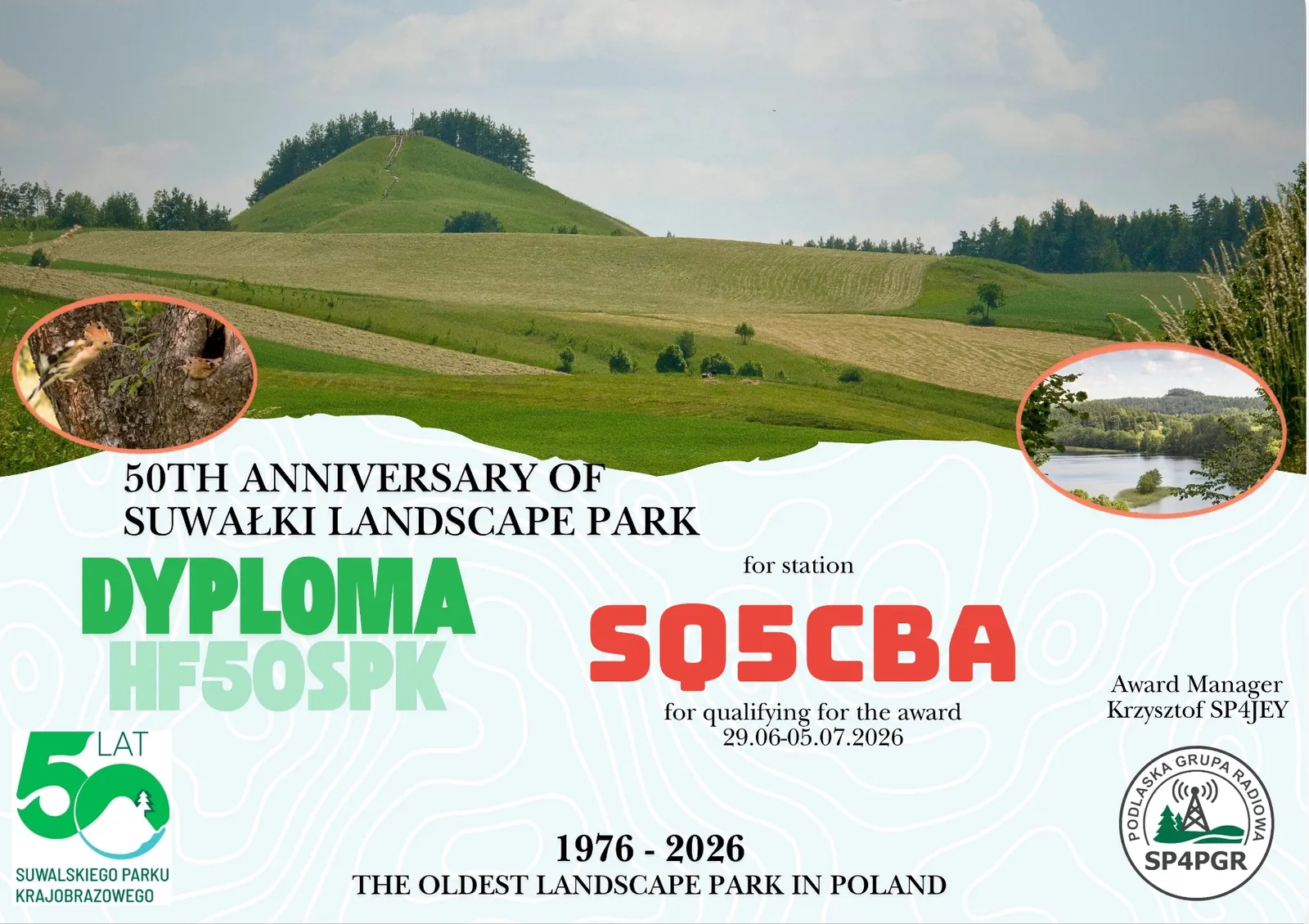
HF50SPK award for station SQ5CBA — 50th anniversary of Suwalski Park Krajobrazowy, 1976–2026 enlarge ⤢
Commemorative award

HF50SPK — 50 years of Suwalski Park Krajobrazowy

Award for contacts with the special event station HF50SPK, operating to mark the 50th anniversary of Suwalski Park Krajobrazowy — the oldest landscape park in Poland (1976–2026).

Station SQ5CBA Contact period 29.06 – 05.07.2026 Issuer Podlaska Grupa Radiowa SP4PGR Award Manager Krzysztof SP4JEY
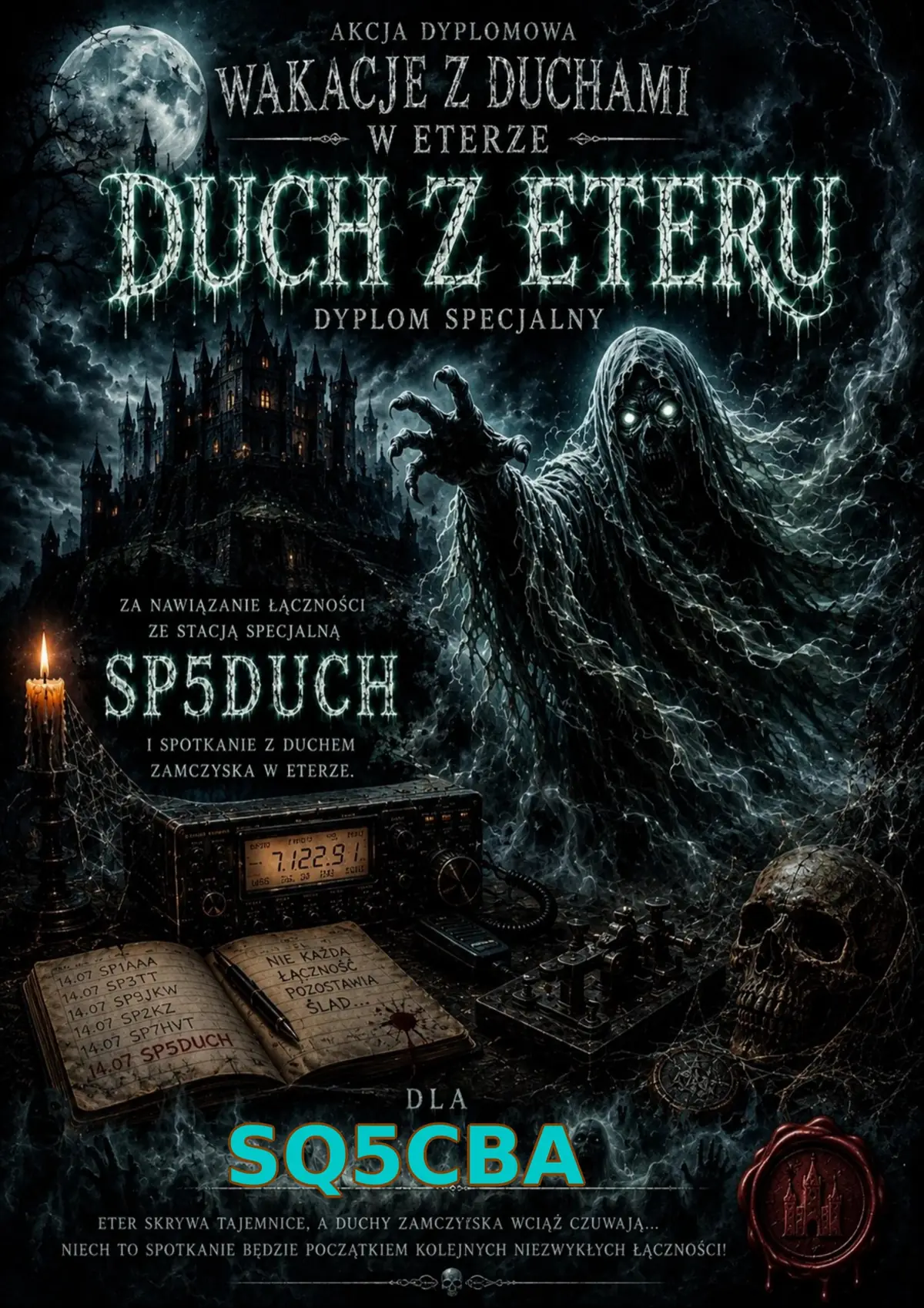
Special award “Spirit from the Ether” for station SQ5CBA — “Holidays with Ghosts on the Air” event, station SP5DUCH enlarge ⤢
Special award

Ghost from the Ether — Holidays with Ghosts on the Air

Special award for making contact with the special event station SP5DUCH during the summer award event “Holidays with Ghosts on the Air” — a meeting with the castle’s ghost on the air.

Station SQ5CBA Special event station SP5DUCH Event Holidays with Ghosts on the Air
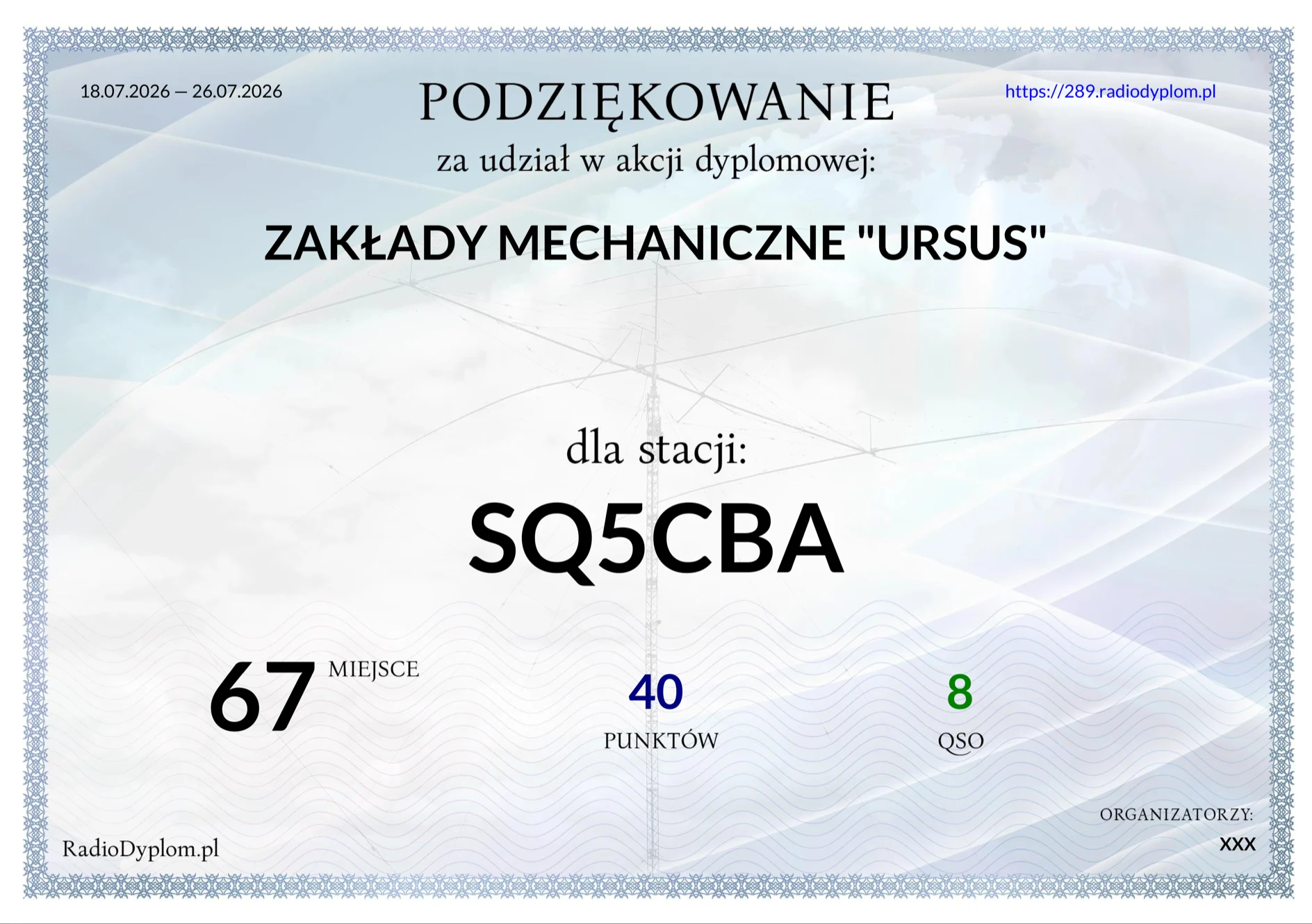
Acknowledgement for taking part in the “Zakłady Mechaniczne ‘Ursus’” award event for station SQ5CBA — 67th place, 40 points, 8 QSO enlarge ⤢
Acknowledgement of participation

Zakłady Mechaniczne “Ursus”

Acknowledgement for taking part in the award event commemorating Zakłady Mechaniczne “Ursus” — the legendary Warsaw tractor factory. Final ranking: 67th place with a tally of 40 points from 8 contacts.

Station SQ5CBA Event period 18.07 – 26.07.2026 Result 67th place · 40 pts · 8 QSO Organiser RadioDyplom.pl

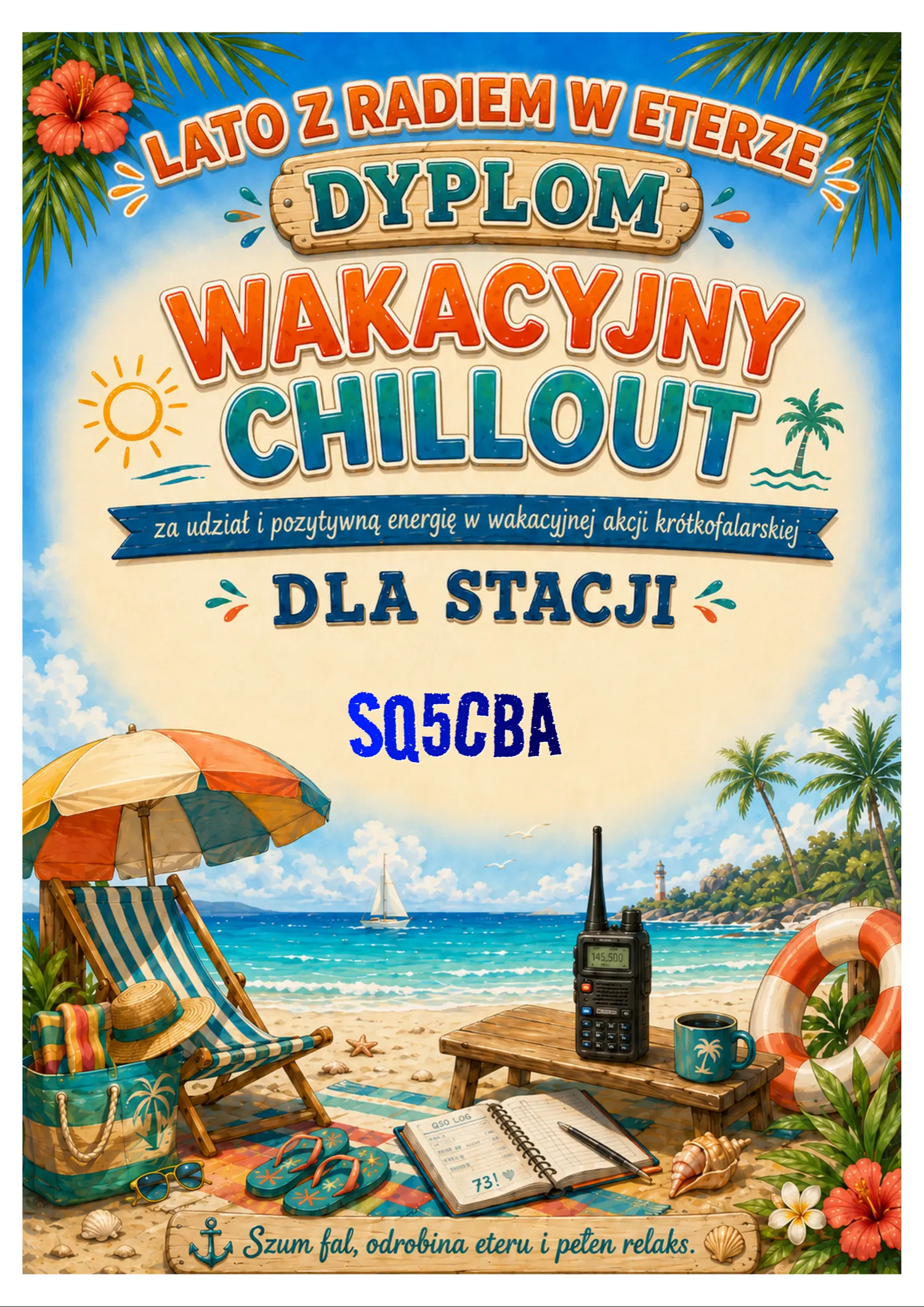
Certificate “Holiday Chillout” from the ‘Summer with Radio on the Air’ event for station SQ5CBA enlarge ⤢
Commemorative award

Holiday Chillout — Summer with Radio on the Air

Certificate “Holiday Chillout” awarded for taking part and positive energy in the summer amateur radio event “Summer with Radio on the Air” — the sound of the waves, a touch of the ether and full relaxation — ham radio, beach edition.

Station SQ5CBA Event Summer with Radio on the Air For taking part and positive energy on the air
QTH

Where I transmit from

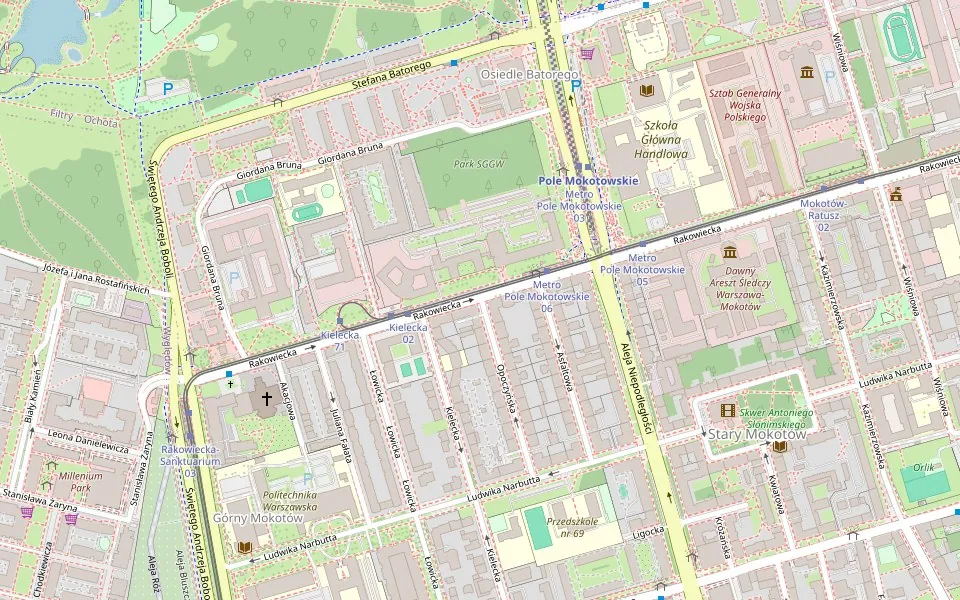
The station operates from Old Mokotów in Warsaw — the corner of Rakowiecka and Opoczyńska, a stone’s throw from Pole Mokotowskie.

Map of Mokotów with the SQ5CBA station marked at the Rakowiecka/Opoczyńska junction © OpenStreetMap
Station location

Warsaw · Mokotów

The antenna operates in the very heart of Mokotów. Nearest landmark: Pole Mokotowskie metro station. Click the map to open the full version.

Latitude 52.20706° N Longitude 21.00562° E DMS 52°12′25.4″N · 21°00′20.2″E Locator KO02ME
A man with a rucksack speaking into a handheld radio on a hill in the sunset glow
My own tool · new

First QSO
simulator

The other station talks to you, you answer on the mic, and the simulator checks your callsign, report, QTH and 73. Repeater, simplex with QSY and VHF contests, and a QSL card to finish. All without a transmitter.

My own tool
··· −−·− ····· −·−· −··· ·−

Morse code
trainer

Interactive CW trainer: character tree, listening, sending and decoding. Practise speed and reinforce the letters right in your browser — no installation.

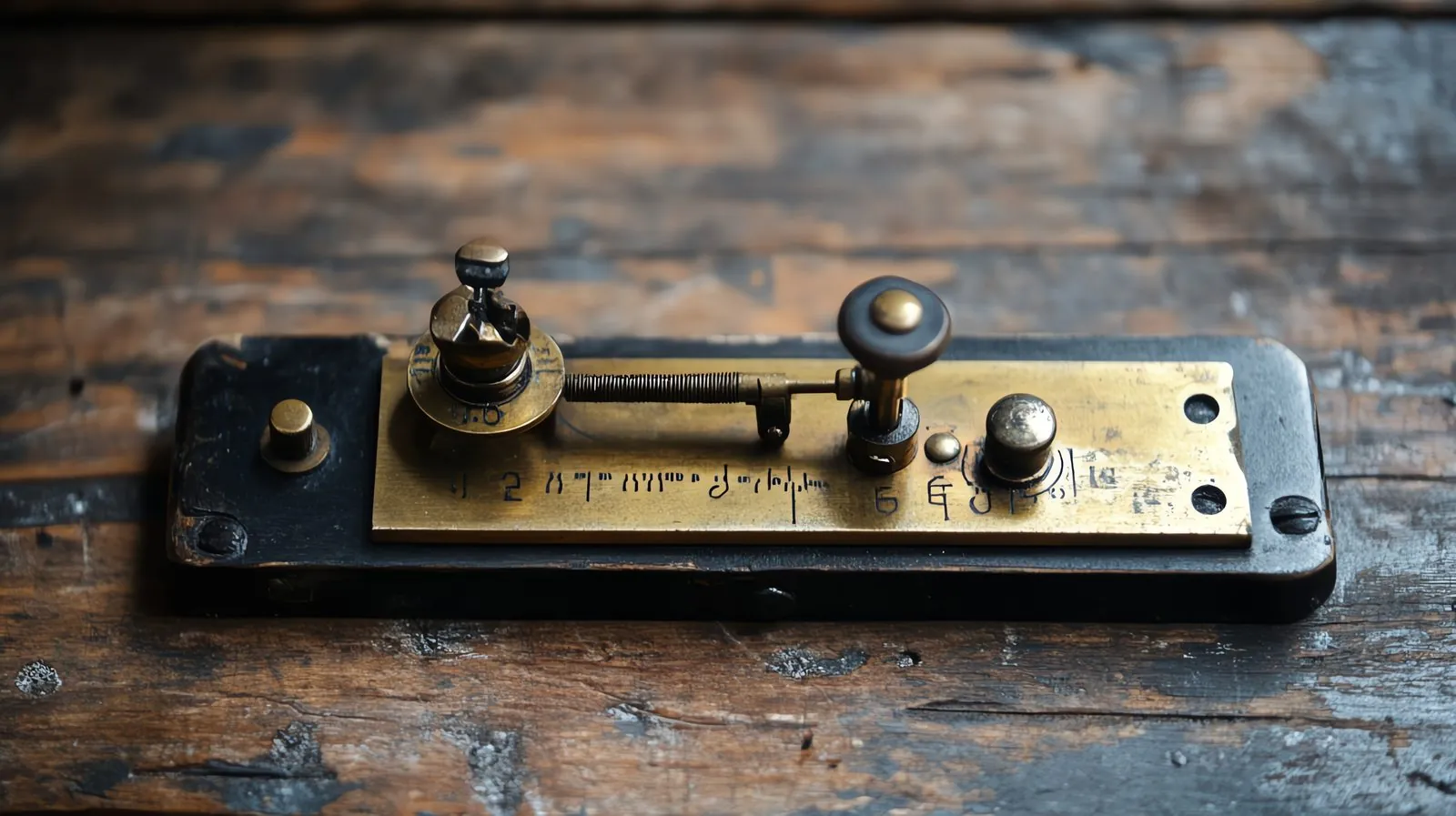
A brass telegraph key for sending Morse on a wooden tabletop
Leave your mark on the air Sign my guestbook — your callsign and a short “73”. Nice to see who’s been by. Guestbook →
Site map

All guides and tools

Everything on sq5cba.pl in one place: guides for beginners, exam cheat sheets, antenna calculators and live data.

Contact

Write to me

A question, a QSL card, a sked or just “heard you on the band” — feel free.

SQ5CBA · Warsaw

I’ll get back to you as soon as I’m off the air

I’m open to meeting new people — if you have a question about gear or repeaters, want to set up a sked or confirm a QSO, leave a message. I’ll reply to the email address you provide.