
Home / My gear
My gear
Radios I operate on the air as SQ5CBA — from all‑mode, multi‑band VHF/UHF/1.2 GHz with digital D‑STAR, through a beefy 2 m mobile, to handheld D‑STAR and C4FM. Five transceivers — three Yaesu and two Icoms — each for a different job. It all runs through a single antenna: Diamond X-200N on the chimney and 28 metres of HyperFlex 10 Sahara cable.
Five radios, five roles
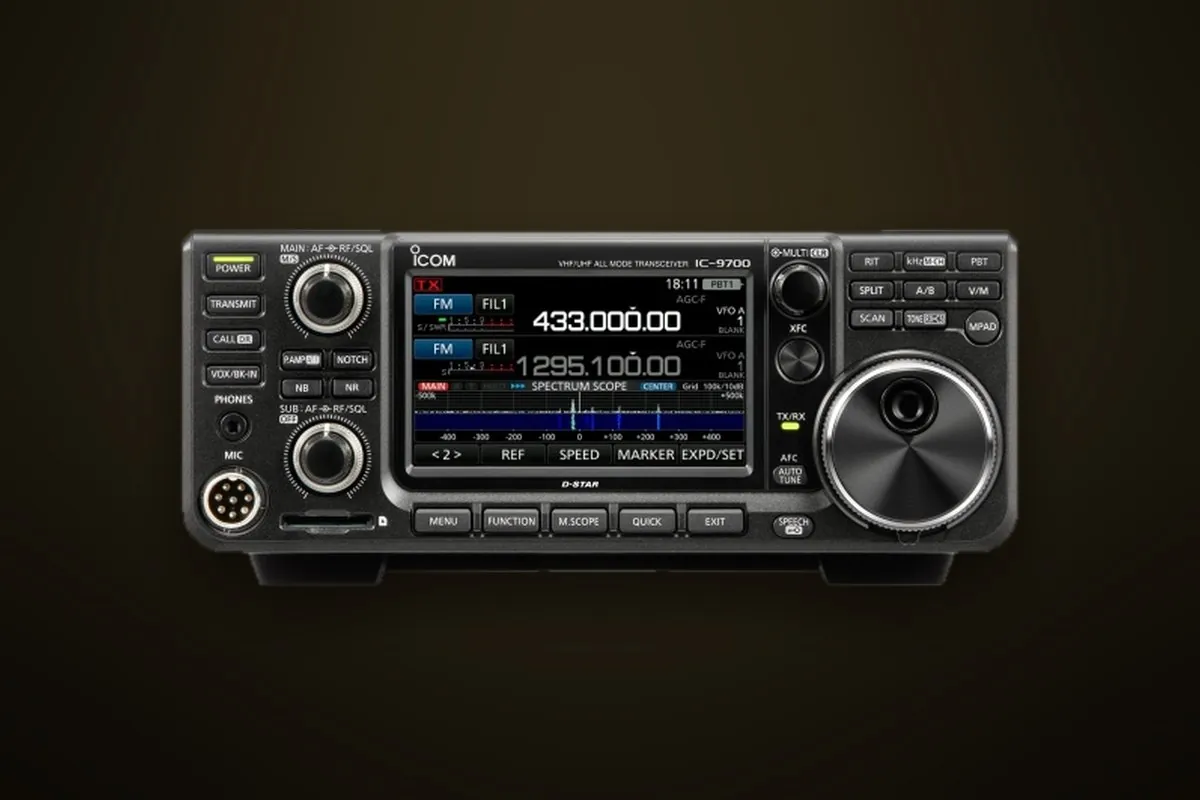
Icom IC-9700
Icom IC-9700 · 2019
An all‑mode, multi‑band transceiver for 2 m, 70 cm and 1.2 GHz with an SDR architecture (direct sampling on 144 and 430 MHz, down‑conversion on 1200 MHz). Output power 100 / 75 / 10 W, supports digital D‑STAR (DV), and the 4.3″ touch display shows a real‑time spectrum and waterfall — like on top‑end HF sets. It also has a full satellite mode (full‑duplex, normal/reverse tracking), so it’s my radio for QO‑100 and LEO satellites.
- Three bands: 144 MHz, 430 MHz and 1240–1300 MHz (23 cm)
- SDR with direct sampling (144/430 MHz) + live spectrum and waterfall
- All‑mode: SSB / CW / RTTY / AM / FM / D‑STAR (DV) plus DD data mode
- Full satellite operation — full‑duplex, 99 satellite memories
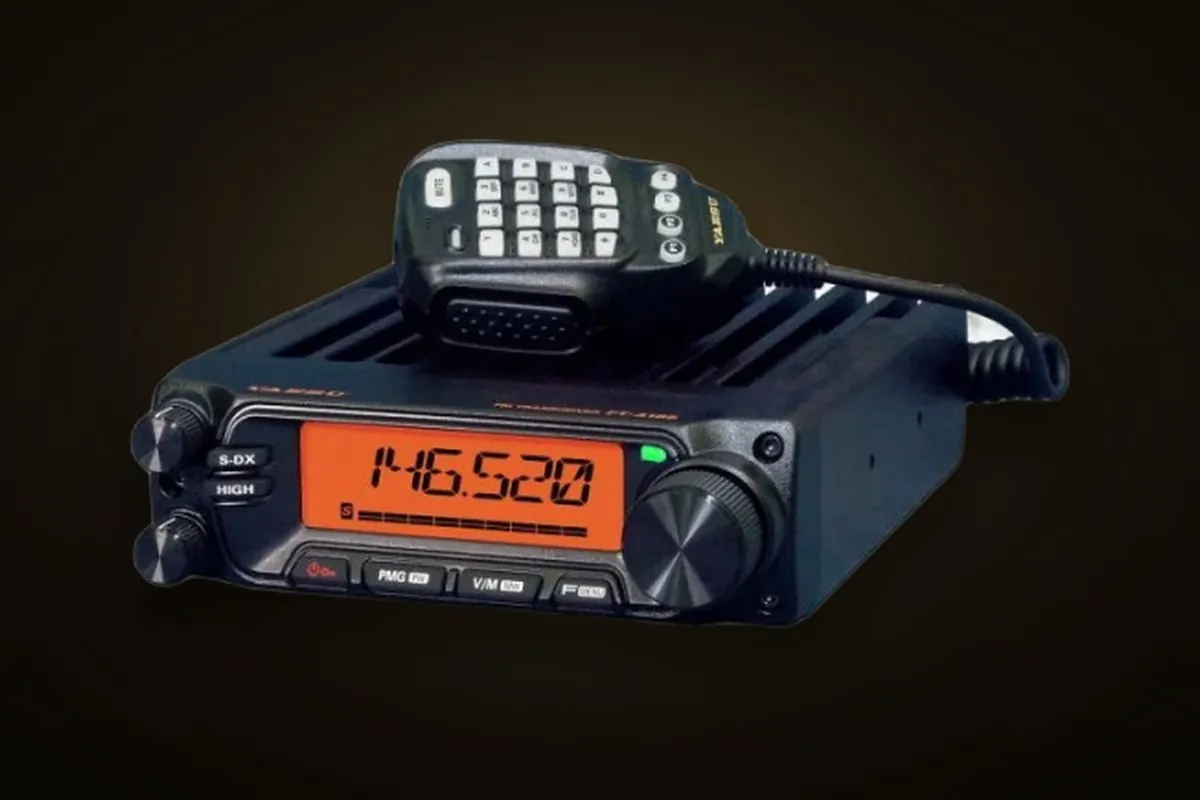
FT-3185E ASP
Yaesu FT-3185E ASP · 2024
A strong 2 m mobile — a single‑band FM transceiver with up to 85 W output (selectable 85/50/20/5 W). Passively cooled with a hefty heatsink, no fan, with Super‑DX and ASP (digital audio processing) to improve weak‑signal reception. Plus 221 memory channels, dual watch and a DTMF keypad mic.
- Transmit power up to 85 W (levels 85/50/20/5 W)
- Passive cooling with a chunky heatsink — no fan
- Super‑DX + ASP to improve weak‑signal reception
- 221 memory channels, dual watch, DTMF microphone
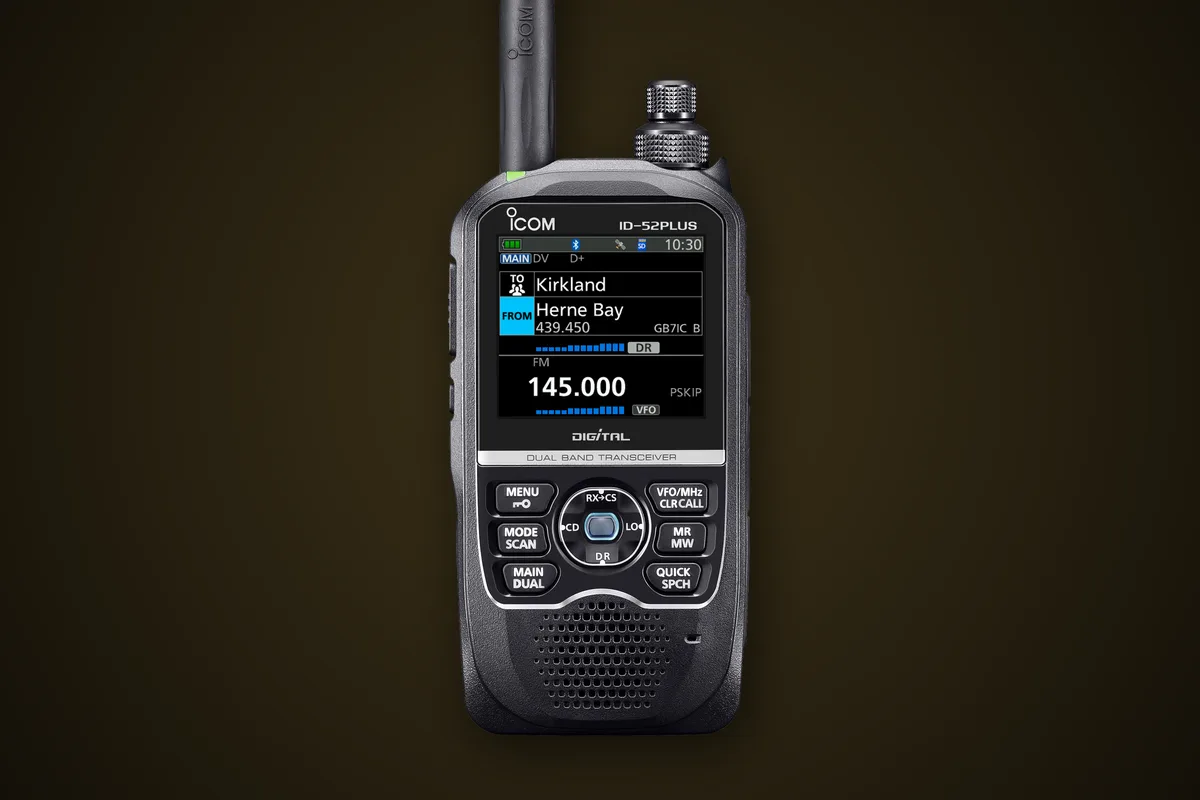
Icom ID-52E PLUS
Icom ID-52E PLUS · 2024
My flagship handheld and the only radio I take everywhere. A dual‑band 2 m / 70 cm transceiver, digital D-STAR and analogue FM, with power adjustable in five steps from 0.1 to 5 W. The large 2.3″ colour display (320 × 280 px) shows a band scope with waterfall — something you usually see on base radios rather than on a handheld. The receiver is wide (108–174 and 225–479 MHz), so I also listen to the airband and the FM broadcast band, and dualwatch V/V, U/U and V/U lets me monitor two frequencies at once. The PLUS version adds a new Bluetooth module (faster terminal/access point mode with a phone and faster photo transfer), terminal mode alongside simplex/repeater operation, and a USB‑C socket.
- 2.3″ colour screen 320 × 280 px with band scope and waterfall
- D‑STAR: DR mode, terminal / access point over Bluetooth, picture transfer
- Dualwatch V/V, U/U, V/U · receiver coverage 108–174 and 225–479 MHz (incl. airband)
- GPS/GLONASS with D‑PRS, microSD card up to 32 GB, USB‑C, IPX7 waterproofing
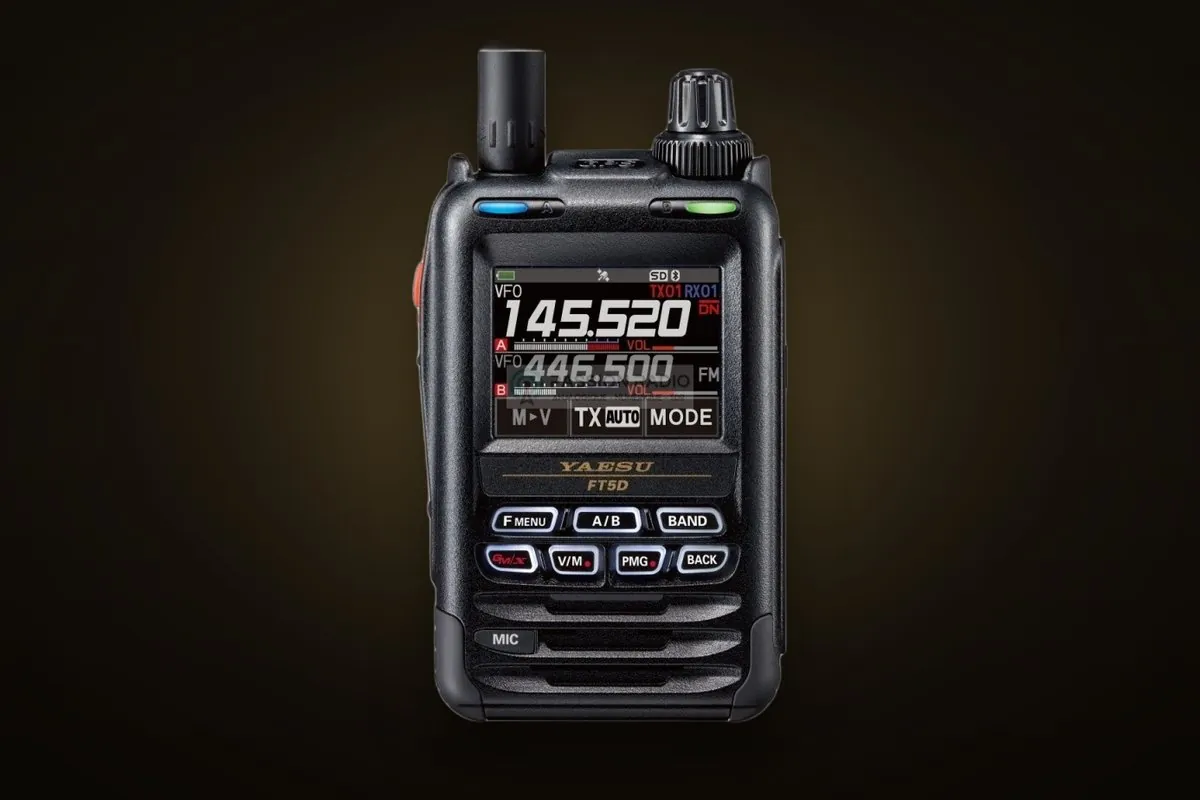
FT-5D
Yaesu FT-5D (FT-5DE) · 2021
My handheld for the Yaesu network — a dual‑band (2 m / 70 cm) C4FM (System Fusion) digital and analogue FM handheld at 5 W. Colour touch display, two independent receivers allowing you to monitor two frequencies at once, built‑in GPS and APRS, factory‑fit Bluetooth and IPX7 waterproofing.
- Colour TFT touch display
- Two independent receivers (true dual receive)
- Built‑in 66‑channel GPS + APRS 1200/9600 bps
- Factory‑fit Bluetooth, IPX7 waterproofing, 2200 mAh battery
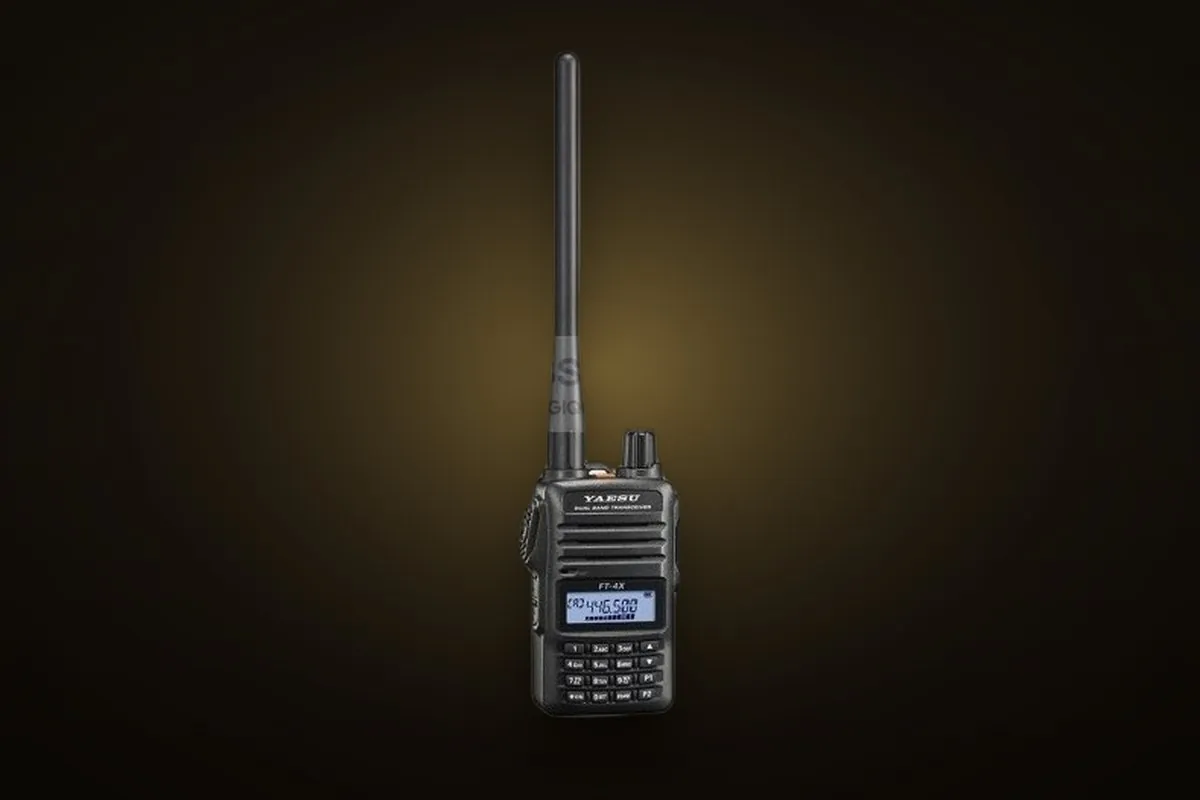
FT-4X
Yaesu FT-4XE · 2018
A compact, reliable daily handheld — dual‑band 2 m / 70 cm, FM, 5 W. Simple, rugged design, 200 memory channels, CTCSS/DCS and ARTS for repeater work, plus a built‑in FM broadcast receiver. Great to start with, to learn on, and as a dependable spare or field set.
- Dual‑band 2 m / 70 cm, power 5 / 2.5 / 0.5 W
- 200 memory channels and several scan modes
- CTCSS / DCS / ARTS for repeater work
- Li‑Ion battery 1750 mAh (~15 h), built‑in FM broadcast radio
Antenna and feedline
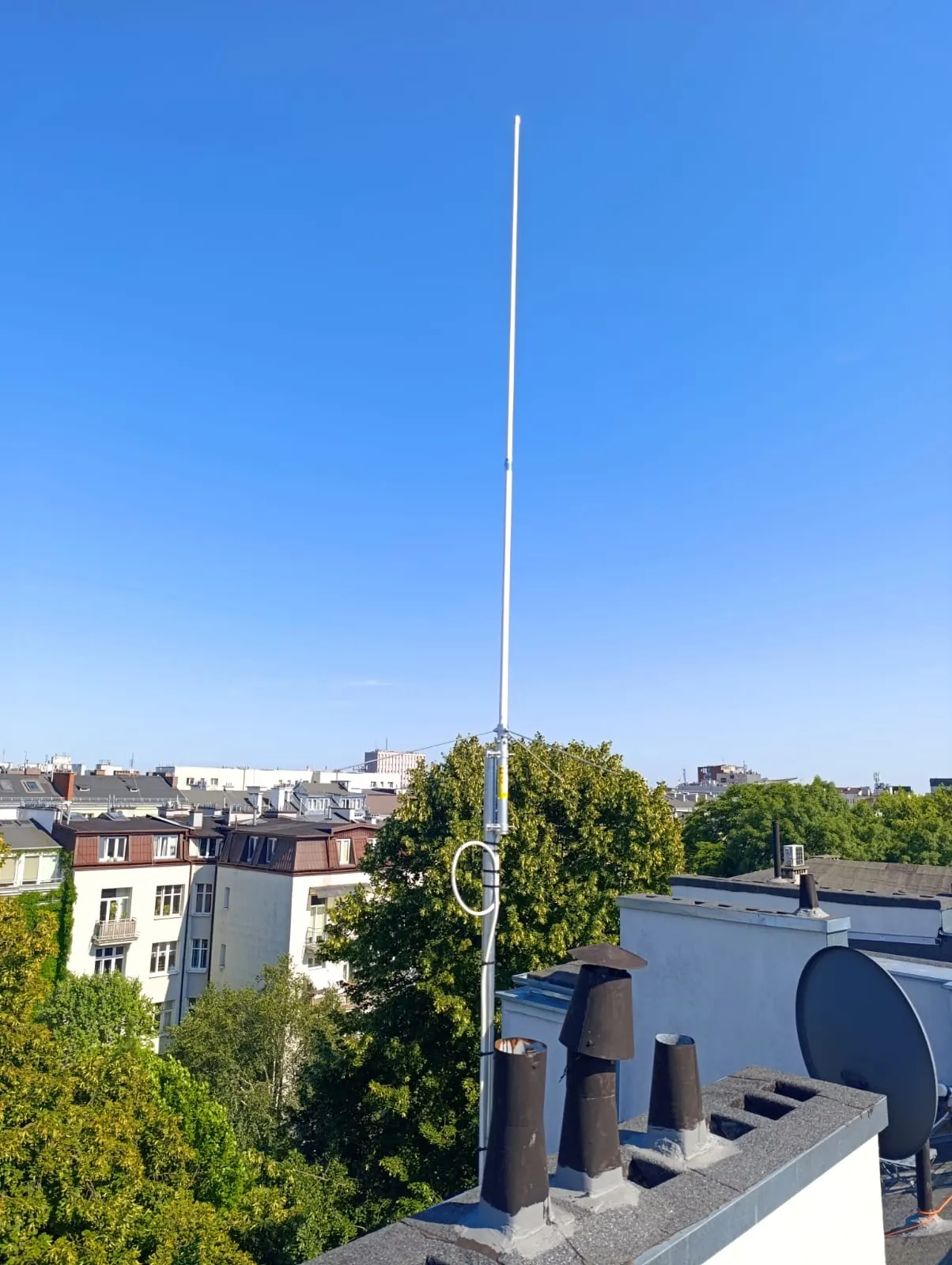
Diamond X-200N
Diamond X-200N · 144 / 430 MHz · 2.5 m
My local and portable work all hangs off this one mast. The X-200N is a classic among 2 m and 70 cm base antennas — a 2.5‑metre, dual‑band vertical, collinear: on 144 MHz it works as 2 × 5/8 λ, on 430 MHz as 4 × 5/8 λ. That gives 6.0 dBi on two metres and 8.0 dBi on seventy centimetres — the gain comes from a flattened radiation pattern: energy that a dipole would throw into the sky and the pavement is pushed here towards the horizon. Exactly where the repeaters and other stations are.
It stands on a tenement chimney, well above the ridge line and above the tree‑tops — as you can see in the photo, it has a clear horizon towards the city. With this kind of antenna it’s not so much the gain that matters as the mounting height: every metre up does more for VHF range than a decibel on paper. It withstands winds up to 50 m/s, has an N connector (not PL — lower loss and better sealed against water), and the radials at the base tune it independently of the mast.
- 2 m: 2 × 5/8 λ, 6.0 dBi · 70 cm: 4 × 5/8 λ, 8.0 dBi
- Length 2.5 m, weight approx. 1.2 kg, mast clamp 30–62 mm
- Power handling 200 W, impedance 50 Ω, N socket
- Wind resistance up to 50 m/s, counterpoise 0.52 m
Messi & Paoloni HyperFlex 10 Sahara FT8
Ø 10.3 mm · 50 Ω · v = 87% · white UV‑resistant jacket
From the radio’s socket to the base of the antenna runs 28 metres of cable — and on VHF and UHF that’s no longer “just a cable”. Over that length the cable, not the radio, decides the outcome of a QSO, so I laid one of the better coaxes on the market here: the Italian HyperFlex 10 in the Sahara FT8 variant. The name comes directly from that mode: FT8 — like RTTY or running an amplifier — is a continuous carrier with a full duty cycle. The cable heats up for the whole 15 seconds of transmitting, and the warmer it gets, the higher the loss. That’s why the manufacturer gave this version a white UV‑resistant jacket which, instead of absorbing the sun, reflects it. A black cable on a roof in July can be well over 40 °C; the white stays noticeably cooler and with it the loss stays as in the datasheet.
- Double screen — 216 strands of pure copper instead of copper‑clad aluminium
- Velocity factor 87% — among the best for this diameter
- Very flexible despite 10.3 mm — can be routed across the roof and through feed‑throughs
- Terminated with N sockets at the antenna end — weatherproofed with self‑amalgamating tape
For comparison: over the same 28 metres a plain RG‑58 would swallow more than 8 dB at 70 cm — out of 75 W only about 11 W would reach the antenna, so seven‑eighths of the power would go into heating the cable. Here I lose 2.4 dB, and the same on receive, which with weak signals from repeaters and satellites makes the difference between “you can sort of hear something” and a readable QSO. You can calculate what your cable loses in the cable calculator.
Have a look at the guide
How to get going on 2 m and 70 cm with this gear — repeaters, simplex, modes and your first QSO step by step.