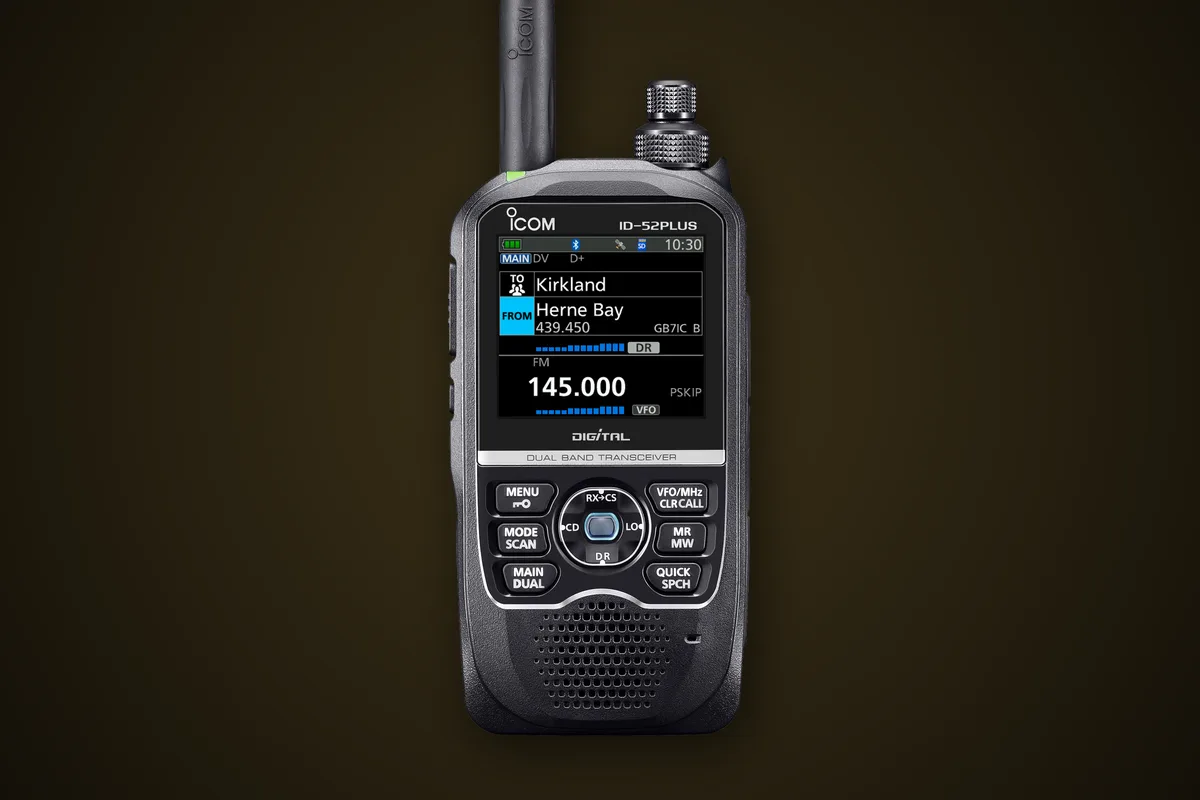
An amateur standard, not a corporate invention
D-STAR (Digital Smart Technologies for Amateur Radio) was developed in the early 2000s by the Japanese amateur radio association JARL — as an open specification for amateurs rather than an adaptation of a commercial system. The hardware is built mainly by Icom, with Kenwood joining along the way. It’s the oldest of the three digital standards you’ll find on repeaters today.
Technically: GMSK modulation, 4800 bit/s in a 12.5 kHz channel. That stream is split into two parts sent simultaneously:
- 3600 bit/s of voice — 2400 bit/s AMBE codec plus 1200 bit/s error correction
- 1200 bit/s of data — GPS position, short text, station description, header with your callsign
- DD mode — 128 kbit/s of pure data, but only on 23 cm (supported by e.g. the IC-9700)
The data rides alongside the voice throughout the transmission — which is why you see the caller’s callsign and QTH on the display before they finish their first sentence.