Home  /  Guide  /  QSL cards

Guide · confirming a QSO

QSL cards:
confirmation on paper

A QSL card confirms that an amateur radio contact took place. The IARU puts it like this: “A QSL is the final courtesy of a QSO”. In Poland, cards are exchanged through the PZK (the Polish Amateur Radio Union) QSL bureau, which primarily serves paid‑up members. Since 29.10.2025 the Central QSL Bureau has been in Czarnowo. On this page you can also design your own card in the generator.

9 × 14 cm PZK QSL bureau Czarnowo from 29.10.2025 IRC until 31.12.2026
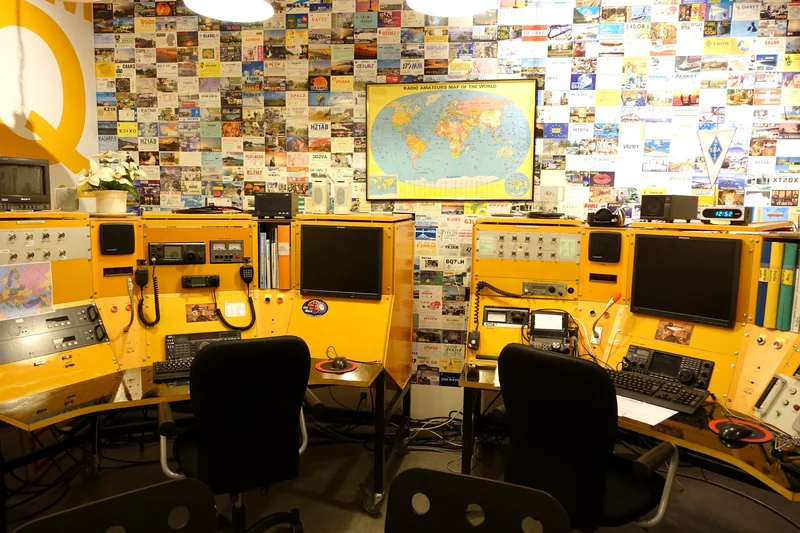
Two operating positions with transceivers and microphones; behind them, a wall completely covered with colourful QSL cards from around the world and an amateur radio map Amateur radio station at the Museum of Technology in Stockholm · Daderot, CC0, crop
What is it

QSL: I confirm receipt

The name comes from the Q code, used in telegraphy and amateur radio. QSL means “I confirm receipt”. QSL? asks whether you confirm receipt of the transmission.

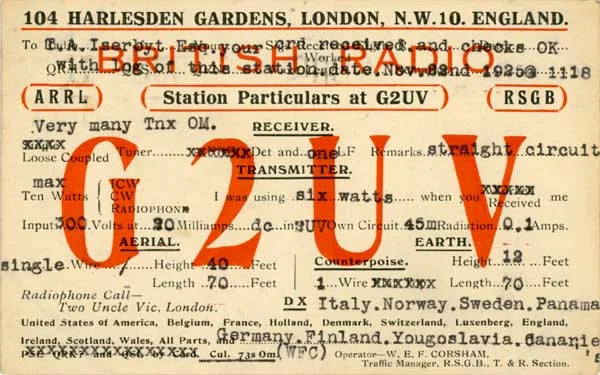
The earliest reference appears to be a card sent in 1916 from 8VX in Buffalo (New York) to 3TQ in Philadelphia. ITU prefixes weren’t used then. It’s thought that a card with the callsign, frequency and date was probably devised in 1919 by C. D. Hoffman, 8UX, in Akron, Ohio. In Europe, William “Bill” Corsham, 2UV, was probably the first to use a QSL card in 1922, operating from Harlesden in England. The source cited by Wikipedia says that in January 1922 Corsham produced a card regarded as the first in Europe, and perhaps in the world.

Collecting cards became popular among radio listeners in the 1920s and 1930s. According to the IARU, it started with postcards reporting long‑distance reception, when two‑way contacts over significant distances were relatively rare, and reports were valued as the best evidence of a station’s reach.

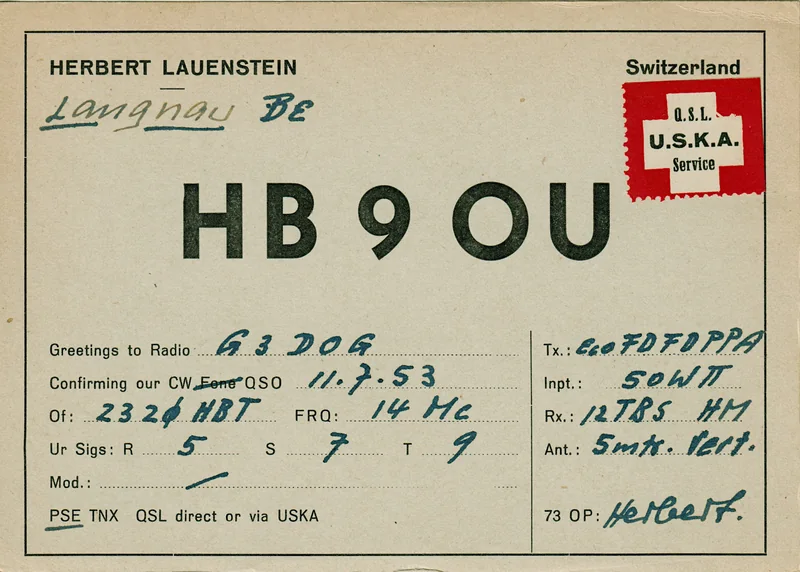
Swiss QSL card from HB9OU, 1953, filled in by hand: correspondent’s callsign G3DOG, date, time, 14 MHz band, RST 579 report, with a red USKA QSL bureau sticker HB9OU card for G3DOG from 11.07.1953 · Herbert Lauenstein (HB9OU), public domain, crop

What to put on the card: requirements and recommendations

  • callsigns of both stations: yours and the correspondent’s (ARRL DXCC, Rule 4, and the RSGB)
  • date and time in UTC
  • band or frequency
  • mode
  • RS or RST report
  • for DXCC credit also the name of the DXCC entity, for example Poland
  • operator’s name and handwritten signature: these are on the Polish list from the magazine “DX” 2/1991; the ARRL and RSGB do not require them
  • wording confirming a two‑way contact: the same Polish list
  • addressee’s callsign clearly on the reverse (IARU Region 1 recommendation, Scheveningen 1972)
  • bottom margin at least 15 mm, with only the addressee’s callsign and no other printing (IARU Region 1, 1987)
  • for Polish special‑event, contest and SO‑prefix stations: also the QSL manager’s callsign (PZK rules 2023)
  • the word via when indicating a manager, for example J8LP via K3LP (UBA recommendation)

No crossing‑out

For DXCC you submit the confirmation exactly as you received it. Rule 12 says that altered, forged or otherwise invalid cards can result in disqualification and loss of DXCC membership privileges. The ARRL advises returning a card with an error to the DX station and asking for a new one, rather than risking rejection due to a correction. Don’t cross anything out. A mistake means a new card.

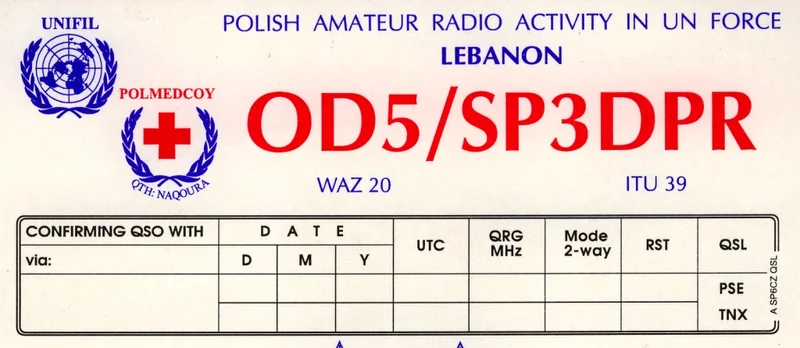
Blank Polish QSL card of station SP3DPR from a UN mission in Lebanon, with fields for QSO details Polish SP3DPR card (mission in Lebanon), upper part · card design: Lubicz, CC BY 2.5
A hand holding a pen writes on a sheet of paper lying on a table
Fill in the card by hand, neatly and legibly – especially the correspondent’s callsign · Helloquence (Unsplash), CC0
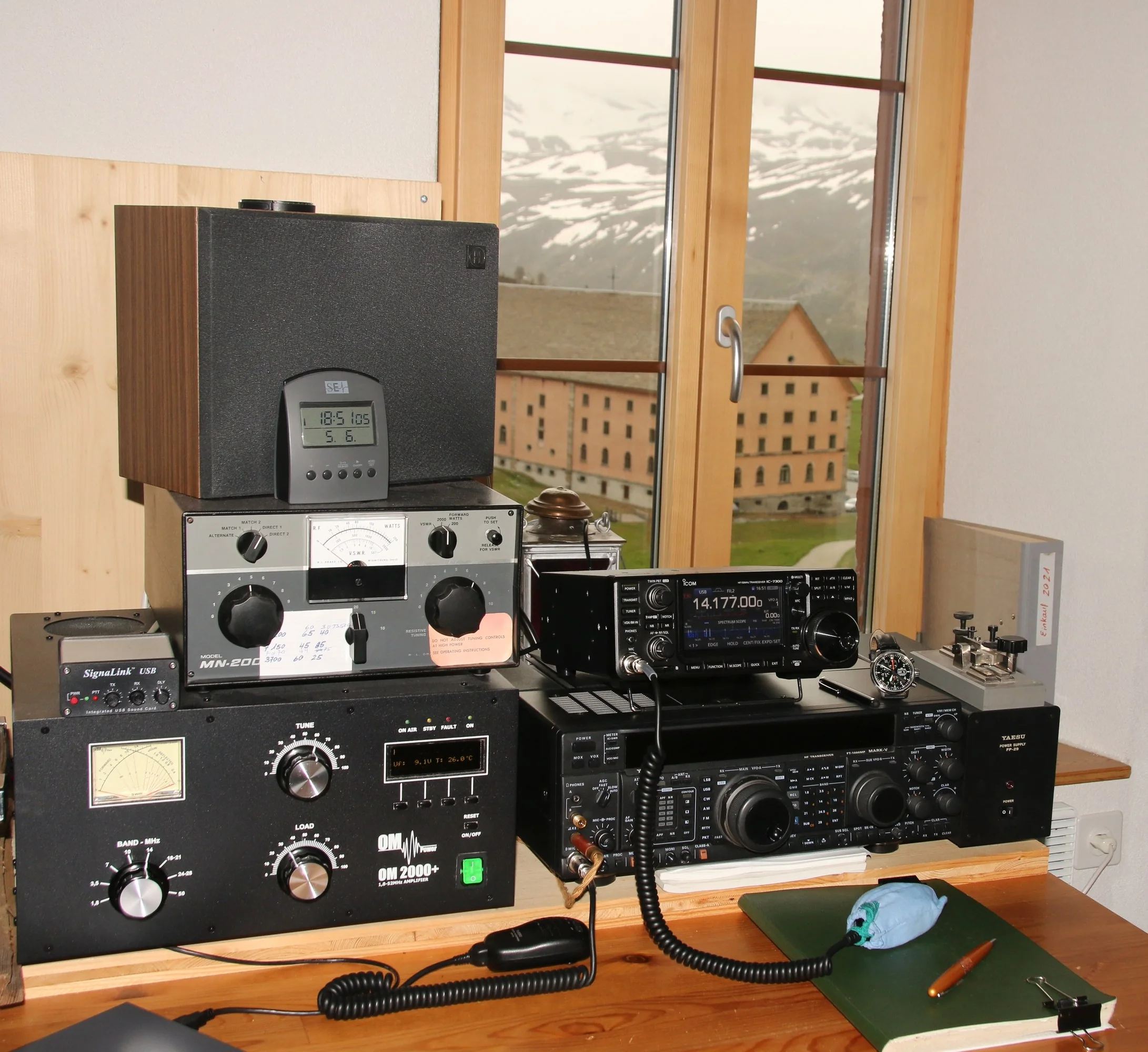
Ham station by a window with a mountain view: Icom IC-7300 and Yaesu FT-1000MP Mark-V transceivers, an amplifier, a Morse key, and on the desk a green logbook with a pen
Even with modern gear, a paper log and a pen are still on the desk · photo: Hp.Baumeler, CC BY-SA 4.0
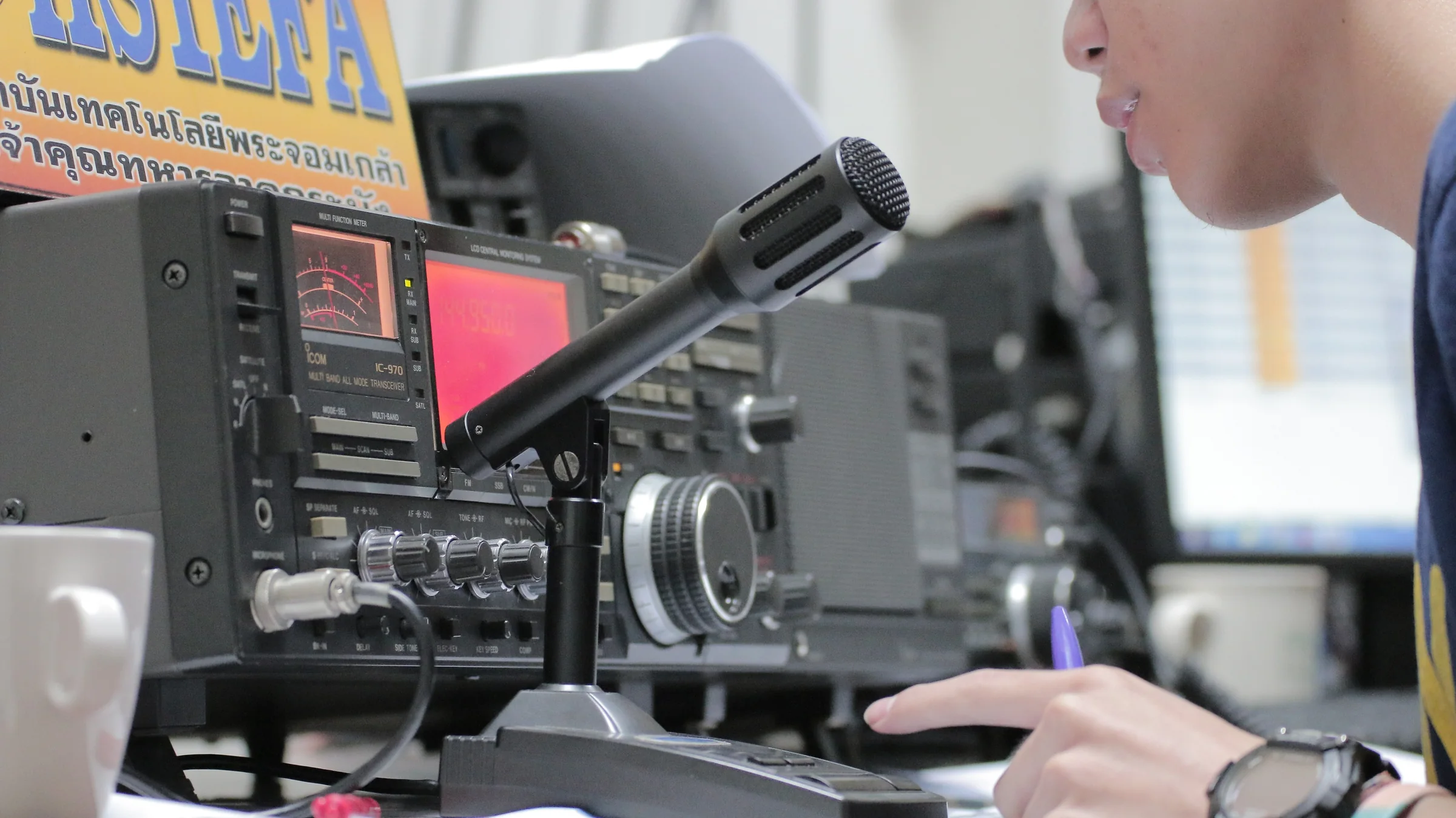
A radio amateur speaks into a desk microphone in front of an Icom IC-970 transceiver, holding a pen to log the contact
Voice QSO at the KMITL Radio Amateur Club (Bangkok) – pen in hand, as every QSO goes into the log · photo: Adirach Toumlamoon, CC BY-SA 4.0
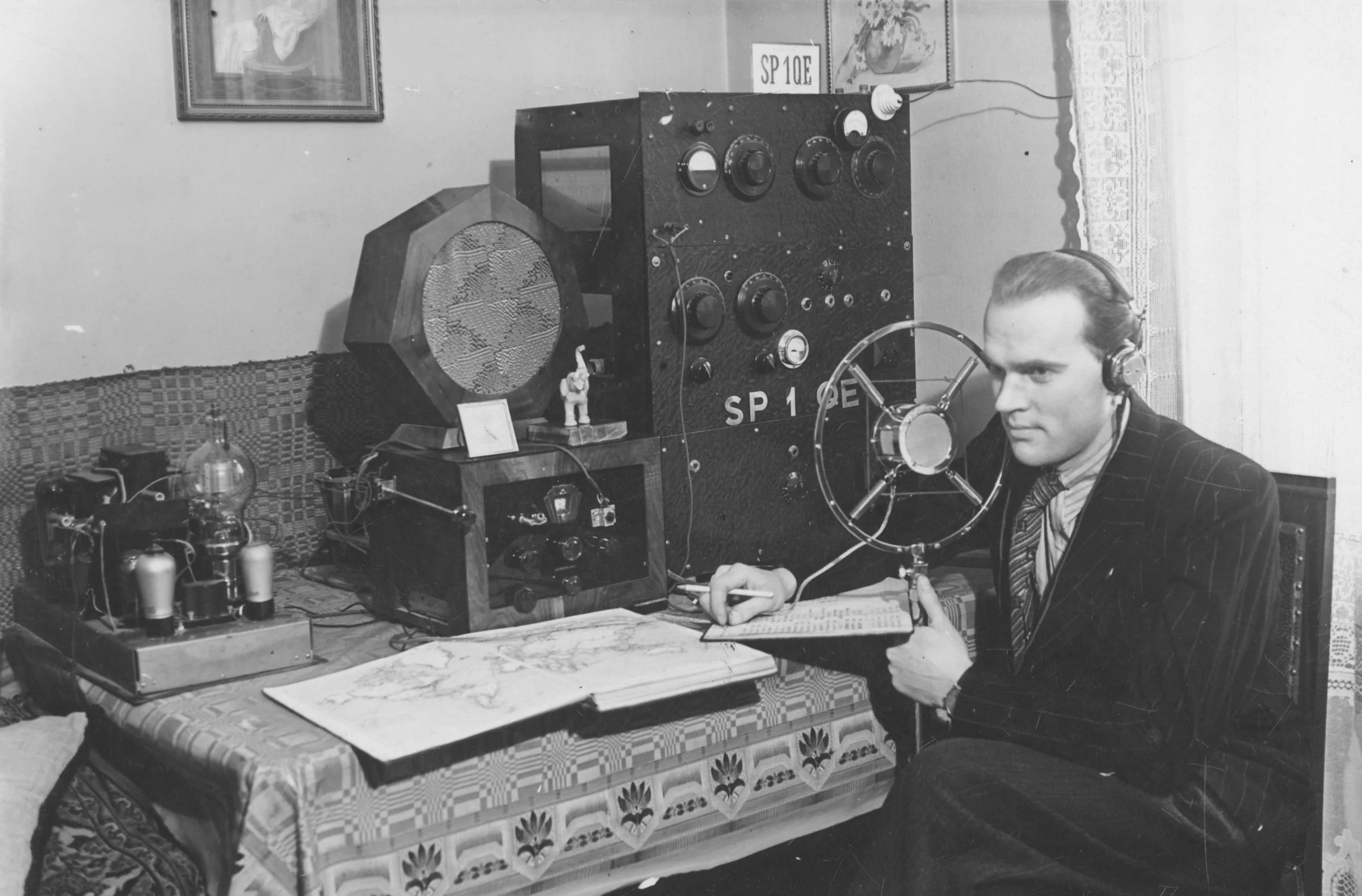
Black-and-white photo from 1939: Michał Wysokiński SP1QE wearing headphones at a valve transmitter with ‘SP1QE’ on it and a framed microphone, writing in the logbook with a pencil, with an open atlas beside him
Michał Wysokiński, SP1QE, at his station in 1939 – pencil, logbook and atlas at hand · NAC, CC0
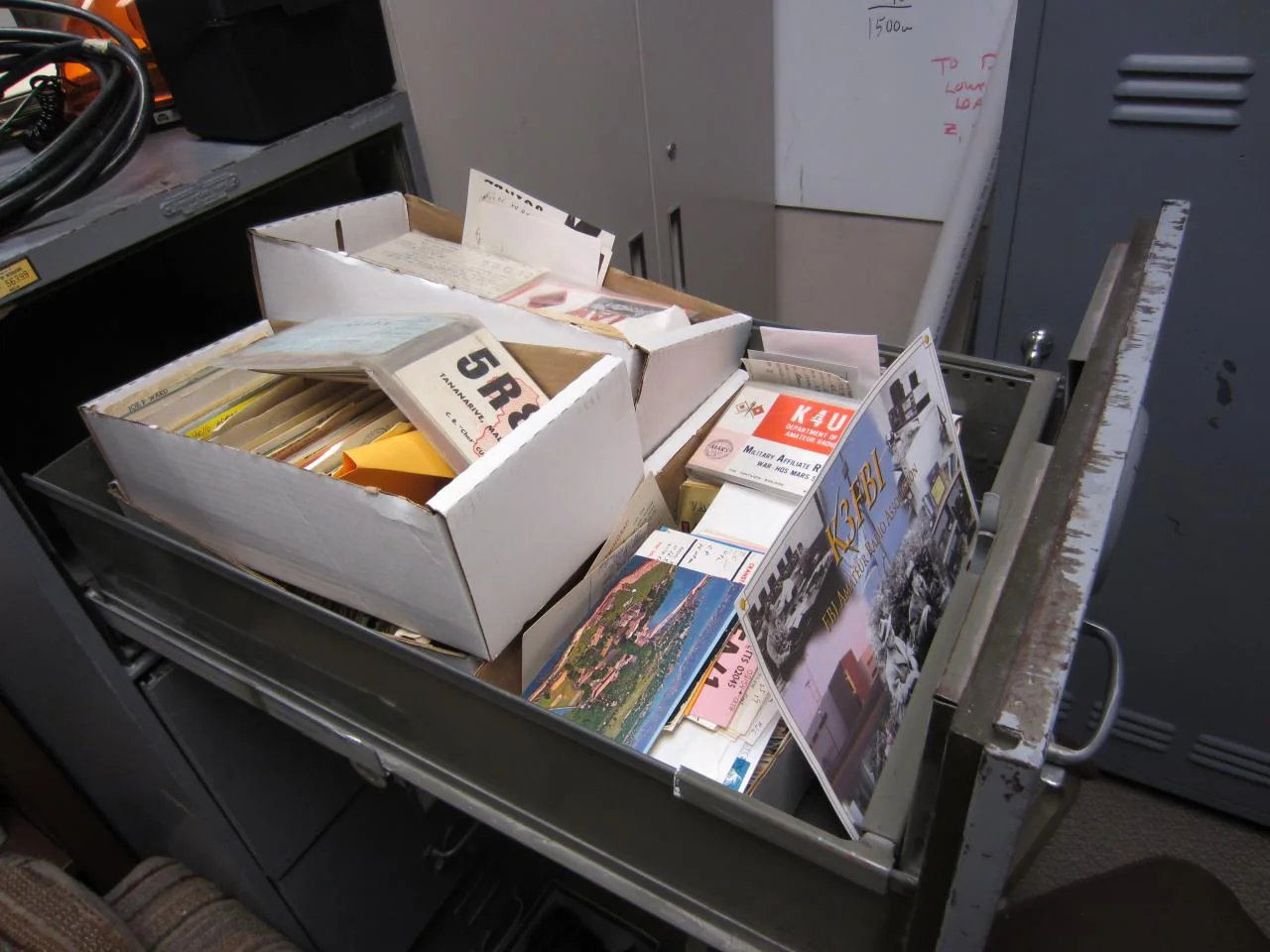
Two operating positions with transceivers and microphones; behind them, a wall completely covered with colourful QSL cards from around the world and an amateur radio map
QSL card collection since 1940 · photo: Sterling Coffey, CC BY 2.0
QSL card of station G2UV from 1925: large 2UV callsign, reception report for an SWL
G2UV card from 1925, one of the first stations in Europe to send cards · public domain
Generator

Design your card

In the generator you fill in the fields, preview the front and back, then download a PNG. It helps you design your own card for printing at 9 × 14 cm.


The card is rendered in your browser and isn’t sent anywhere. The file is 1400 × 900 pixels (10 px per millimetre): print at 140 × 90 mm, without fitting to the page. The bottom strip of the back remains blank apart from the addressee’s callsign, in line with the IARU Region 1 recommendation.

Front and back · bottom strip of the back (≥ 15 mm) contains only the addressee’s callsign
PZK QSL bureau

How a card travels through the bureau

A QSL bureau is a bulk exchange of cards between the bureaus of IARU member societies. In Poland this exchange is organised by the PZK.

Flow of QSL cards through the PZK bureau Sending: you hand in sorted cards at the QSL bureau of your PZK Regional Branch. From there they go to the PZK Central QSL Bureau in Czarnowo, which sends them to the QSL bureaus of foreign societies, and those on to correspondents. Incoming cards return the same way in the opposite direction, via the district and branch bureaus. Branches send cards once they have gathered at least a kilogram, no less often than once a quarter, so the cycle takes months. outgoingincoming cards yousorted cardsby prefixes;for SP by call districts Branch bureauYour BranchPZK Regional Branch Central QSL BureauPZKul. Owsiana 687‑134 Czarnowo Bureau abroadorganisationIARU member society Statione.g. DL, G, JA Stationsends the cardthrough its bureau Bureau abroadin bulk to PZK Central QSL Bureauonce a weekto districts when≥ 1 kg is collected District and branchdistrict bureau,then branch bureau youcollect in personor by post The bureau is available, among others, to PZK members with their dues paid. District bureaus keep foreign cards for stations not on the lists for at least 8 months.

← swipe sideways →

Flow diagram shows the path of a card from a member through the branch bureau to the Central QSL Bureau, and then to the bureau of another IARU organisation. Incoming cards return from the Central Bureau via the district bureau to the branch.

The QSL handling regulations for PZK members were adopted by PZK Main Board (ZG PZK) resolution no. 705/01/23 on 21 May 2023. The bureau may be used by honorary members and by ordinary and extraordinary members with their current dues paid. Added to this are clubs registered for handling in the given contribution period by the relevant OT and DX stations of Polish QSL managers, for a fee equal to the ordinary member’s dues for each such station. PZK carries out domestic exchange between members and foreign exchange between PZK members and members of other IARU organisations.

Annual rates for 2026 follow PZK Main Board resolution no. 718/01/24 of 23 March 2024. An ordinary member pays 160 PLN, from age 71 120 PLN, up to 20 years old or a student up to 26 years old 40 PLN. An SWL, as an extraordinary member, pays 40 PLN. To these amounts you add the branch fee, set separately by each OT. 1st half‑year payable by 15 January 2026, 2nd half‑year by 15 July 2026. Failure to pay on time ends membership on the day following the deadline.

The structure includes the Central QSL Bureau, district QSL bureaus, branch QSL bureaus and field QSL managers. Branch bureaus operate under the supervision of OT boards. The OT board sets the place and access times, recommended at least once a month. Branch bureaus are funded by the branch. The Central Bureau and district bureaus are funded by PZK from central funds.

Foreign cards for stations not in the current PZK lists are kept by the district QSL manager for at least 8 months. Payment of arrears and the current fee within this time means the cards are forwarded to the proper branch. Undeliverable foreign cards are not returned. Domestic cards to stations not on the lists go back in the next dispatch, stamped ZWROT. ARRL lists Poland among countries that deliver cards only to members of the national society.

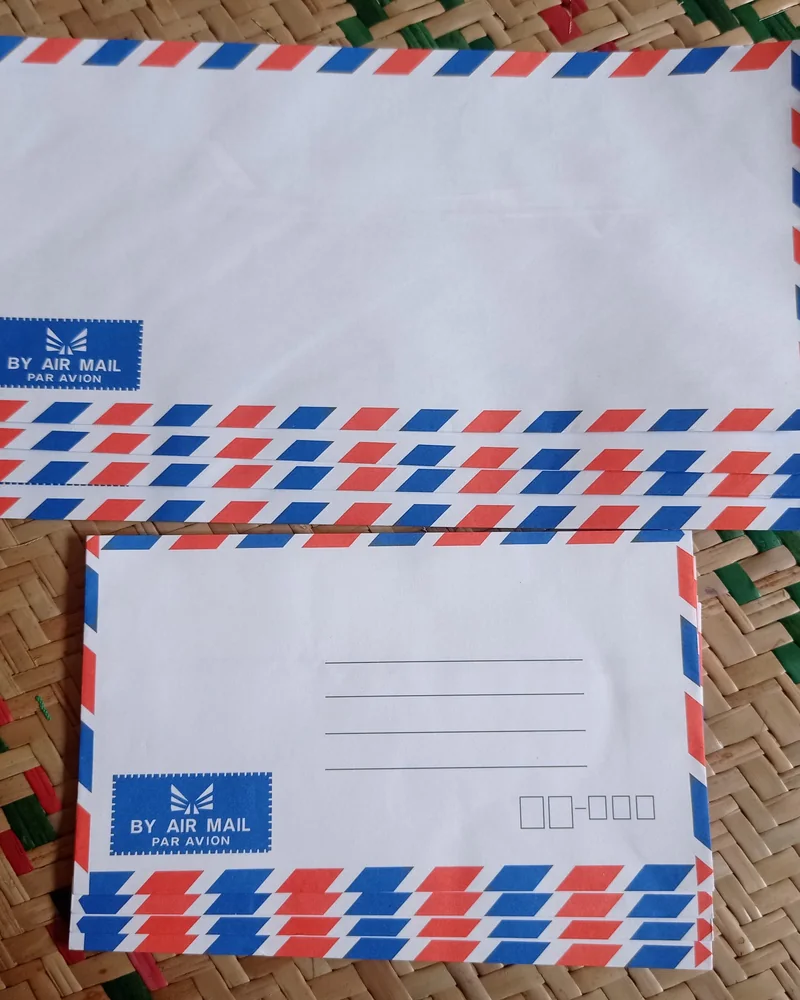
Two stacks of empty airmail envelopes with red–white–blue edging and a ‘By Air Mail’ sticker on a woven mat Airmail envelopes · SarKaLay (စာကလေး), CC0, crop

Posting step by step

  • Sort foreign cards alphabetically by QSL bureaus (prefixes), as in the PZK rules. OT73 points to the IARU bureaus list for sorting. Sort cards for SP by district.
  • The rules recommend the recipient’s OT number on cards for Polish stations. You take the number from the ‘Callsigns by districts’ list: pzk.org.pl/osec_pzk_sp.txt.
  • Submit your cards at your OT’s QSL bureau. The normal route is via the branch QSL manager, not straight to the Central Bureau.
  • OT37, the Warsaw and suburban branch, accepts cards sorted by country, and for SP by district. On cards for SP you give the district number and the OT number. Drop‑off and collection at the OT37 bureau are free of charge. Postage for letter or parcel dispatch is paid by the member.
  • From 29.10.2025 the sole address of the Central QSL Bureau is PZK QSL Bureau, ul. Owsiana 6, 87‑134 Czarnowo (as given by the IARU bureaus list of 27.07.2026). Skipping the branch, you may send sorted cards there only by arrangement with the head of the Central QSL Bureau.
  • Do not send cards to the PZK registered office address, ul. Augustyna Kordeckiego 66 U1, 04-355 Warsaw. That address is for paper correspondence excluding QSL cards. Do not use the old addresses in Bydgoszcz: Al. Wojska Polskiego 65A pok. 204, 85-825 Bydgoszcz, nor PO BOX 54, 85-613 Bydgoszcz 13.

Collecting cards

The Central Bureau forwards cards to districts once a week, when at least 1 kg has accumulated. At the branch you collect them in person or by post, in the manner and on dates agreed with the OT board. Since 1.12.2014 OT37 has a postal dispatch for members with PZK and branch dues paid. OT73 sends cards by ordinary post to the home address.

At OT73, cards arrive from the SP5 district bureau 2 to 4 times a year, and outgoing ones on average 1 to 4 times a year. With those timings the turnaround is measured in months. SWLs are advised to place, in a visible spot, a card with the number of the branch that serves them. Opening hours are set by each branch, so the simplest is to ask your branch QSL manager.

Format

Dimensions and weight of the card

QSL card dimensions according to IARU Region 1 A card sent via the bureaus should be between 8 by 13.5 cm and 10.5 by 15 cm, the preferred size is 9 by 14 cm, and the weight no more than 4 grams. On the reverse, a bottom margin of at least 15 millimetres is recommended, with the addressee’s callsign only and no other print. at most 10.5 × 15 cm 9 × 14 cmpreferred size at least 8 × 13.5 cm SP0ABC ← ≥ 15 mm: addressee’s callsign only weightat most 4 g format in PZKdomestic cards 9 × 14 cm only on the reverseaddressee’s callsign clearly, no crossings‑out mistakebetter a new card than a corrected one Scale: 3 pixels per millimetre. Source: IARU Region 1 HF Manager’s Handbook v9, PZK QSL rules 2023, DXCC rule 12.

← swipe sideways →

Card size: IARU Region 1 recommends a range from 8 × 13.5 cm to 10.5 × 15 cm, and 9 × 14 cm is the preferred size, not the maximum. PZK permits only 9 × 14 cm for domestic exchange, since Q2 2002. On weight the sources differ: IARU Region 1 states not more than 4 g per card, RSGB and DARC in 2026 a maximum of 3 g.
Outside the bureau

Direct, OQRS and electronic confirmations

Direct and IRC

Direct posting goes straight to the correspondent or the QSL manager, with a self‑addressed envelope (SAE) and funds for postage. The IARU Region 1 code requires a manager to reply direct within a reasonable time if the letter includes a return envelope and funds for the exact return cost. If the enclosed funds cover airmail, the manager should return the card by airmail. It is not permitted to demand more IRCs or ‘green stamps’ than needed for that cost. IARU understands ‘green stamps’ as US dollar banknotes.

On 17.09.2025 the UPU countries at the Dubai congress decided to withdraw IRCs as of 31.12.2026. Until that date coupons remain valid. Whether Poczta Polska sells IRCs and at what price is unconfirmed. OQRS is an online request for confirmation; according to the DXLab Wiki description Club Log accepts such requests: via the bureau at no charge, or direct with PayPal payment. In PZK notices some stations give OQRS and LoTW, and some no longer issue paper cards.

LoTW, eQSL, QRZ

LoTW is an ARRL database: you upload a digitally signed log, and confirmation appears when both stations’ records match. There is no picture card there. eQSL and QRZ allow you to exchange a QSL as a JPEG or GIF image. DXCC accepts paper cards and LoTW. eQSL, even printed, are not accepted. In the general rules of PZK awards you compare your list with QSL cards or with LoTW. eQSL are not accepted. I have described QRZ Logbook separately in the guide QRZ Logbook: two entries, one QSO.

Awards

A QSL card is sometimes needed for an award. DXCC, the ARRL award, is earned for confirmed contacts with 100 entities on the DXCC list, either with paper QSL cards or via LoTW. The PZK (the Polish Amateur Radio Union) “POLSKA” award counts contacts from 1.01.1999; the match between your list and the QSL cards is confirmed by the signatures of two licensed operators, not necessarily PZK members. The general PZK award rules accept QSL cards or LoTW, but not eQSL. The fee is 10 PLN for PZK members and 20 PLN for stations that are not members.

I show my special event awards, for example for a contact with HF50SPK, in the Awards section on the home page.

Countries without a QSL bureau

The IARU list of QSL bureaux of 27.07.2026 marks 26 entries as CLOSED, including Egypt (SU), Morocco (CN) and the Vatican (HV). Singapore (9V) closed its bureau on 14.02.2025 and no longer accepts cards. For such stations you are left with direct, electronic confirmation or, if the station has a QSL manager in another country, the QSL bureau that serves that manager. IARU Resolution 18‑1, from 1.01.2019, encourages societies to run bureaux as long as it is economically justified, and operators to use confirmations that reduce unwanted cards, including electronic ones.

Sources

Where do these rules come from

  1. PZK: QSL handling rules for PZK members (PZK Main Board resolution no. 705/01/23 of 21.05.2023) · pzk.org.pl
  2. PZK: notices 39/2025 and 01/2026 (Central QSL Bureau address) · komunikat.pzk.org.pl
  3. PZK: list of callsigns by call districts · pzk.org.pl
  4. PZK OT37: QSL bureau · ot37.pzk.org.pl
  5. PZK OT73: QSL handling in the virtual branch · ot73.pzk.org.pl
  6. IARU: list of QSL bureaux (27.07.2026) and bureau descriptions · www.iaru.org
  7. IARU Region 1 HF Manager’s Handbook v9 (recommendations for QSL cards) · www.iaru-r1.org
  8. ARRL: DXCC rules (rules 2, 4 and 12) and FAQ · www.arrl.org
  9. RSGB: preparing cards for the bureau · rsgb.org
  10. UBA: recommendations for QSL cards · www.uba.be
  11. UPU: withdrawal of IRC coupons (17.09.2025) · www.upu.int
  12. Wikipedia: QSL card (history) · pl.wikipedia.org

In October 2026 the pzk.org.pl website was being modernised, so I quote the rules from an archived copy. Before posting, check with your branch whether the rules have changed.

Next step

Fill in your first card

You can lay out the card in the generator, and after paying the membership fee hand the printout in at your OT bureau. I wrote about confirmations in QRZ Logbook at /qrz-logbook.html.