
Philately
I collect postage stamps with an amateur radio theme: Morse keys, antennas, transmitting valves and callsigns from far‑off islands. It’s a natural blend of two passions, because a QSL card travels by post too, with a stamp stuck on it. Below I describe each issue in turn, from the oldest.
Five countries, one radio
50 years of radio in the Falklands
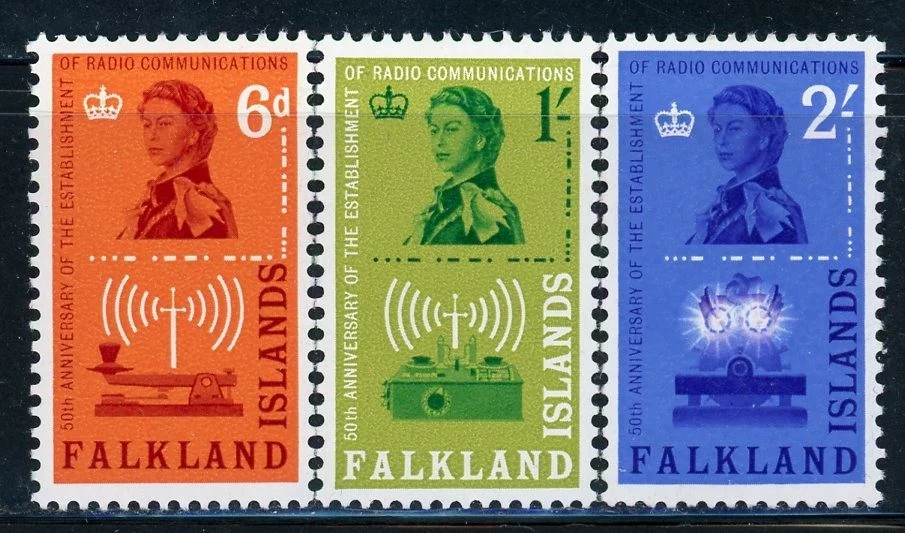
Set of 3 stamps · 6 d, 1 s, 2 s
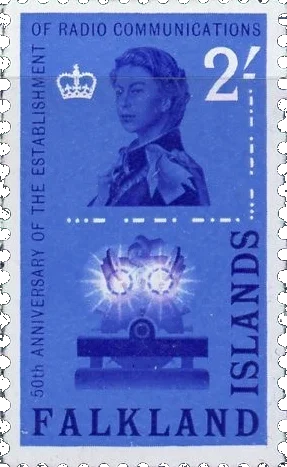
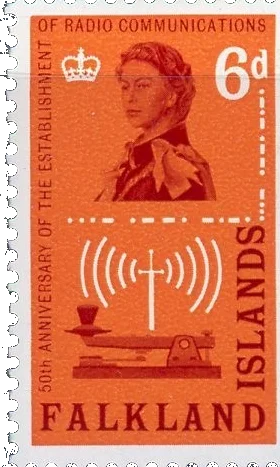
A set for the 50th anniversary of radio communication in the Falklands. In 1912, on the ridge at the eastern end of Murray Heights, a few kilometres from Stanley, a Marconi radiotelegraph station was erected. The place is still called Wireless Ridge. The first contact was made on 23 September 1912 with the ship HMS Active at anchor in Montevideo, and the station was officially opened the next day. For islands where messages had previously taken weeks by ship, this meant an instant link to the world. Two years later, in December 1914, Admiral von Spee sailed to the Falklands in part to destroy that station.
- 6 d, orange: a Morse key under an antenna radiating waves
- 1 s, olive: a radiotelegraph set under the same antenna
- 2 s, blue: the transmitter’s glowing valves
- Each bears a portrait of the young Queen Elizabeth II and a crown
Source: bought from a seller in Canada (Calgary, Alberta)
Amateur radio club from Djibouti
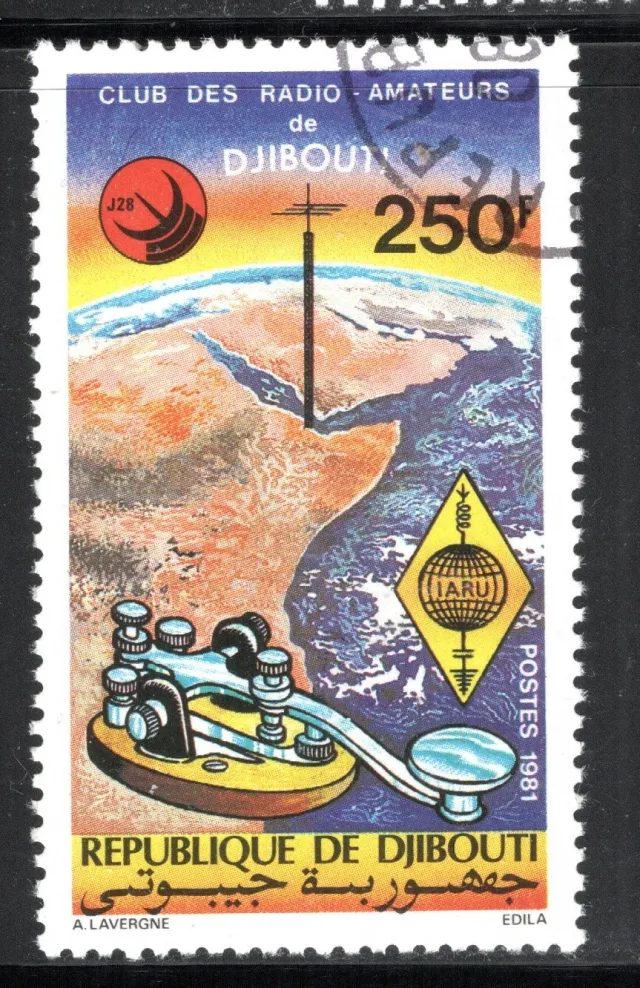
1 stamp · 250 F
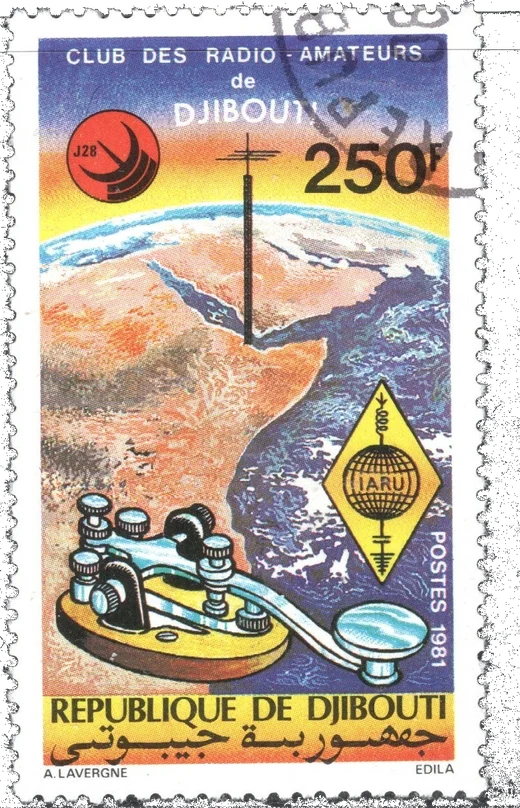
Stamp dedicated to Djibouti’s amateur radio club, Club des Radio‑Amateurs de Djibouti. Against a view of the Horn of Africa from orbit, at the mouth of the Red Sea, stands a mast with a Yagi beam antenna, and in the foreground a classic Morse key. On the right, the diamond of the IARU (the International Amateur Radio Union); on the left, the club’s red emblem with the prefix J28.
- J28 has been Djibouti’s prefix since independence on 27 June 1977; earlier, stations operated as FL8
- The first radio amateur with Djiboutian citizenship was J28AA, previously FL8HM
- CTO: a cancel applied at the post office to the sheet; the stamp did not pass through the post
- Signatures on the bottom margin: designer A. Lavergne and the Edila printing house
Source: bought from a seller in the USA (Cape Coral, Florida)
From 5VX to 4S7RS
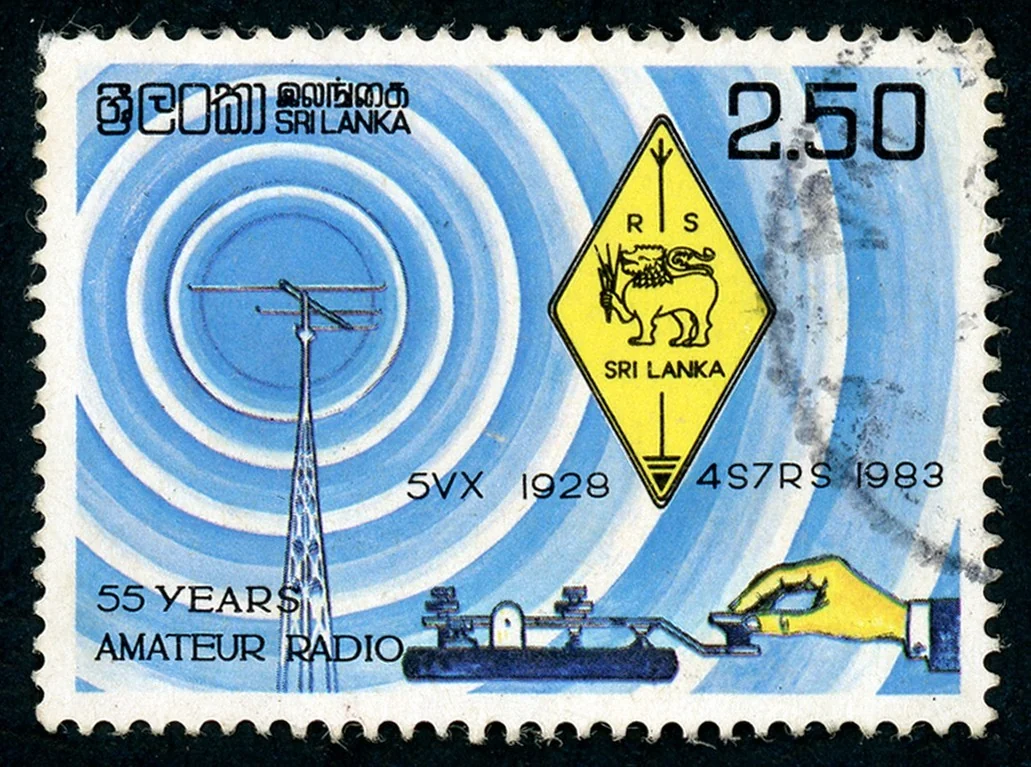
1 stamp · 2.50 rupees
A stamp for 55 years of amateur radio on the island, counted from 1928. The official name of the issue is 55th Anniversary of Amateur Radio Society. Against a light blue background a Yagi antenna on a lattice mast, concentric waves around it, and in the foreground a hand on a Morse key. In the middle, the society’s yellow diamond with the letters RS and a lion with a sword, as on the national flag. Below it two callsigns with dates: 5VX 1928 and 4S7RS 1983, the beginning and the jubilee.
- The inscription “55 YEARS AMATEUR RADIO” counts the years from 1928, and the callsign 5VX is written without the country prefix
- After the war, transmitting licences in Ceylon were issued from 1946, with the prefix VS7
- On 21 August 1949 radio amateurs gathered for the first hamfest at the shortwave transmitting station of Radio Ceylon in Ekala, and in July 1950 the Radio Society of Ceylon was founded
- In 1952 the VS7 prefix was replaced by 4S7, and since 1974 the society has been called the Radio Society of Sri Lanka
- The country name in three languages: Sinhala, Tamil and English
From: bought from a seller in Australia (Sydney, New South Wales)
Jamboree with radio
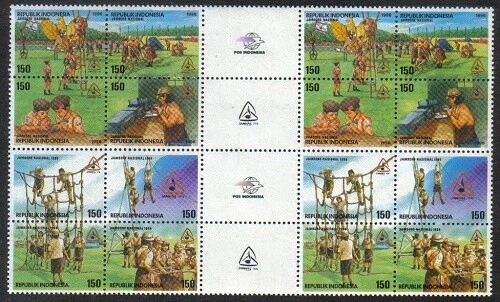
Block of 16 stamps with a gutter · 8 designs at 150 Rp
Issue for the 6th Jambore Nasional, the national jamboree of Indonesian scouts (Gerakan Pramuka) in Cibubur near Jakarta, from 26 June to 4 July 1996. The stamps were issued on the opening day. Eight scenes of camp life: rope climbing, ladders and a slide, building structures, riding a unicycle, soldering and, most important to me, a girl scout at the radio.
- Radio is a fixture of scouting: every October there is Jamboree on the Air (JOTA), in which scouts worldwide make contacts via amateur radio stations
- My copy is a centre-of-sheet block: two complete sets separated by a margin strip (gutter)
- On the strip, the Pos Indonesia logo and the jamboree emblem
Source: bought from a seller in the USA (Buffalo, New York)
VR6: radio at the end of the world
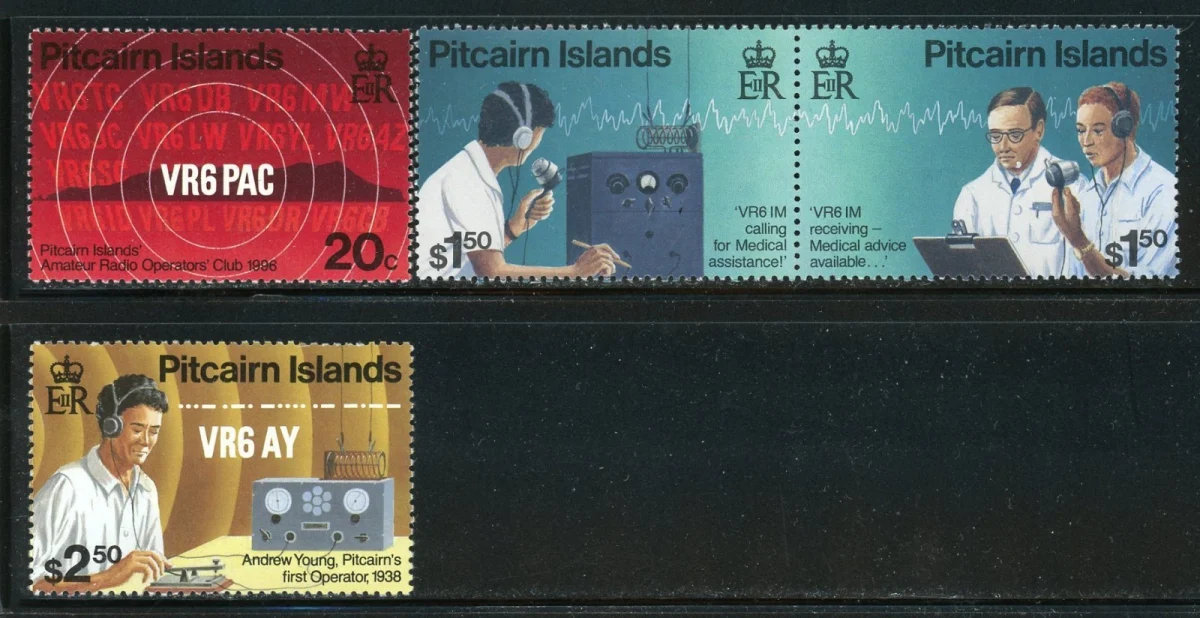
Set of 4 stamps · 20 c, pair 2 × 1.50 $, 2.50 $
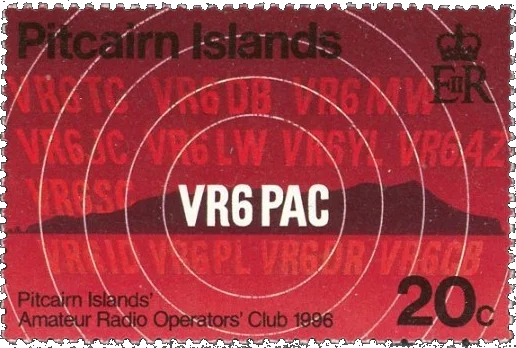
Pitcairn is a tiny Pacific island settled by the descendants of the HMS Bounty mutineers. With no airstrip and no resident doctor, for decades it was linked to the world really only by radio. The 1996 set tells that story across four stamps.
- 20 c: club callsign VR6PAC of the Pitcairn Islands’ Amateur Radio Operators’ Club, against the island’s outline and the residents’ VR6 callsigns
- Pair $1.50: “VR6IM calling for Medical assistance!” and “VR6IM receiving: Medical advice available…”, that is, calling a doctor by radio and receiving advice from the other side of the ocean
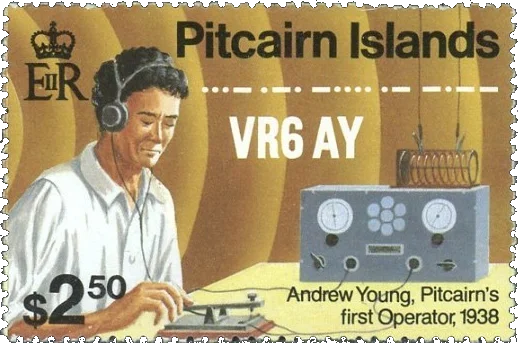
- $2.50: Andrew Young, VR6AY, “Pitcairn’s first Operator, 1938”, at a Morse key
Andrew Clarence David Young (1899–1988) took up radio in 1921 and operated the island’s first receiver. In 1938 a transmitter was installed here, and the station went on the air as VR6AY, whose suffix was the operator’s initials. In 1940 Young was also the island’s Chief Magistrate. Today Pitcairn uses the prefix VP6, and a QSO with it is still a dream for many DX chasers.
Source: bought from a seller in Canada (Calgary, Alberta)
QSL cards
The other postal trace of amateur radio: how to send and collect cards confirming QSOs.