
Home  /  News  /  Field telephones

Field test · 7 November 2026

Field telephones: talking with no signal

No network, no transmitter and no coverage. All you need is two telephones, a pair of wires and a crank. Out in a clearing in Puszcza Kozienicka Piotr SP5MOR set up his field telephones: the American EE-8-B from the Second World War and the Czechoslovak TP-25 from the 1950s. Marian SQ4MN and I volunteered for the tests. Below: how it works, an animated line diagram and archival photos of field telephones from the fronts of the Second World War.

Filip SQ5CBA — portrait
Filip SQ5CBAtext and photos · equipment: Piotr SP5MOR
EE-8-B · USA TP-25 · ČSSR two-wire line 0 W from the mains
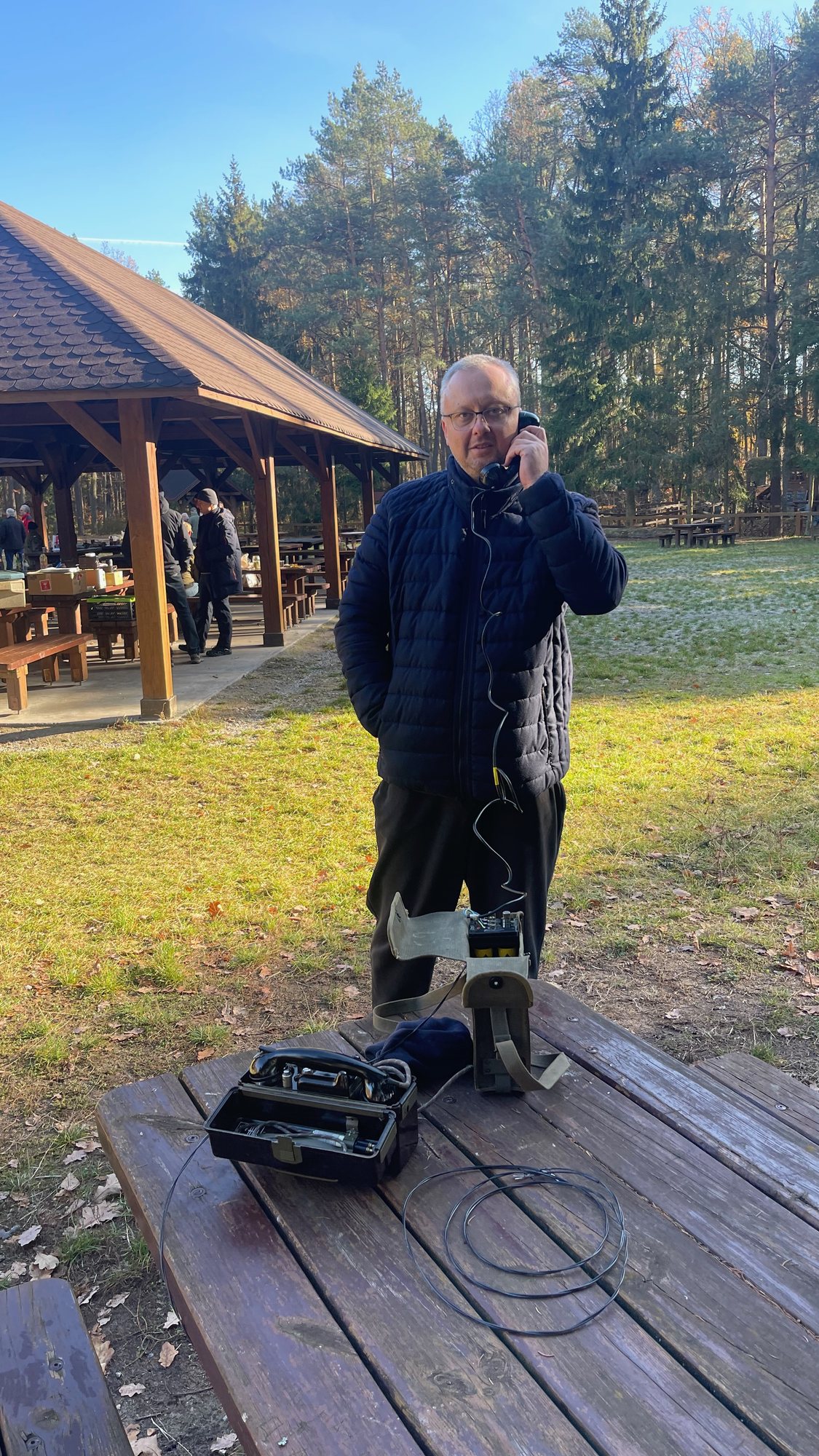
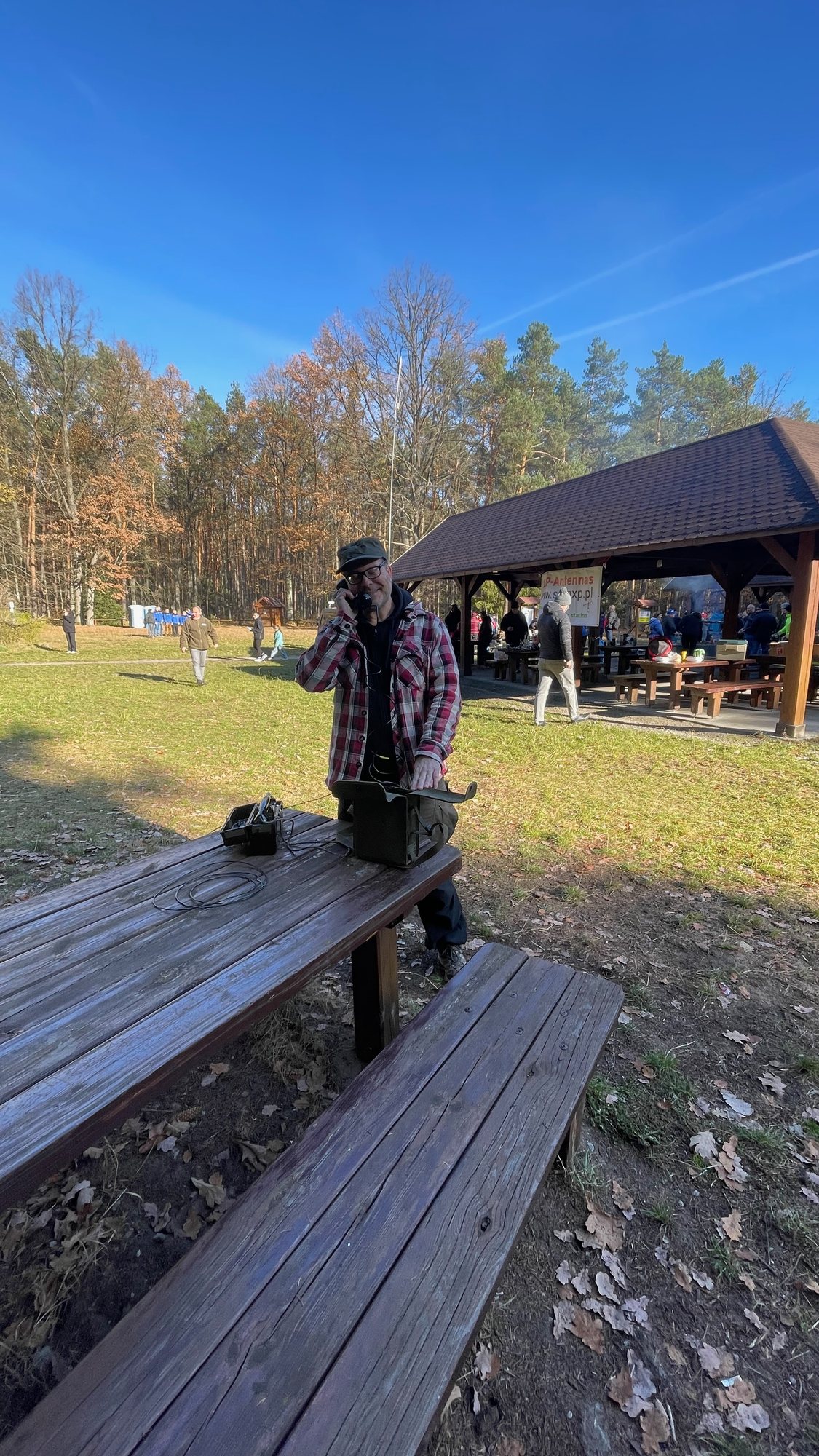
11:58 · SP5MOR at the EE-8-B, hand on the crank
16Hzringing current from the EE-8 magneto at 1000 rpm
100Vmagneto open-circuit voltage (TM 11-333)
3Vtwo 1.5 V cells power the EE-8 microphone
18kmEE-8 range on W-110-B cable (11 miles, according to the manual)
In the clearing

America calls Czechoslovakia

Two sets from two armies and two eras, one pair of wires. Times from EXIF data.

A table, two telephones, a thin cable

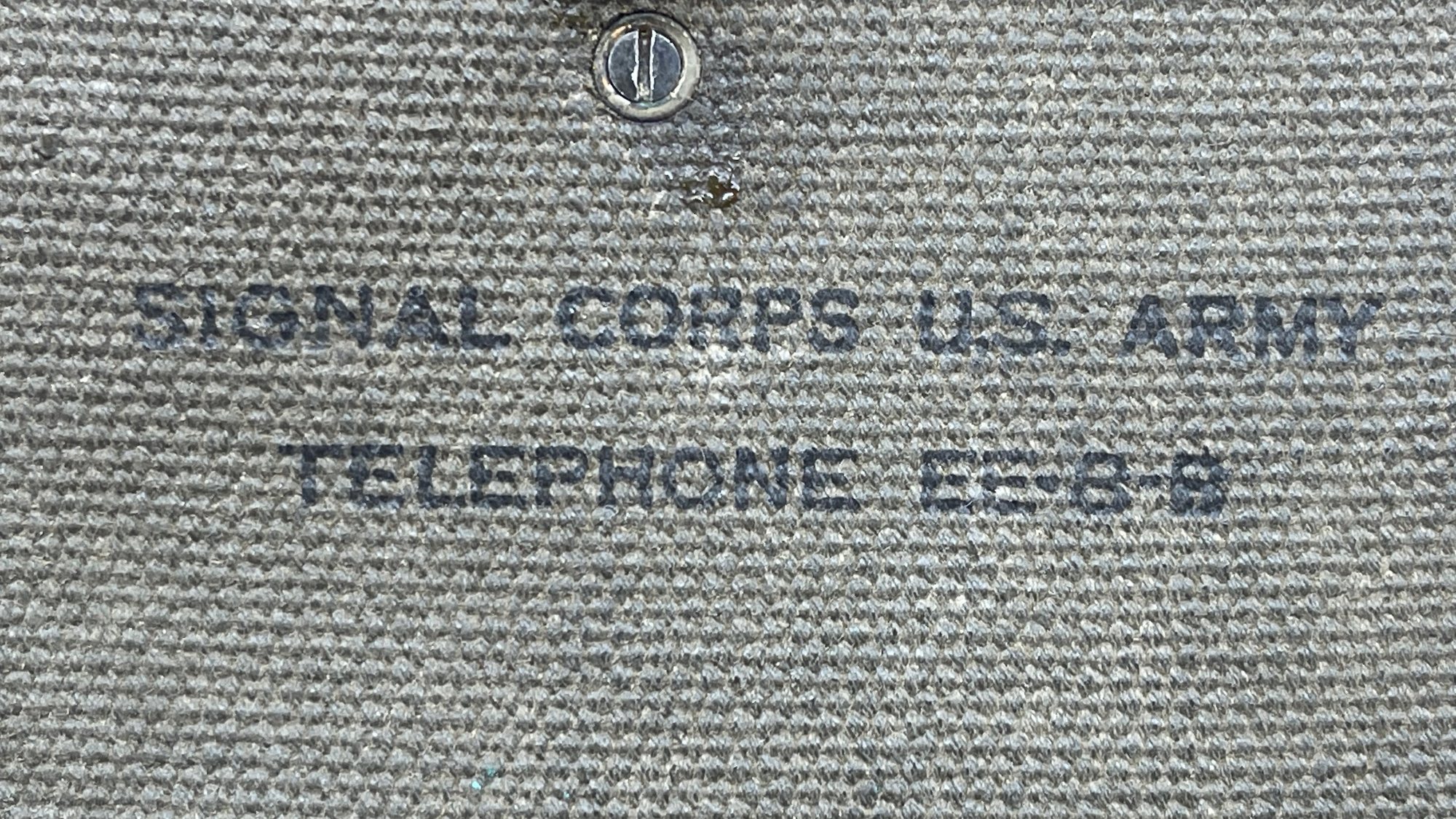
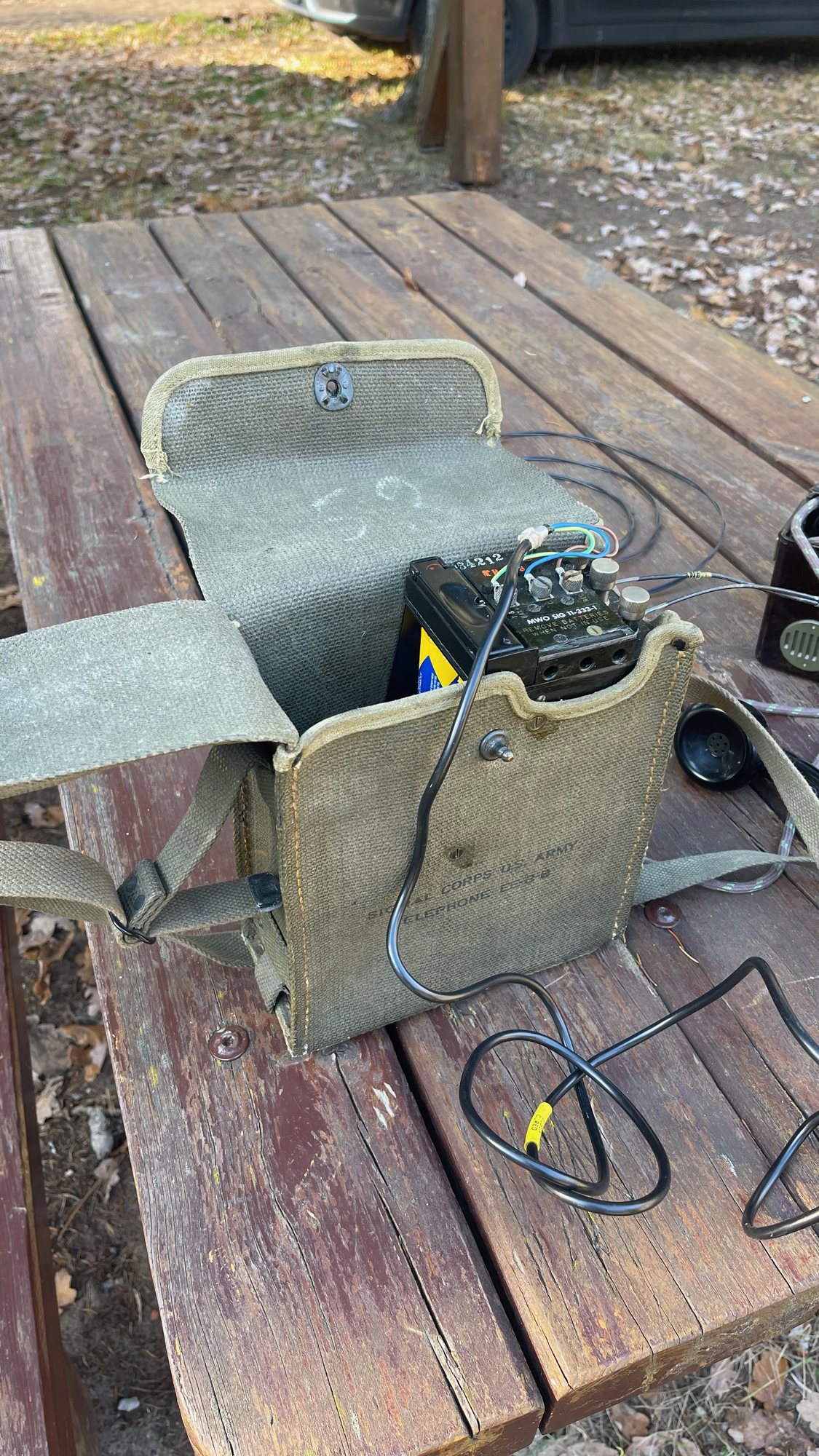
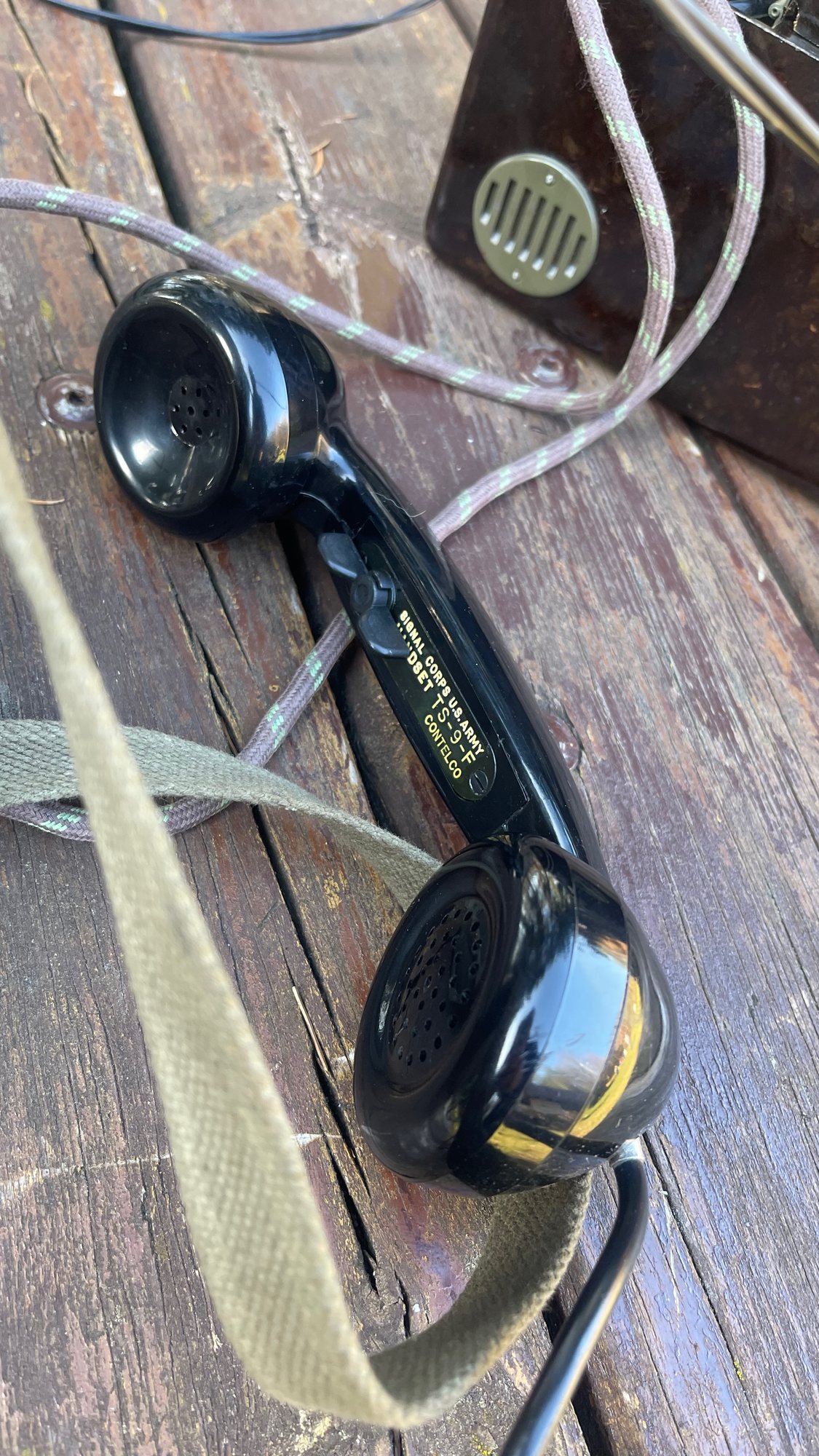
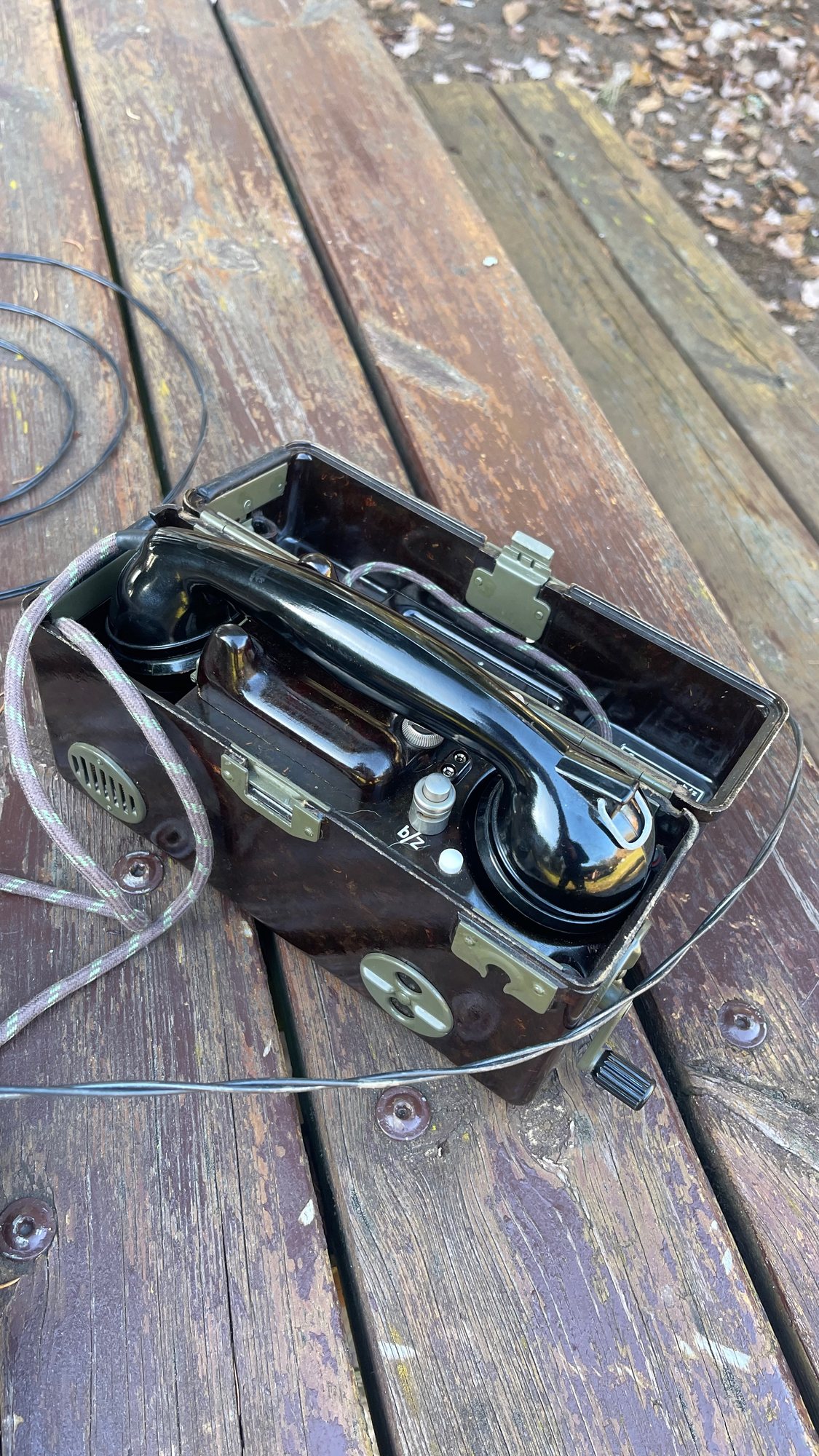
At a quarter to twelve, two telephones stood side by side on a wooden table by the car park. On the left, the EE-8-B in a canvas bag marked Signal Corps U.S. Army, with a TS-9-F handset on a cord. On the right, the Czechoslovak TP-25 in brown Bakelite, with a latch‑closed lid. Between them a thin, black, two‑core cable. That’s the entire infrastructure. No repeater, no network operator, no charger.

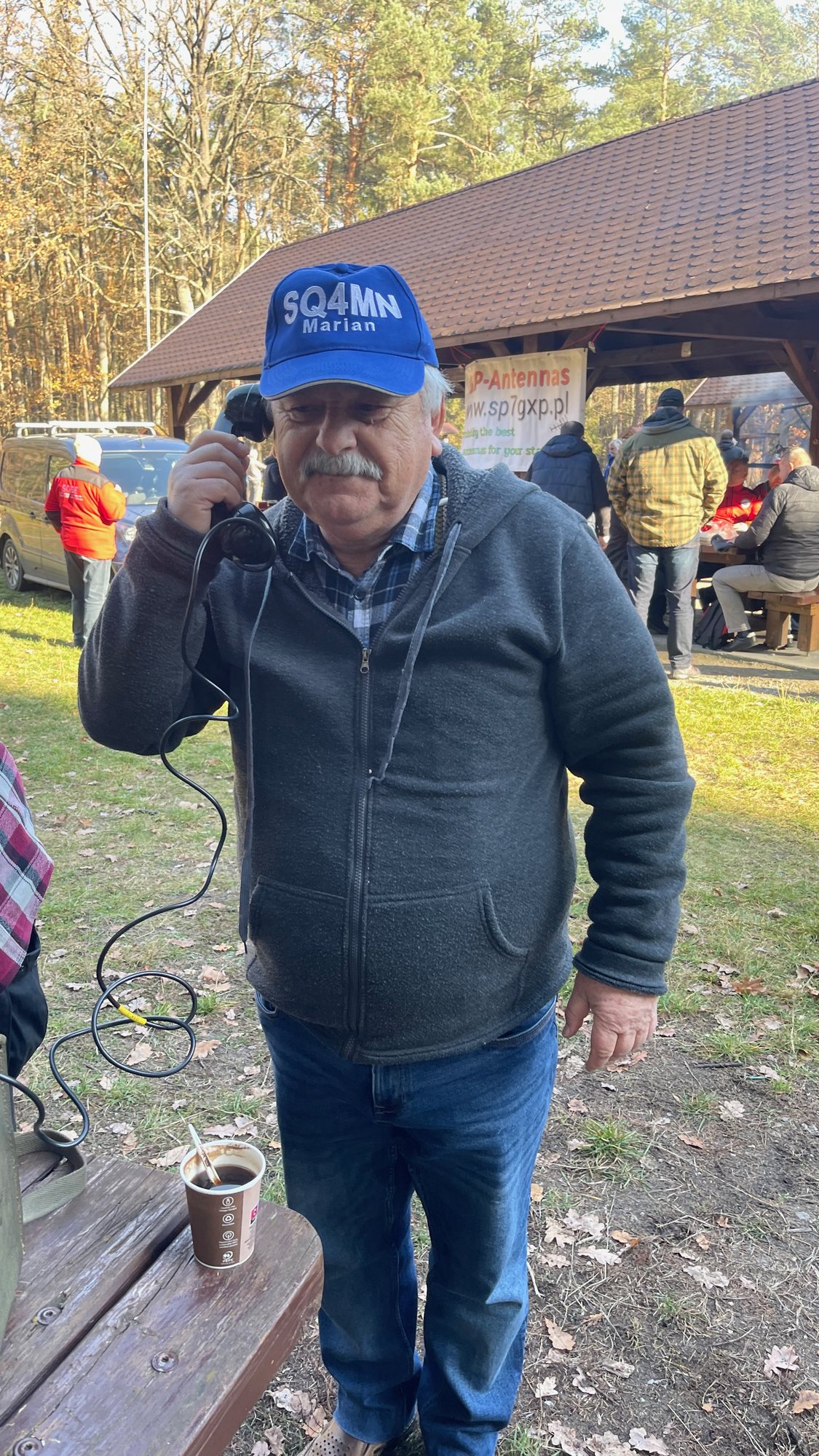
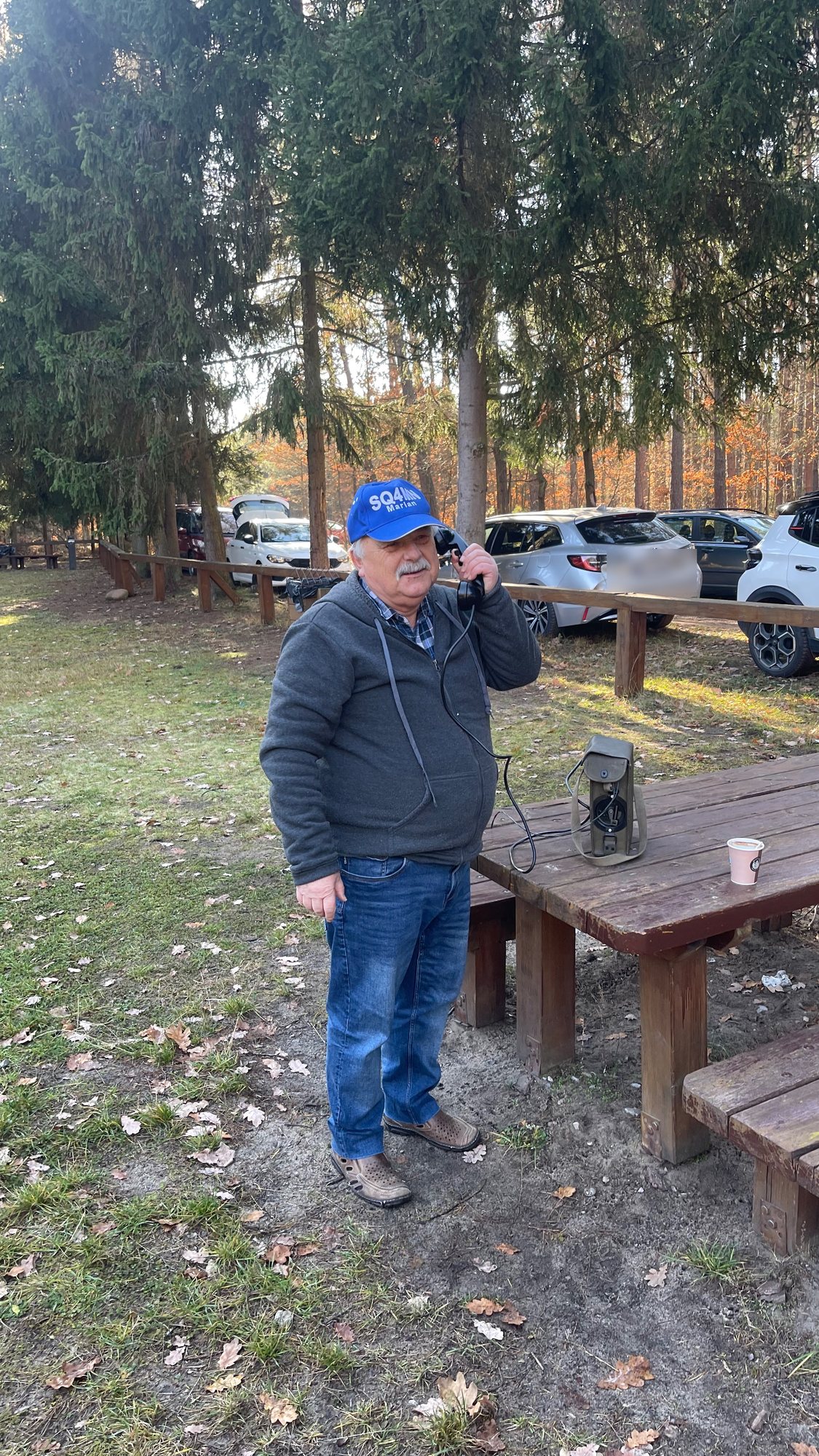
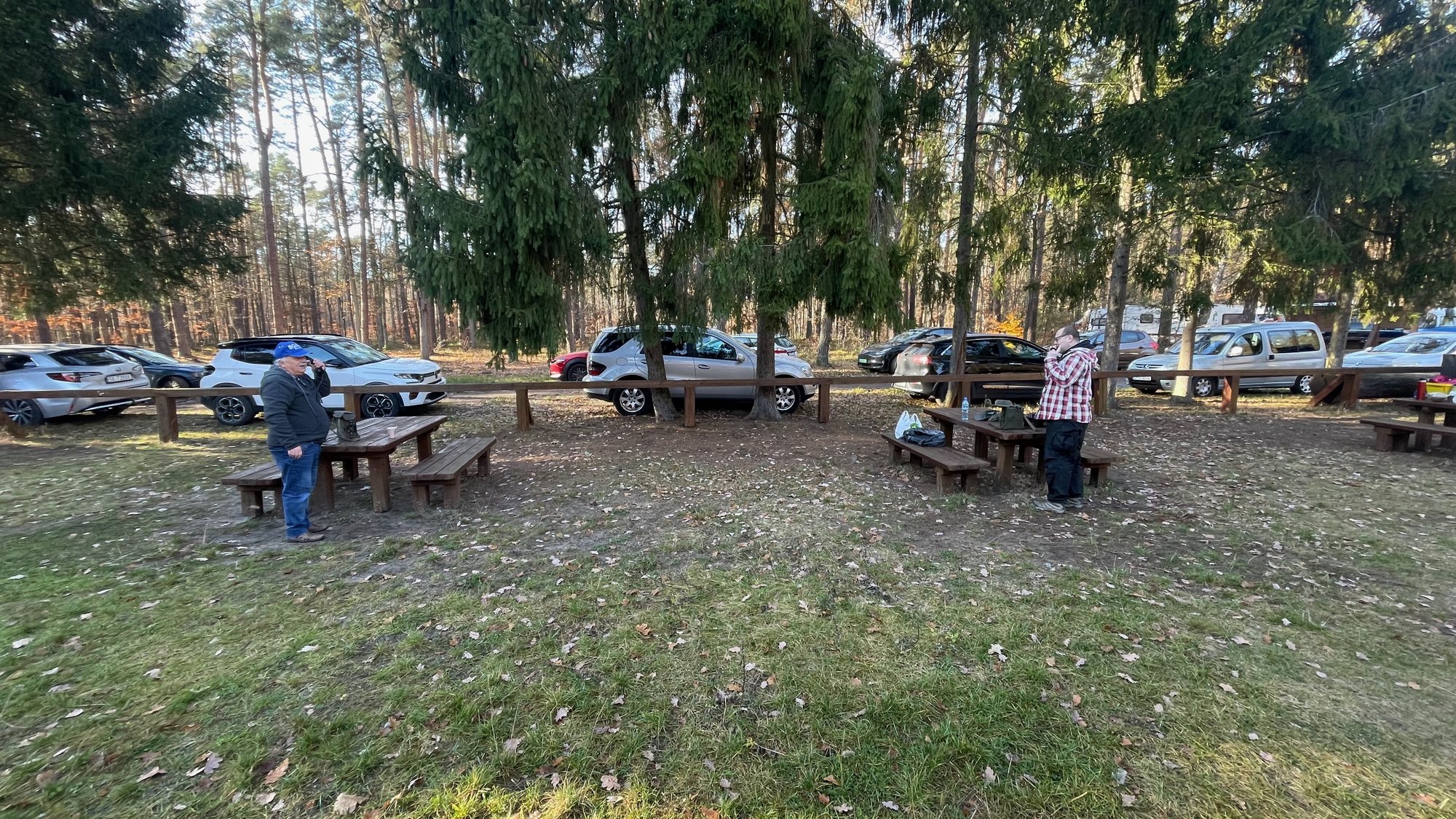
Piotr SP5MOR took one set to the far end, turned the crank and called. Then it was our turn. At 11:58 I was on the line, and after twelve Marian SQ4MN walked to the other end of the line, across the whole clearing. We could hear each other clearly, with no delay and no network in between.

The best bit is that the EE-8 and TP-25 were never meant to meet. One was built for the US Army in the 1930s, the other for the Czechoslovak army after the war. But both are MB sets (with their own battery and a magneto for ringing), so on an ordinary pair of wires they understand each other without an interpreter.
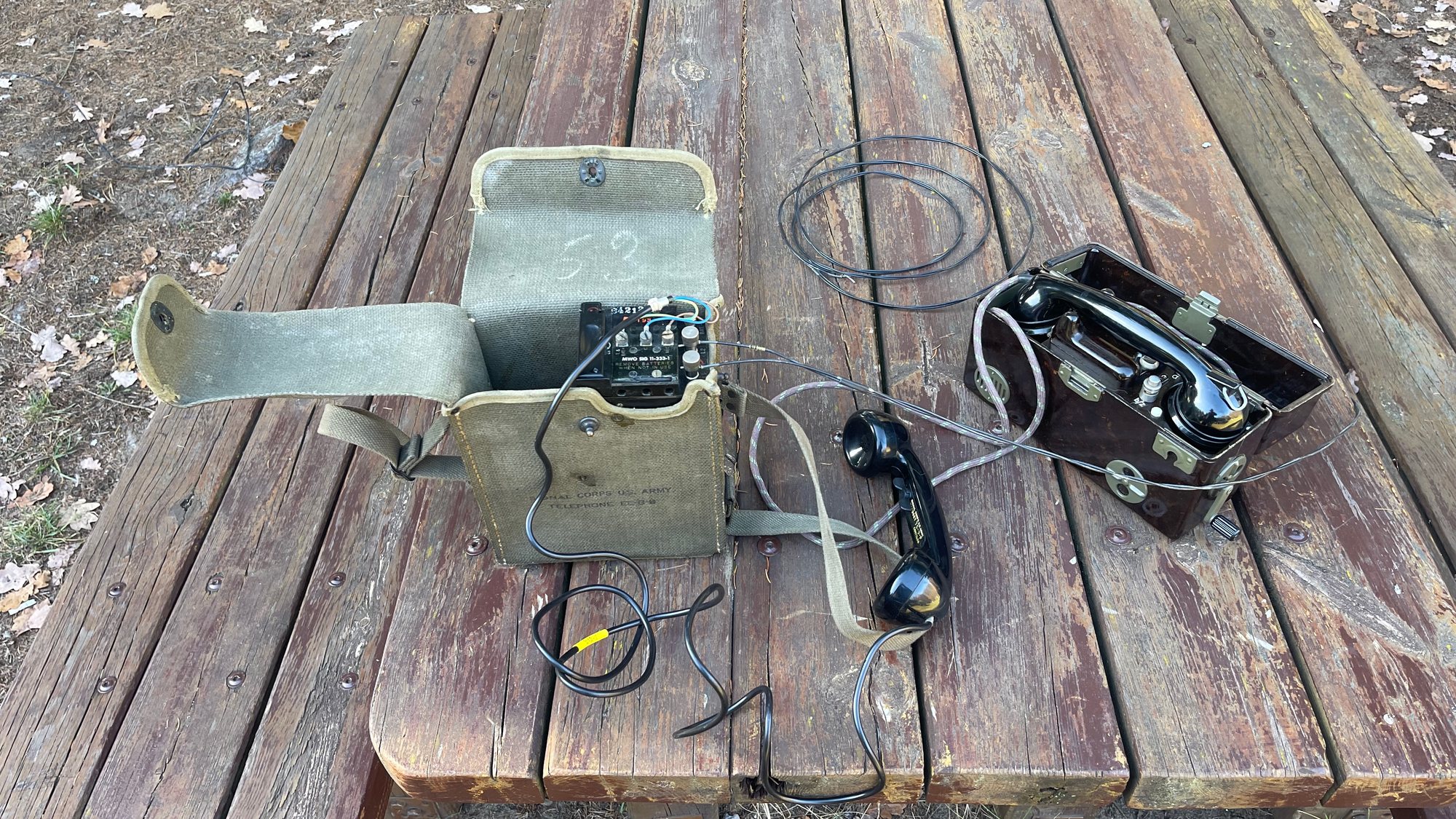
On a wooden table there is an open canvas bag with the EE-8-B telephone and its black handset, and a brown Bakelite TP-25 telephone with its lid open; they are connected by a thin black lead 11:57 · EE-8-B and TP-25 on one line
How it works

A crank, a bell and two wires

Call from the EE-8-B to the TP-25. Click in order: ring, talk, hang up. With the sound of a real 16 Hz bell.

Field telephone line diagram: an EE-8-B set connected by two wires to a TP-25 set field cable · 2 cores ~100 V · 16 Hz speech current ~ (AC) G magneto bell 3 V battery coil microphone L1L2 EE-8-B USA · in service since 1937 G magneto bell cell coil microphone ab/z TP-25 ČSSR · 1950s DRRR! SP5MOR here. How do you read? SQ4MN: loud and clear!

IdleTwo MB sets linked by a pair of wires: L1 to a, L2 to b/z. Nothing flows on the line and the batteries wait until someone lifts the handset.

The stars of the test

EE-8-B and TP-25 up close

EE-8 figures are from the military manual TM 11-333 (1945/1951). TP-25 data are given by the Military Museum in Prague, with some supplied by collectors; I’ve indicated which.

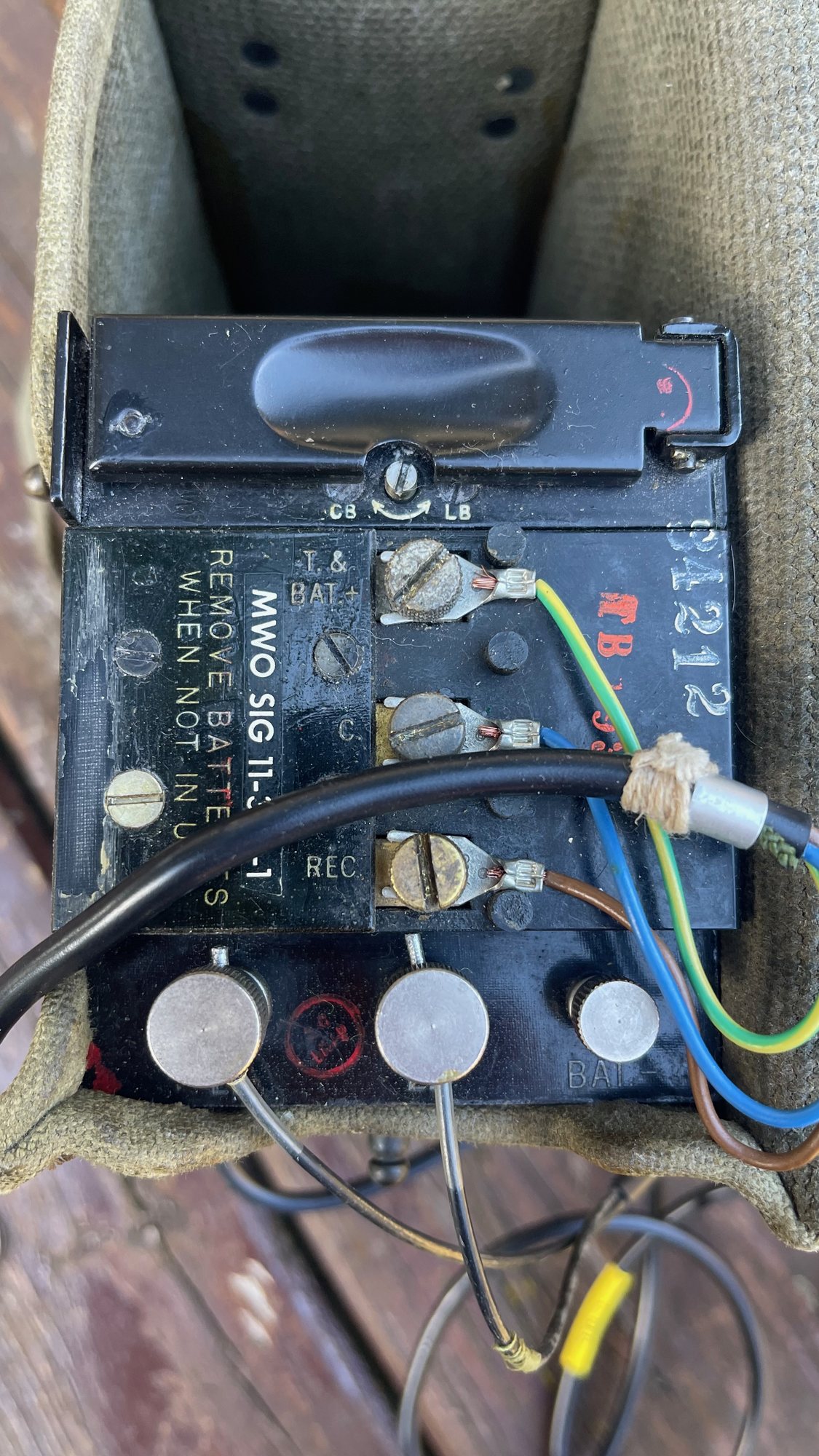
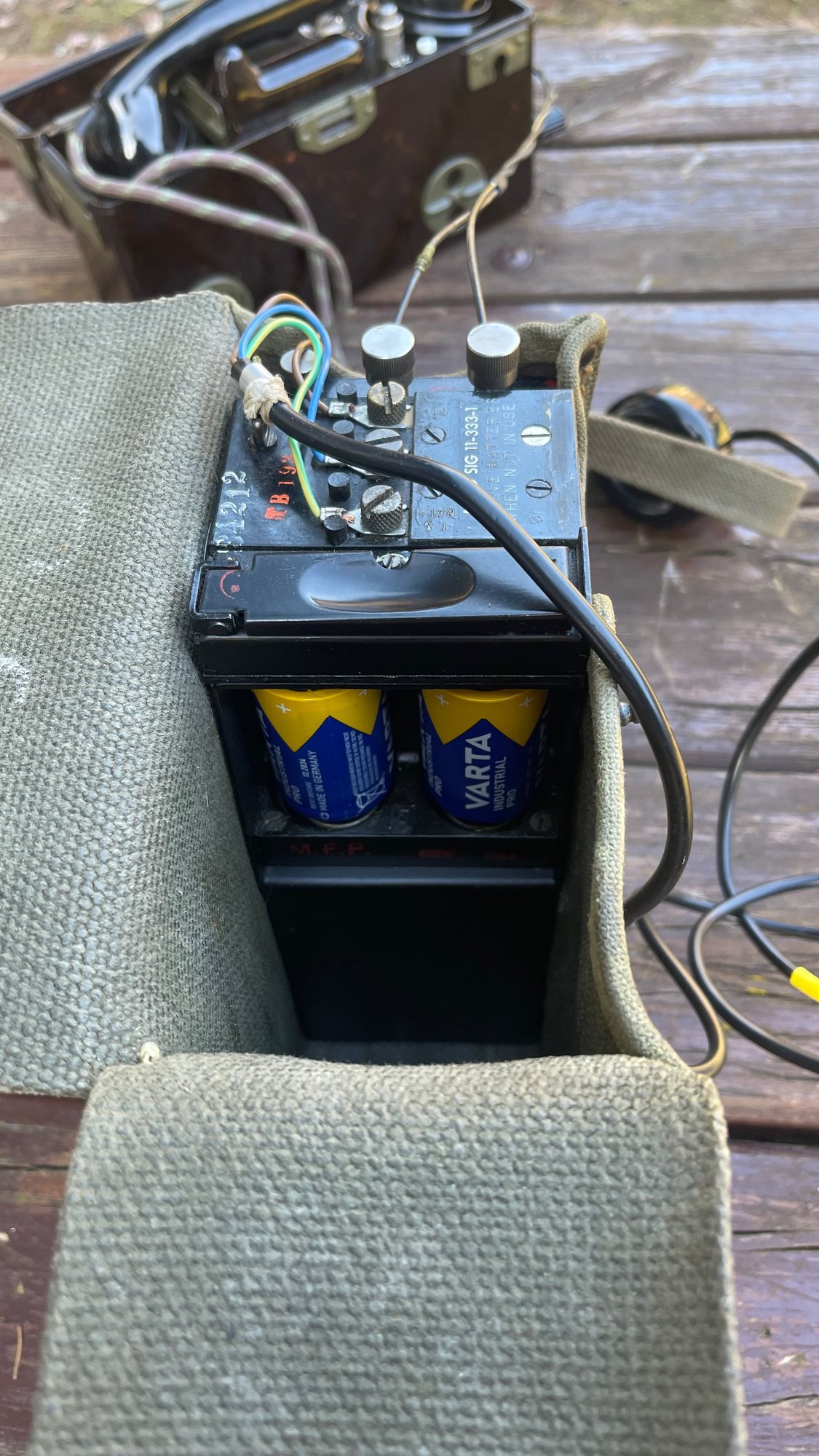
Open EE-8-B canvas case: black front panel with MWO SIG 11-333-1 plate, screw terminals and coloured wires USA

EE-8-B

Signal Corps U.S. Army · TS-9-F handset
in service
since 1937: Second World War, Korea, Vietnam. Around 200,000 sets went to allies under Lend-Lease.
system
LB (local battery) or CB (central battery). You switch it with the CB/LB screw visible in the photo.
signalling
GN-38 magneto: 16 Hz at 1,000 rpm, approx. 100 V off-load; MC-131 bell, 1,300 Ω
feedpoint
2 BA-30 cells (1.5 V, D size) in series, total 3 V. Piotr’s set has ordinary Varta cells fitted.
range
11–17 miles (18–27 km) on W-110-B cable, depending on weather and how the cable is laid
weight
approx. 4.4 kg with batteries (9¾ lb)
manufacturers
including Western Electric, Kellogg, Automatic Electric, Connecticut Telephone & Electric
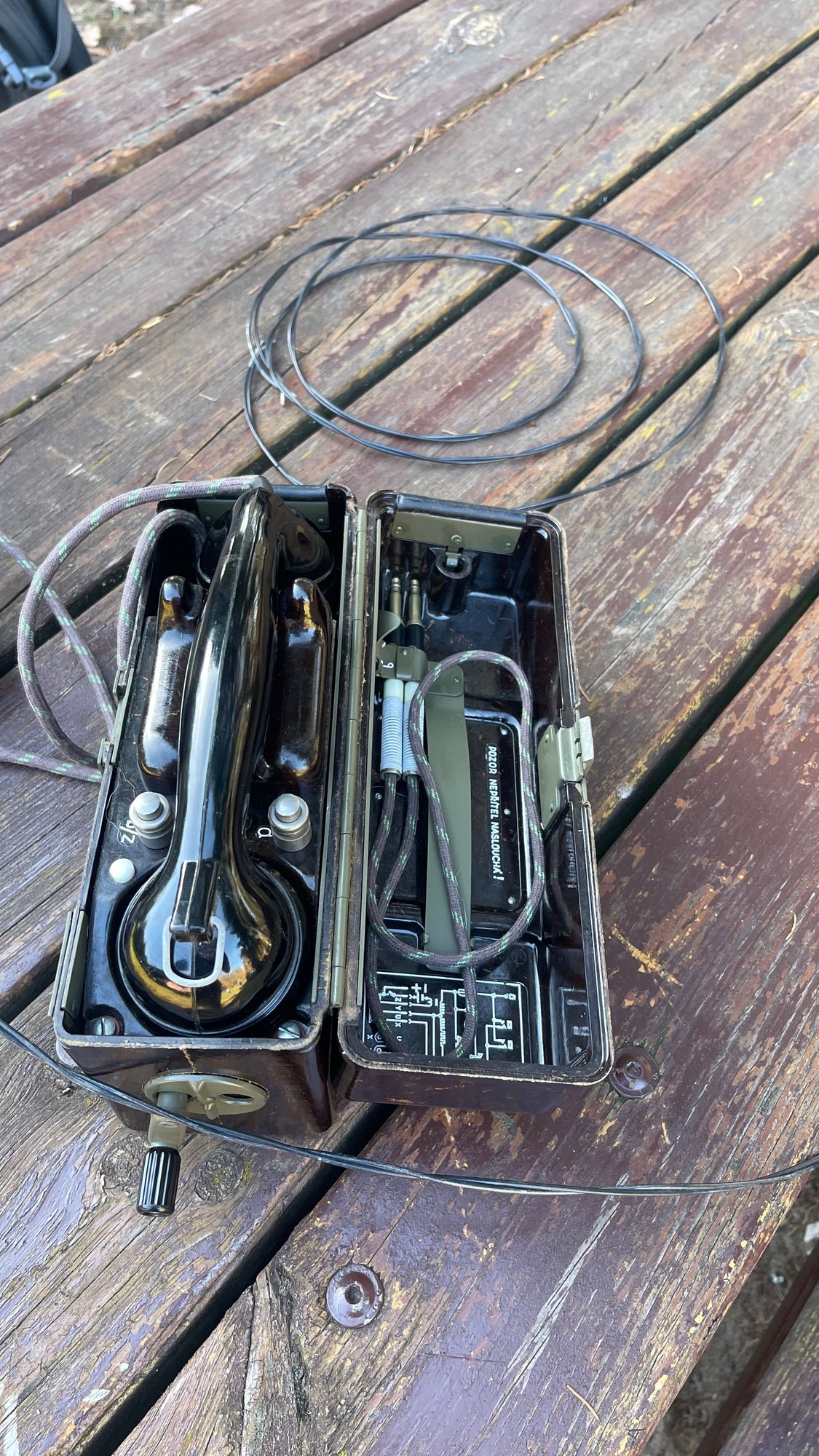
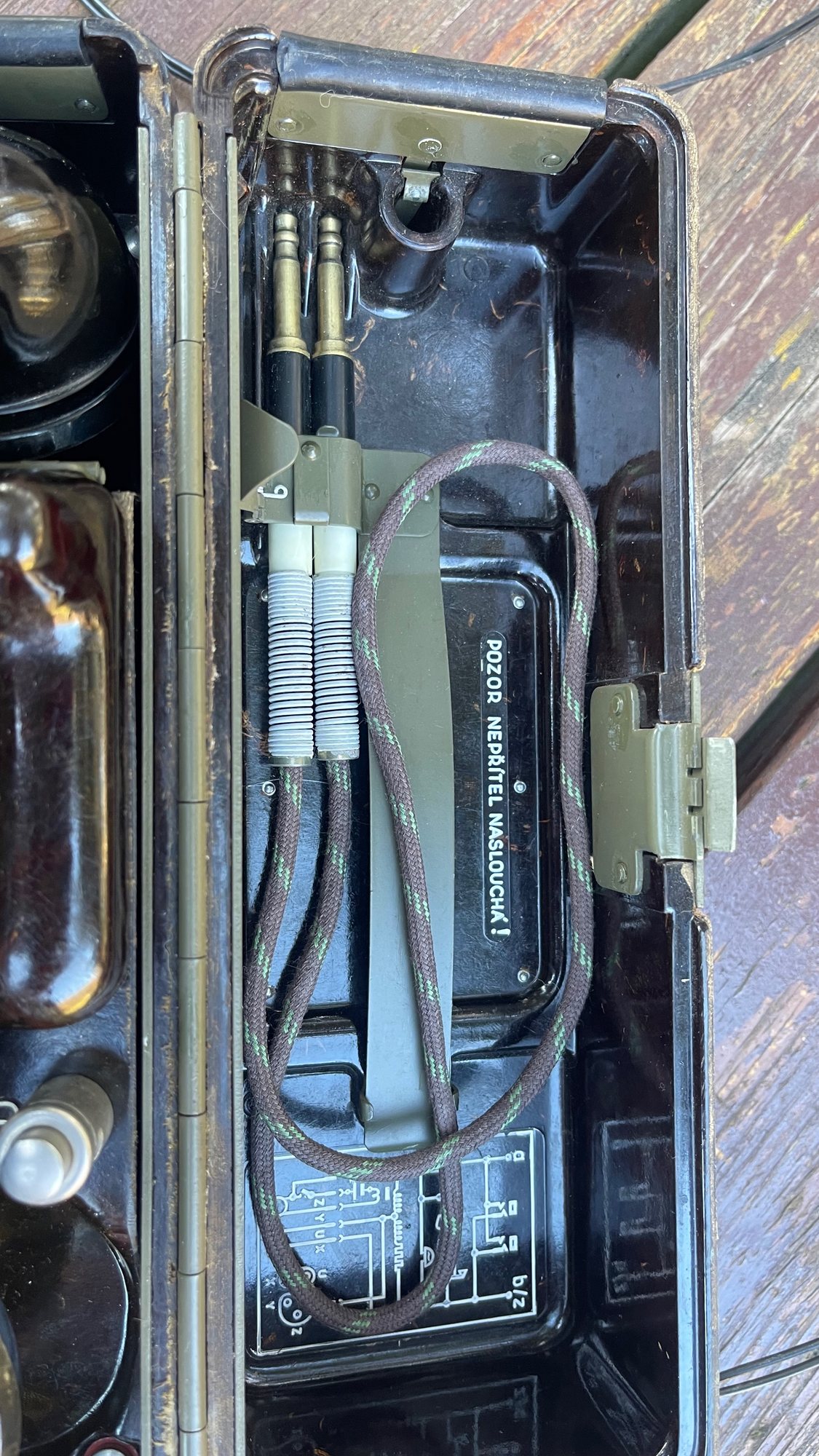
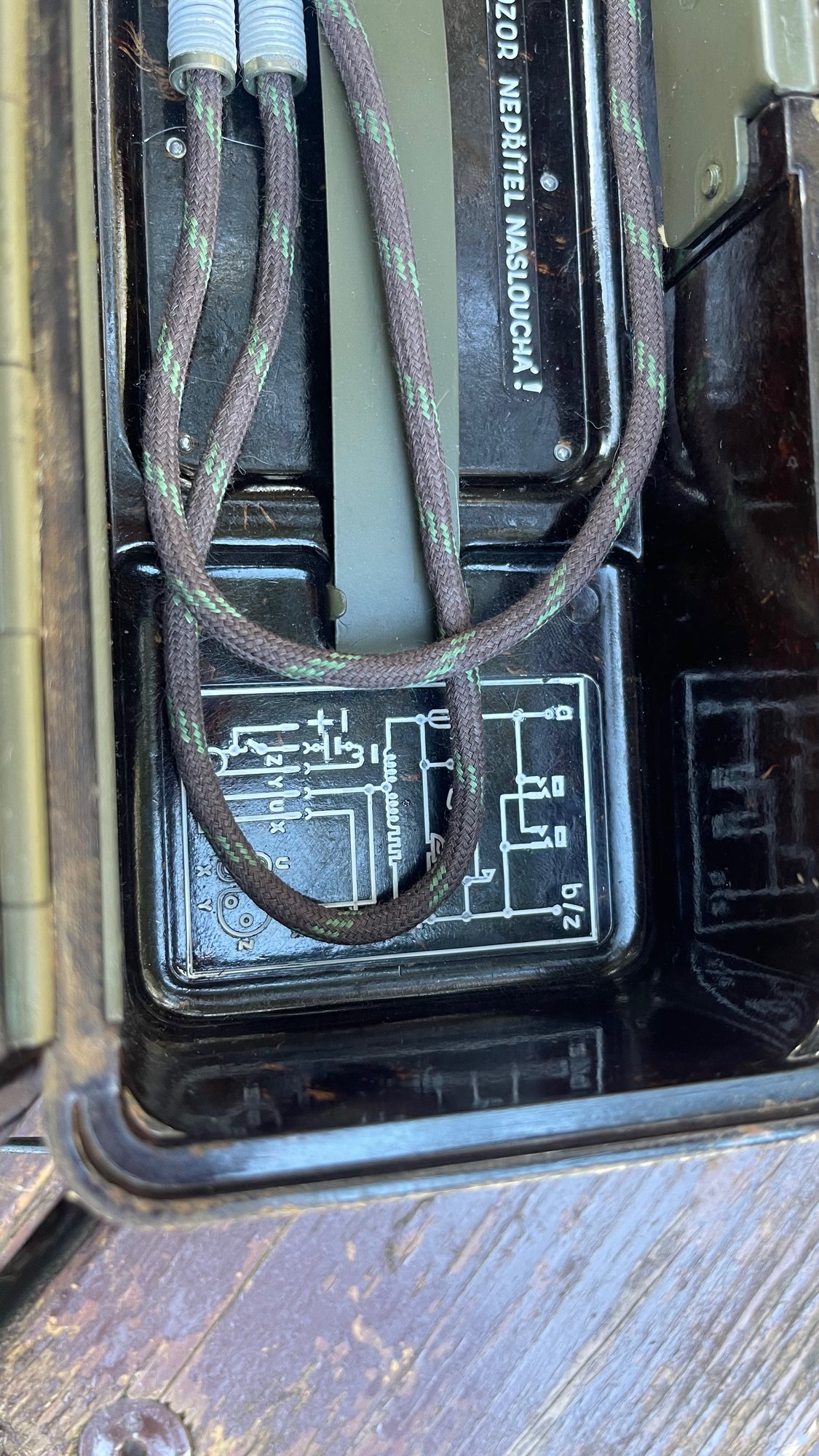
Brown Bakelite TP-25 case with lid open: black handset in the cradle, line terminals, magneto crank on the side, schematic and the inscription POZOR NEPŘÍTEL NASLOUCHÁ on the lid ČSSR

TP-25

TESLA Valašské Meziříčí · Bakelite
origin
developed in 1951–54 during the rearmament of the Czechoslovak army, modelled on the German FF33. Known examples date from 1952–1975.
system
LB: its own cell for the microphone and a magneto for signalling
terminals
a and b/z. “z” is most likely země, i.e. earth: if needed the second wire could be replaced by an earth connection.
feedpoint
one cell approx. 1.4–1.5 V (according to collectors)
signalling
magneto approx. 75–120 V, approx. 25 Hz (according to collectors)
range
approx. 25 km (according to collectors)
weight
approx. 3.5–3.8 kg without batteries

The small details that say the most

MWO SIG 11-333-1. On the EE-8-B front panel there is a plate reading Remove batteries when not in use (“remove the batteries when not in use”). MWO is a Modification Work Order, i.e. a modification order. The number refers to manual TM 11-333. So both the manual and the official modification concern the same set.

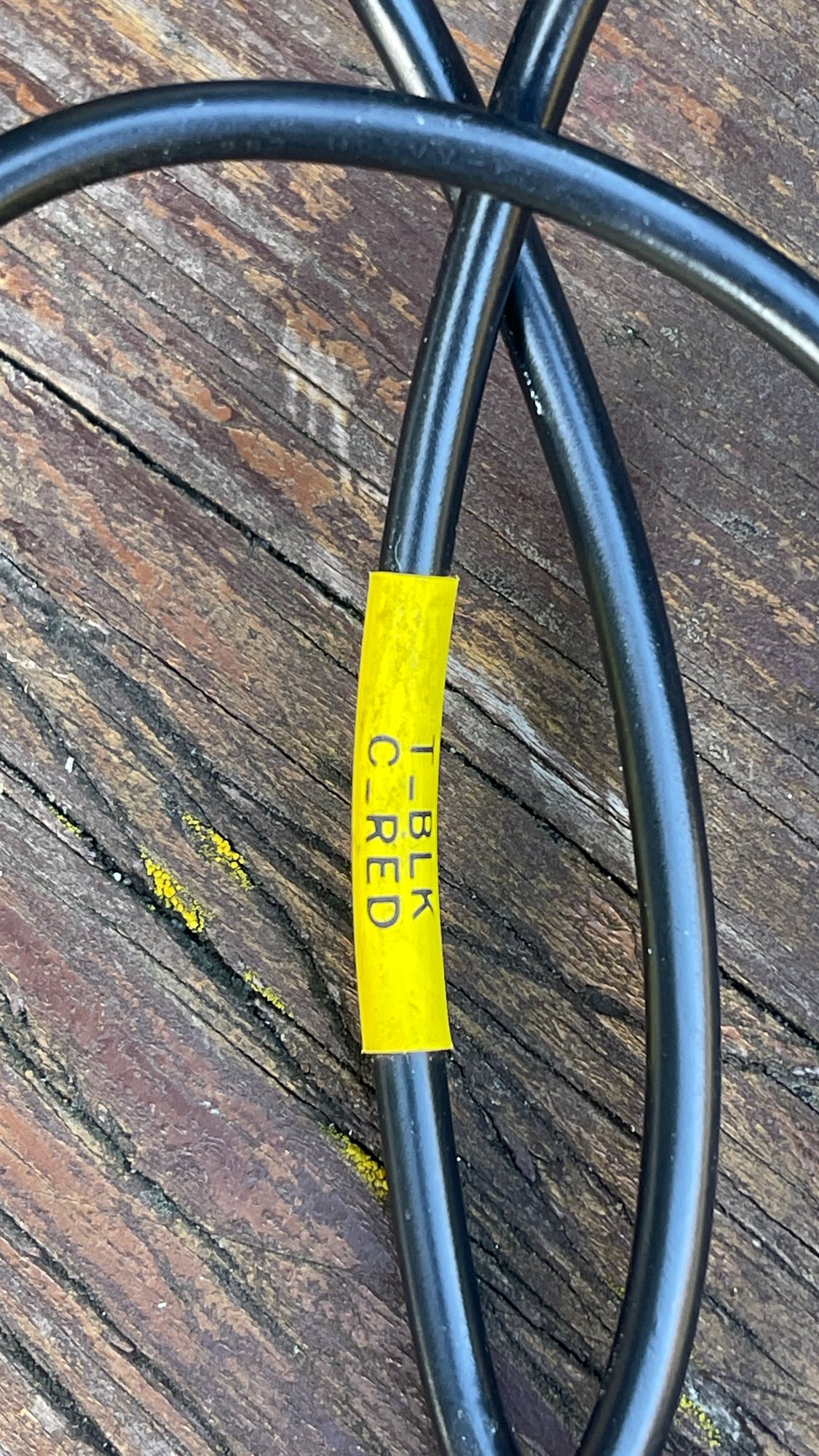
Yellow T_BLK / C_RED label. Looks like an ordinary sticker on the lead, but it’s a crib straight from the manual. In the TS-9 handset cord the black core goes to terminal T & BAT+, the red to C, and the white to REC. Anyone re-wiring a handset knows why that label is there.

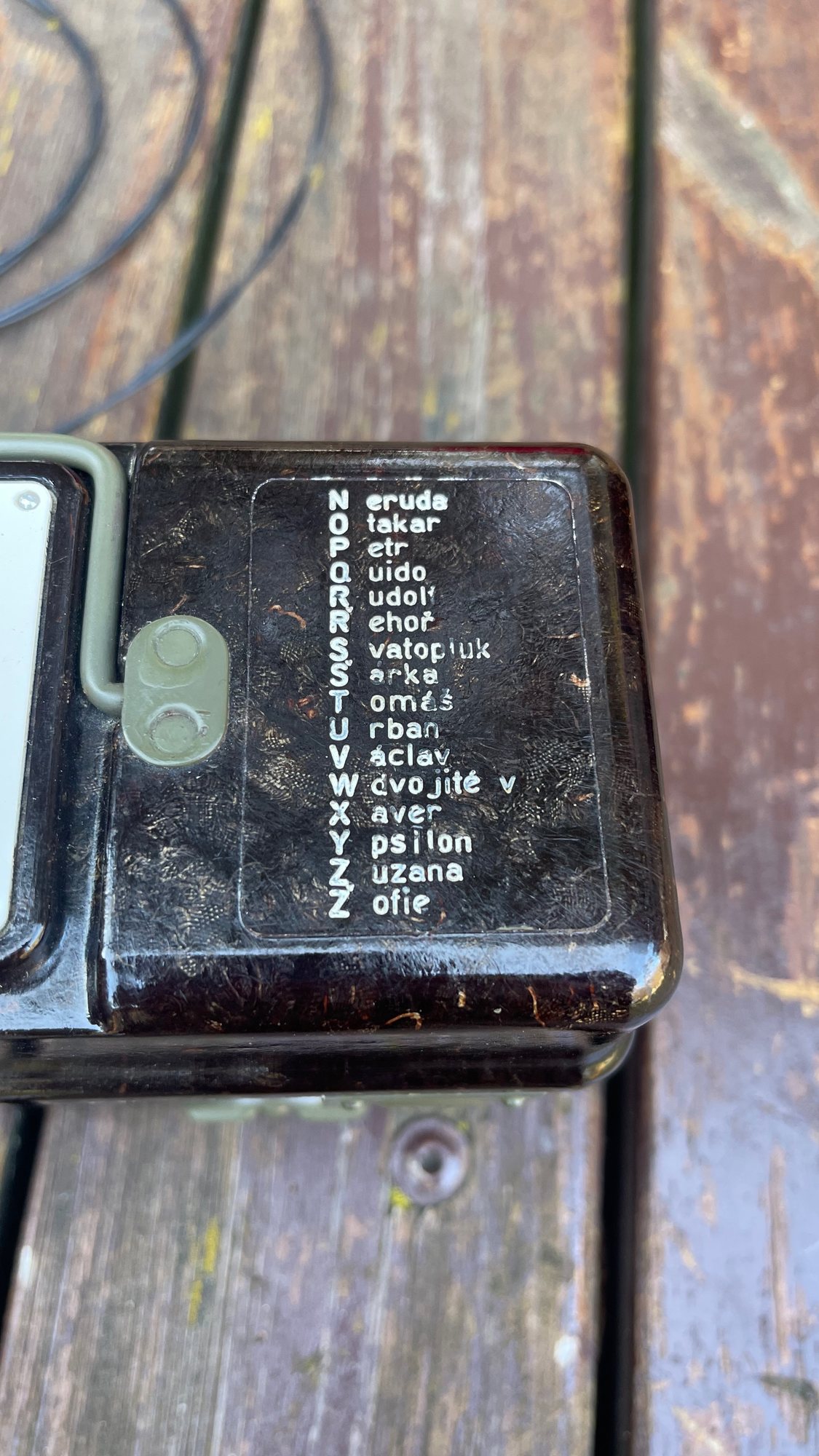
“POZOR, NEPŘÍTEL NASLOUCHÁ!” That’s Czech for “Attention, the enemy is listening!”. The inscription is embossed inside the TP-25. Field telephones were already being tapped in the First World War: the wire lies in the grass, so it’s enough to clip onto it. That’s why next to the warning there’s also the Czech spelling alphabet: Neruda, Otakar, Petr…

Close-up of the black EE-8-B panel: CB/LB switch screw, T & BAT+, C and REC screw terminals with coloured wires, plate MWO SIG 11-333-1 REMOVE BATTERIES WHEN NOT IN USE CB/LB · T & BAT+ · C · REC · MWO SIG 11-333-1
Fun for a radio amateur

Spell out your callsign the military way

Three alphabets: the Czech one from the TP-25 (1950), the British–American wartime version (1943), and today’s NATO/ICAO, the one we use on the bands.

Enter any callsign or word. I replace Polish letters with the nearest Latin equivalents.

TP-25 · Czechoslovakia

1950 · inscription on the set’s lid

    Able–Baker · 1943

    British and U.S. armies · D Mk V and EE-8 sets

      NATO / ICAO

      since the 1950s · today on every band
        From the front

        Field telephone in wartime

        Public-domain archive photos (U.S. Army Signal Corps, NARA, National Digital Archives), via Wikimedia Commons.

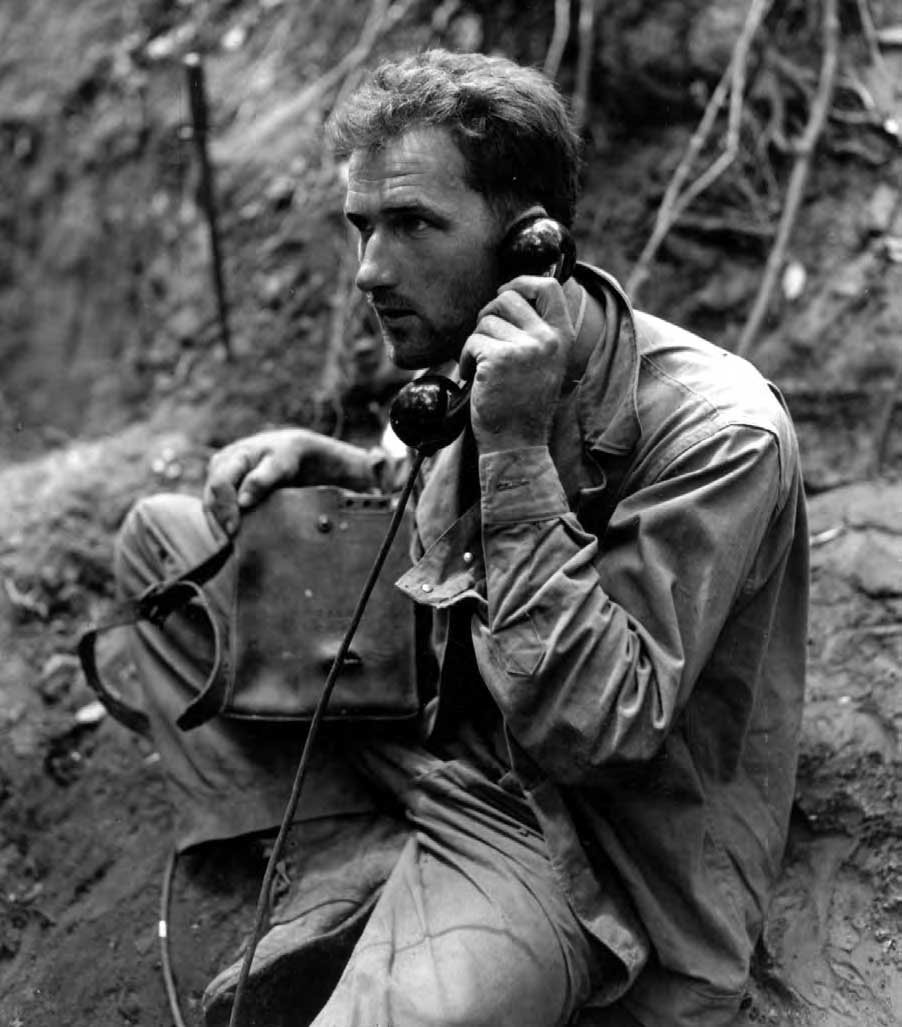
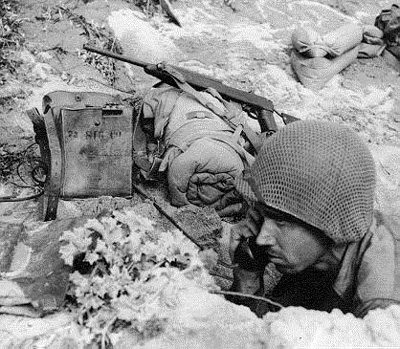
        A bearded soldier sits on the ground talking on the handset of a field telephone in a bag
        Solomon Islands · 1942–45The set kept working, even though it was struck by a fragment from a Japanese mortar shell that exploded less than two metres away. With unreliable radio in the jungle, a cable was more reliable.photo · U.S. Army · public domain · Commons
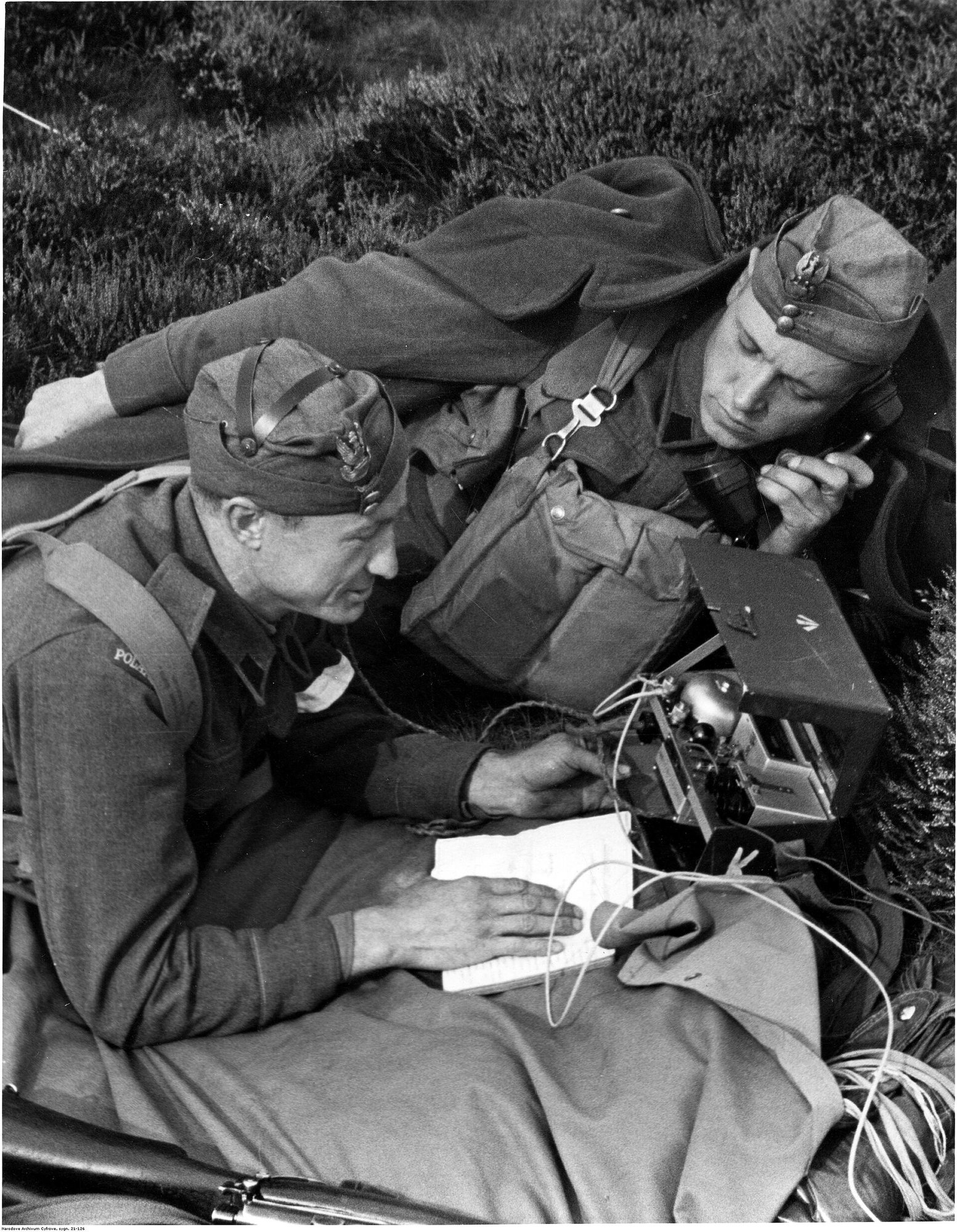
        Two Polish soldiers in forage caps lie in the grass by a field telephone, one speaking into the handset, the other taking notes
        Poles in the United Kingdom · 1940–44Training with the British Telephone Set D Mk V. This is the set that went with the Able, Baker, Charlie alphabet.National Digital Archives · public domain · Commons
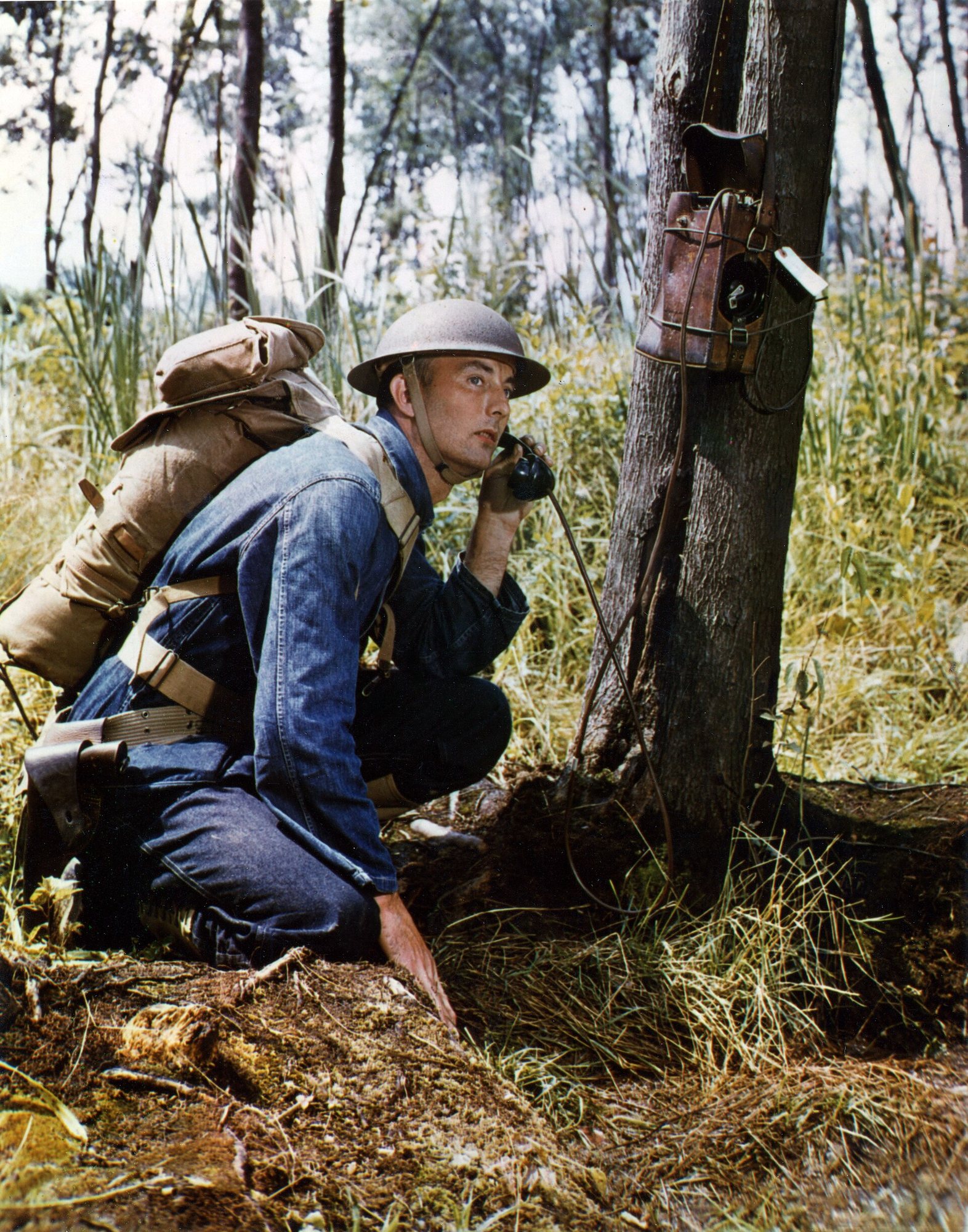
        Colour photo: a soldier in a helmet with a rucksack kneels by a tree with a field telephone hanging on it, speaking into the handset
        Signal Corps · c. 1942Field training: set hanging from a tree, line run up the trunk, handset in hand.Signal Corps Archive · public domain · Commons
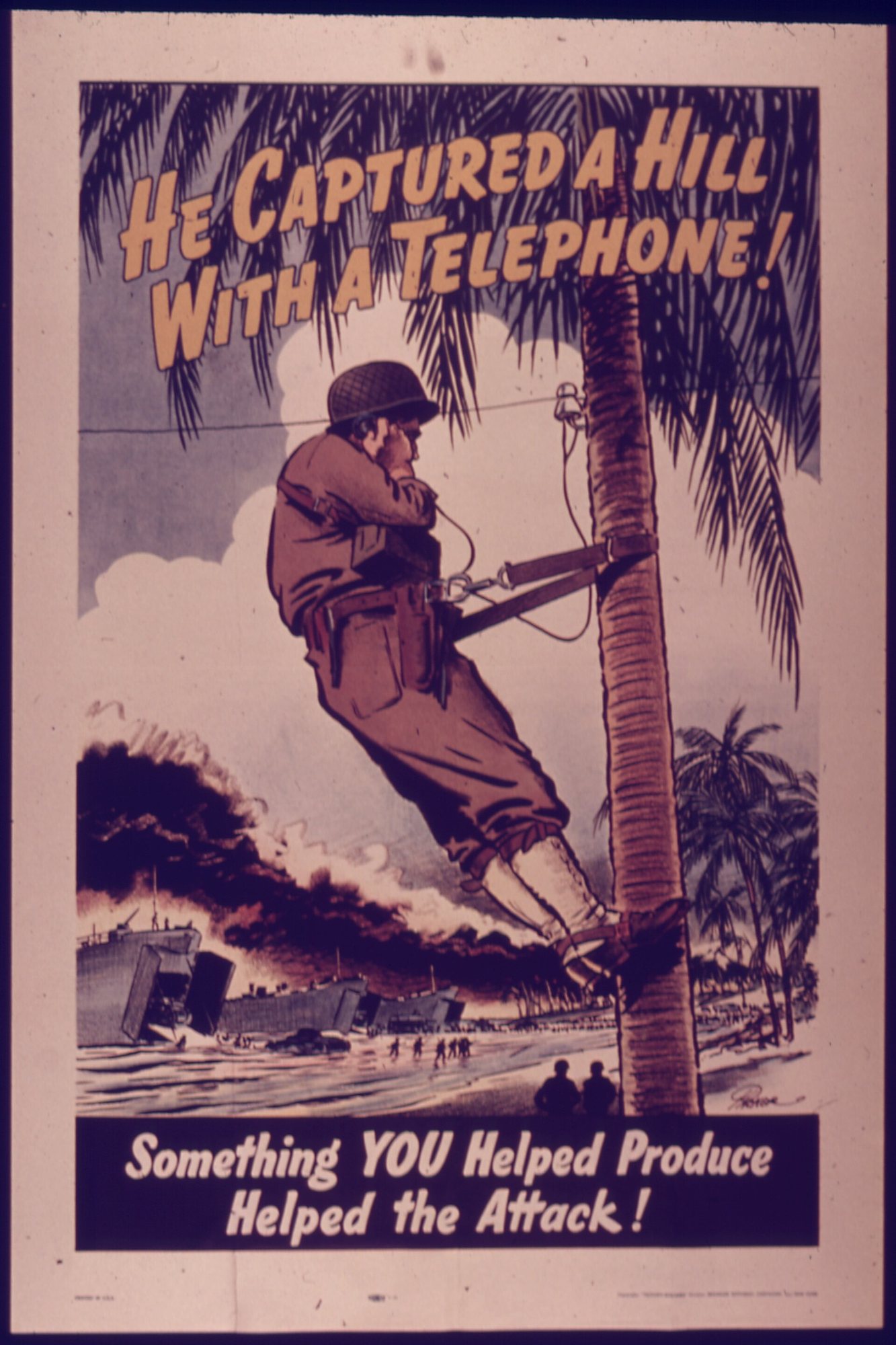
        Wartime poster: a soldier perched on a palm tree talks on a field telephone, caption He Captured a Hill with a Telephone
        Poster · 1941–45“He captured a hill with a telephone!” A poster for factory workers: the equipment you make helps the assault. That’s how important the field telephone was back then.NARA 514445 · public domain · Commons
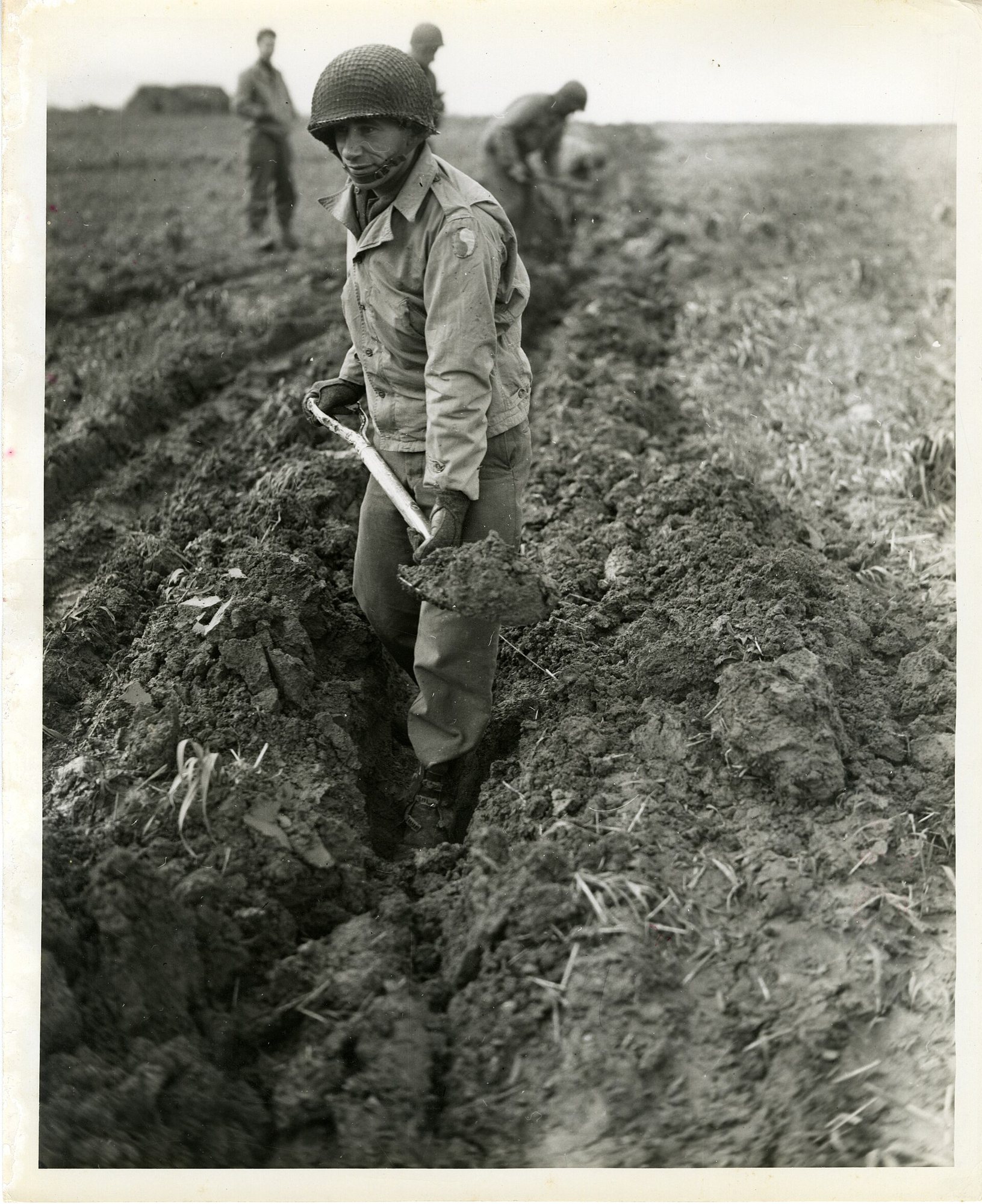
        A soldier in a helmet with a shovel stands in a freshly ploughed furrow in a field, with more soldiers behind him
        Engelsdorf, Germany · December 1944The cable still had to be laid. A 9th Army signalman clears a furrow ploughed by a German plough to bury the line in it. A buried cable is safer than one left on the surface.photo Pvt. G. LaMond, U.S. Army Signal Corps · public domain · Commons
        A helmeted soldier in a trench, with an EE-8 telephone in its bag standing on the edge beside him
        Trench · 1940sEE-8 in a bag on the edge of a trench. The same set was on the table in the clearing on Saturday.U.S. Army Signal Corps · public domain · Commons
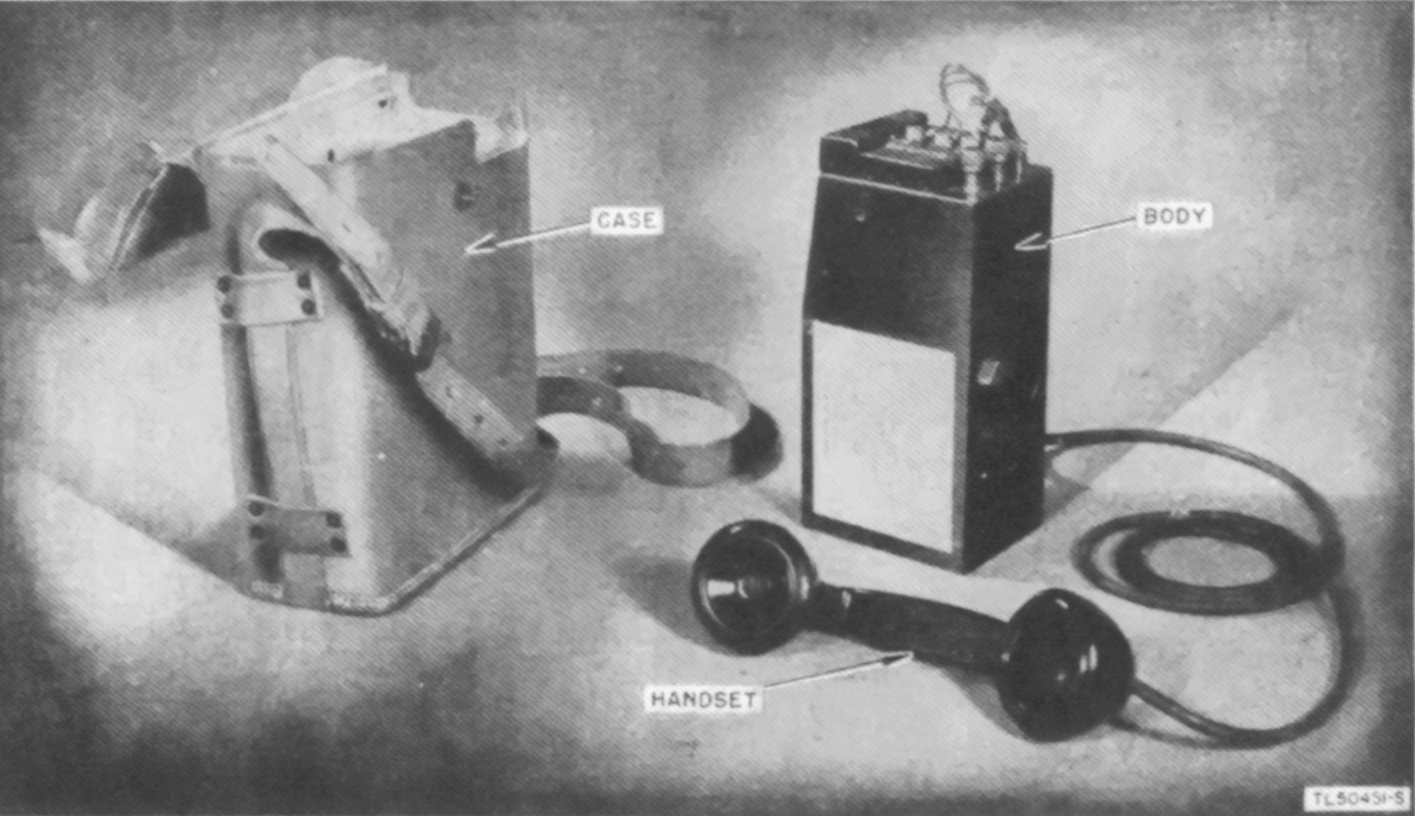
        Photo from the manual: EE-8 bag, metal body of the set and handset labelled CASE, BODY, HANDSET
        Manual TM 11-333 · 1945Bag, body and handset. The EE-8-B has a steel chassis, and the older EE-8 and EE-8-A are aluminium.U.S. War Department · public domain · Commons
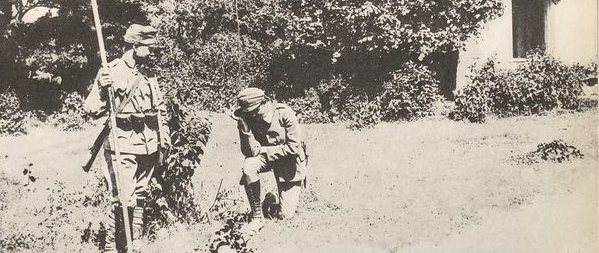
        Old photo: Legion soldiers with a field telephone in the field
        The Legions · 1914–17Field telephone of the 1st Brigade of the Polish Legions. Wires, crank and handset. The operating principle did not change for the next half century.author unknown · public domain · Commons

        Why should a ham care

        Because it’s the simplest communications link you can build. When the mobile network, the internet and the mains are down, the field telephone still rings. It only needs a battery costing a few PLN, a crank and a length of wire. For the same reason hams practise emergency communications: what matters is kit that works without anyone’s infrastructure.

        There’s also pure technical pleasure in it. A carbon microphone, magneto, coil and bell form a circuit you can understand as a whole with a single glance at the diagram embossed inside the TP-25. And when the American wartime set rings the Czechoslovak one from the 1950s, you see how universal the standard was.

        Piotr SP5MOR runs a Facebook page for his collection of military field communications: “Telefonia polowa dzisiaj”. You’ll find more sets there with descriptions and history, including MB-66, TAI-43 and EE-8-A.

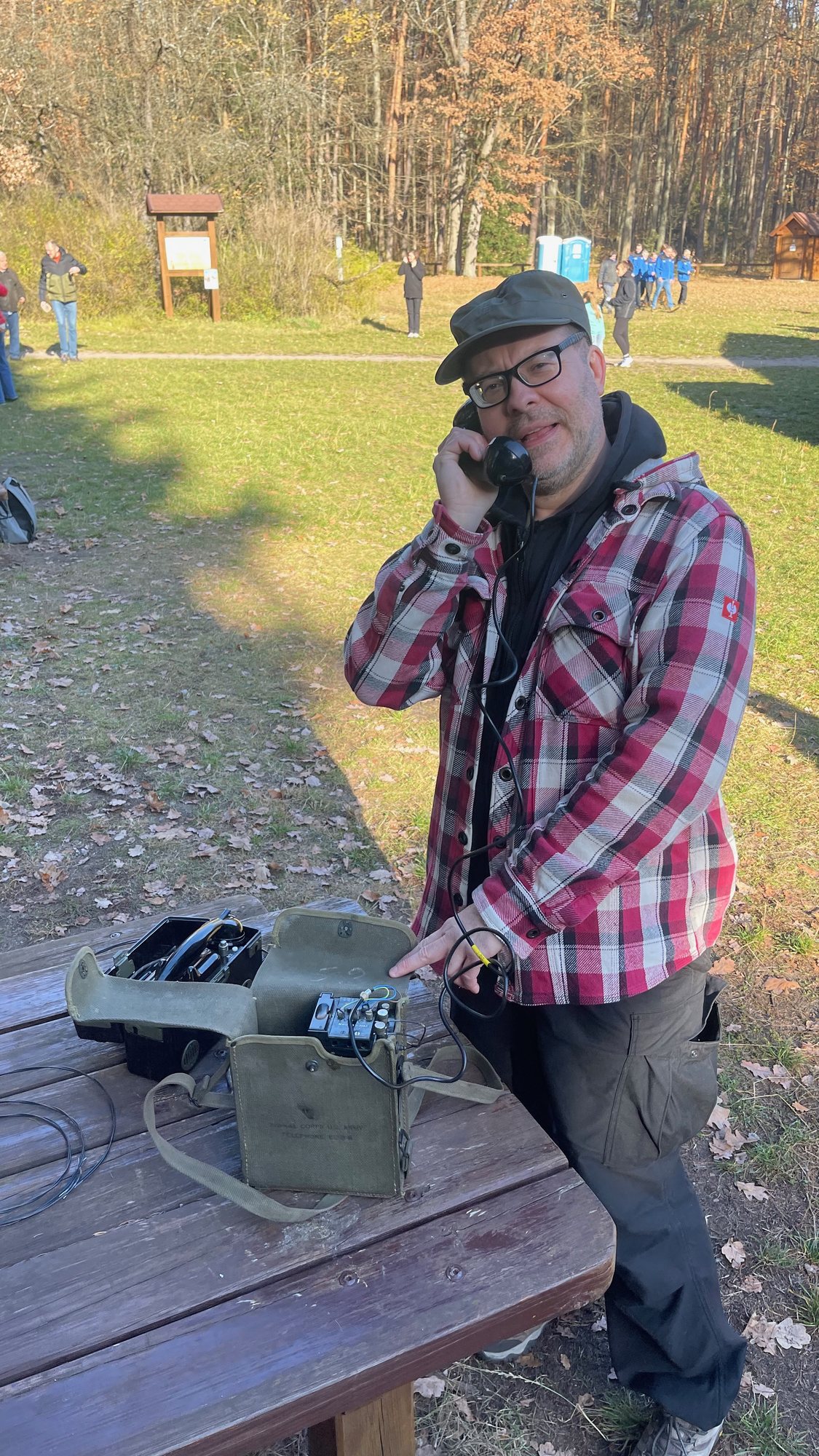
        Piotr SP5MOR, in a checked shirt, speaks into the handset of the EE-8-B field telephone on the table SP5MOR · “Telefonia polowa dzisiaj” collection
        Filip SQ5CBA — portrait SQ5CBA
        Text and photos

        Filip SQ5CBA

        Day to day I transmit from Stary Mokotów on 2 m, 70 cm and 23 cm, most often via repeaters. On Saturday I was cranking. Out in the clearing it was pleasantly simple: no CTCSS tones, codes or menus, just the crank and “hello”. Thank you to Piotr SP5MOR for the gear and patience, and to Marian SQ4MN for the first conversation across the whole clearing.

        KO02MEEE-8-B ⟷ TP-2516 Hz · 100 Vno coverage
        Read more

        A whole Saturday at Królewskie Źródła

        The field telephone test was part of the 19th Radio Amateurs’ Gathering in Puszcza Kozienicka. There was also a campfire, a Nysa, footbridges over the Zagożdżonka and Adam SP5RZL’s records.