
Quadraphony
Four audio channels hidden in a single record groove — and the man who’s been building gear for forty‑odd years to pull them out.
 BuilderMarian SQ4MNSQ decoders · valve amplifiers
From one loudspeaker
to a concert hall
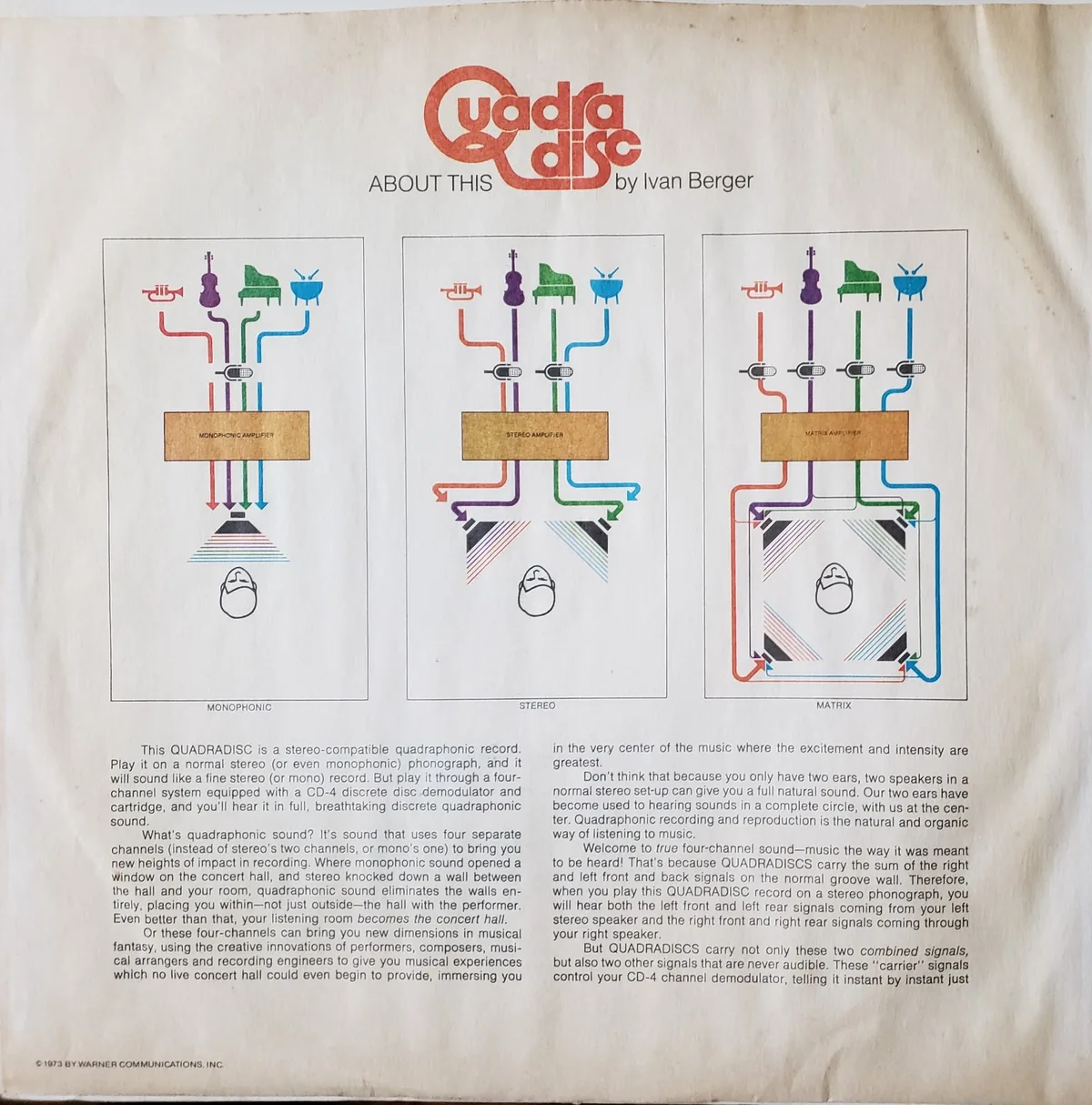
Mono is a single point, stereo — a stage in front of the listener. Quadraphony puts the listener in the middle of the room: music and reverberation come from the front, from the sides and from behind.
Captions: Marian SQ4MN · drawing based on the Quadradisc (1973) insert
Four channels
in a single groove
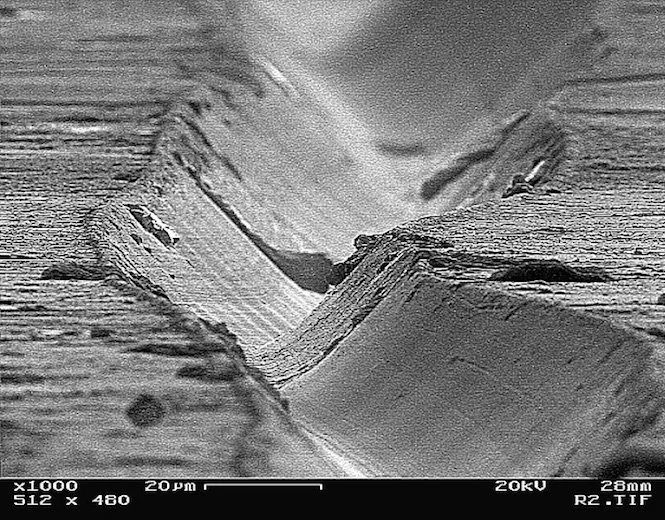
A stereo record groove has a V‑shaped cross‑section, and its walls are inclined at 45°. Each wall carries one channel: the stylus moves perpendicular to the left wall for the left channel and perpendicular to the right — for the right.
In the film Marian asks a simple question: “How can you record 4 independent channels in such a groove?” The SQ system’s answer is elegant. The front channels stay where they were. The rear ones don’t get a new place — they get a new movement. The stylus draws a spiral in the groove: to the right for the left rear, to the left for the right.
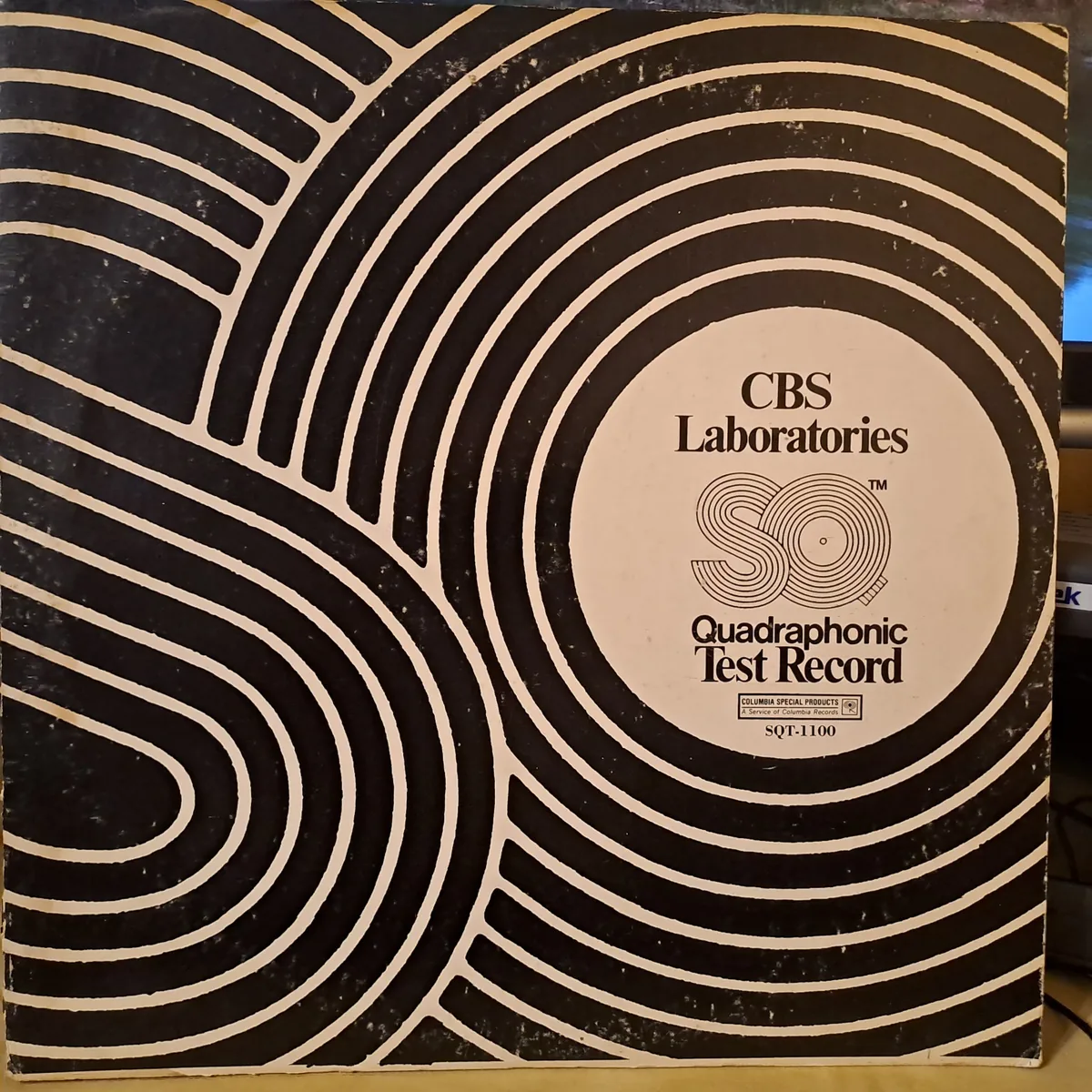
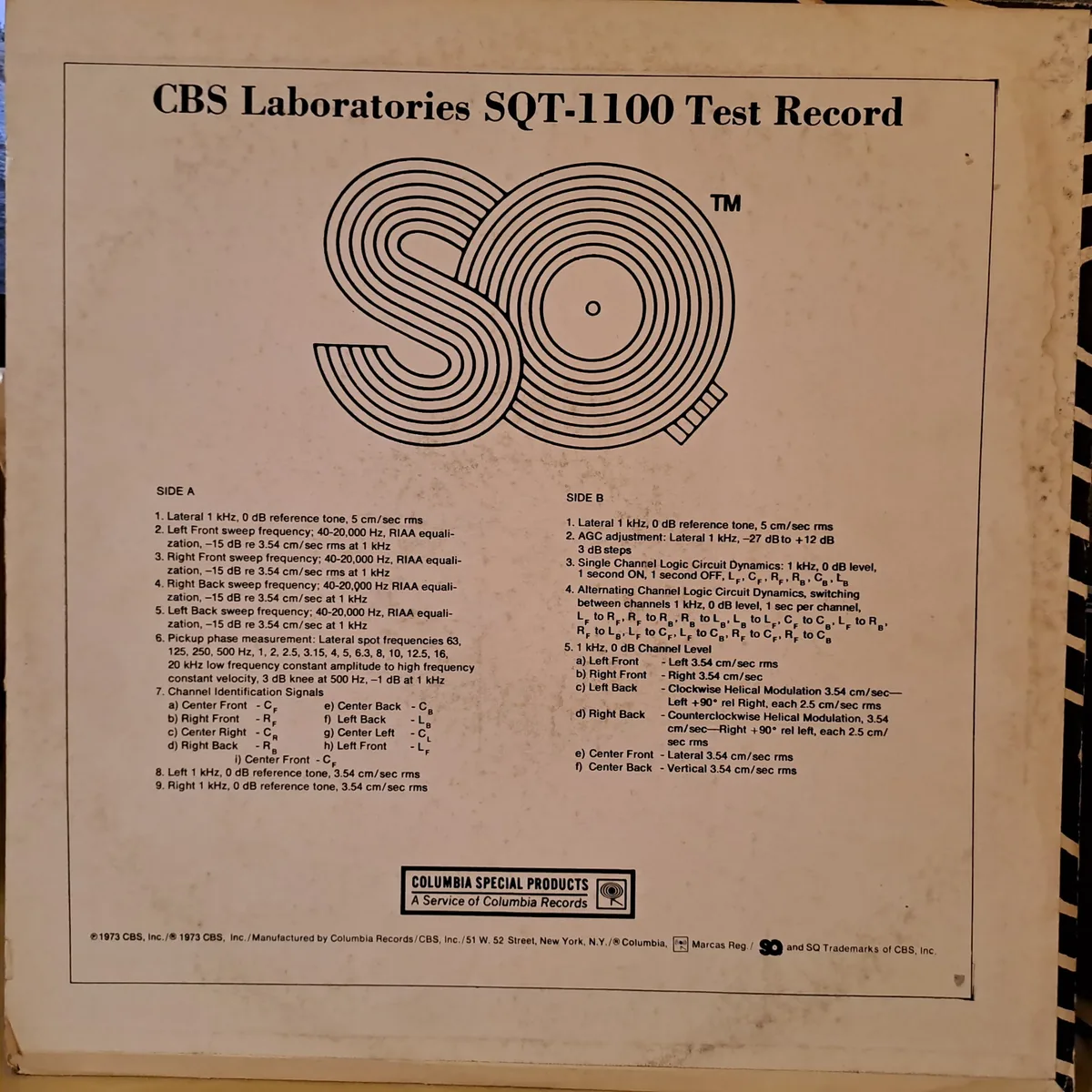
That’s how the CBS SQT-1100 test record’s sleeve itself puts it: “Left Back — Clockwise Helical Modulation”, “Right Back — Counterclockwise”.
SQ matrix:
a phase trick
The encoder mixes four channels into two, and the decoder unweaves them again. An SQ record will play on a normal stereo turntable — and with Marian’s decoder it opens in four directions.
The encoder passes the front channels straight through: the left front goes to the left track, the right front — to the right. The rear channels feed into both tracks, but attenuated to 0.7 (−3 dB) and shifted in phase by 90°. The decoder reverses this operation with the same phase shifters and summers.
A plain matrix gives full separation between left and right front, but between front and rear only about 3 dB. That’s why in the mid‑1970s decoders with “logic” appeared — circuits that continuously track where the dominant sound is coming from, and boost the separation. Such circuits are used in Marian’s new decoder.
P = Pp − 0.7·Lt + j·0.7·Pt
j — a 90° phase shift. Notation as in Marian’s schematic: Lp, Lt — left front and rear; Pp, Pt — right front and rear.
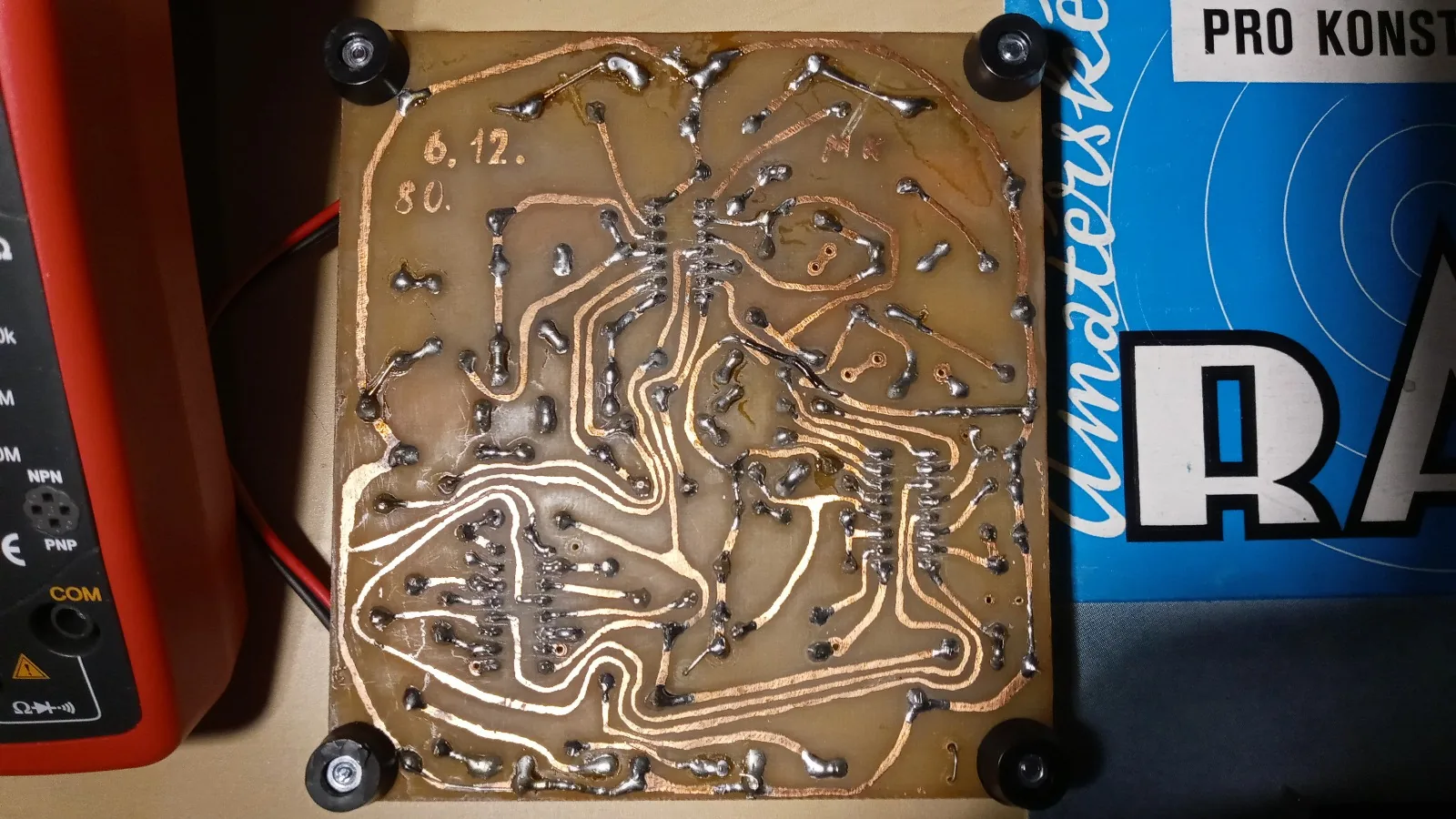
6 December 1980.
A board that still plays today
No computer, no CAD, and no PCB factory. Tracks laid by hand, etched in copper and soldered. After 46 years the decoder still works.
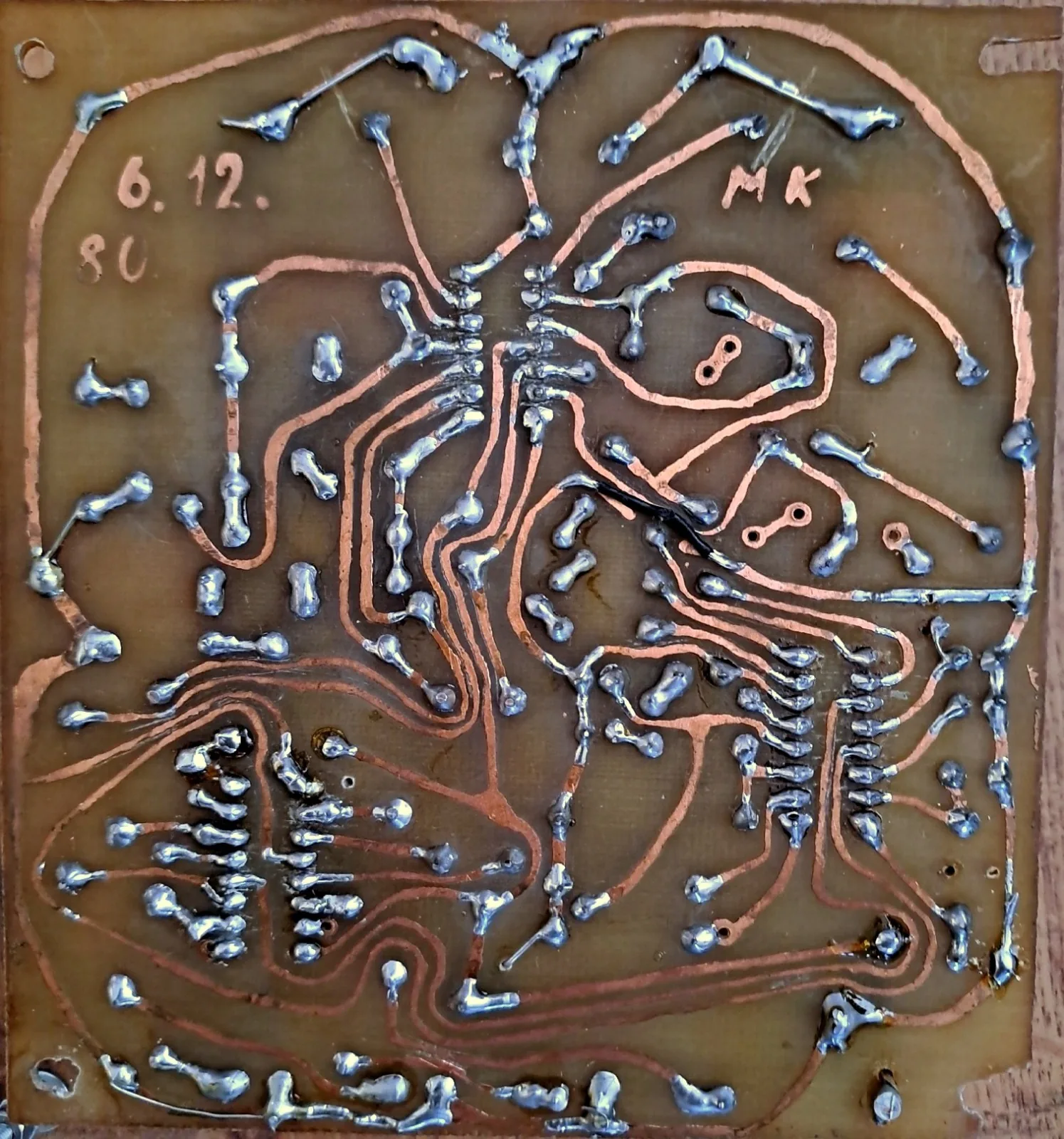
- “6.12.80”Date of completion, etched in copper together with the tracks. Marian signed the board with the date like a letter.
- “MK”Marian’s initials in the top right corner — the builder’s signature, like an artist’s on a painting.
- Pads for ICsDense rows of pads at DIP pitch. Drawn freehand on a 2.54 mm grid.
- Tracks like handwritingArcs and bends drawn by hand — each line is a single stroke. Today a program would do it; in 1980 it was patience.
- Wire on the copper sideA thin additional connection routed outside the tracks — just as it was done on hand‑drawn boards.
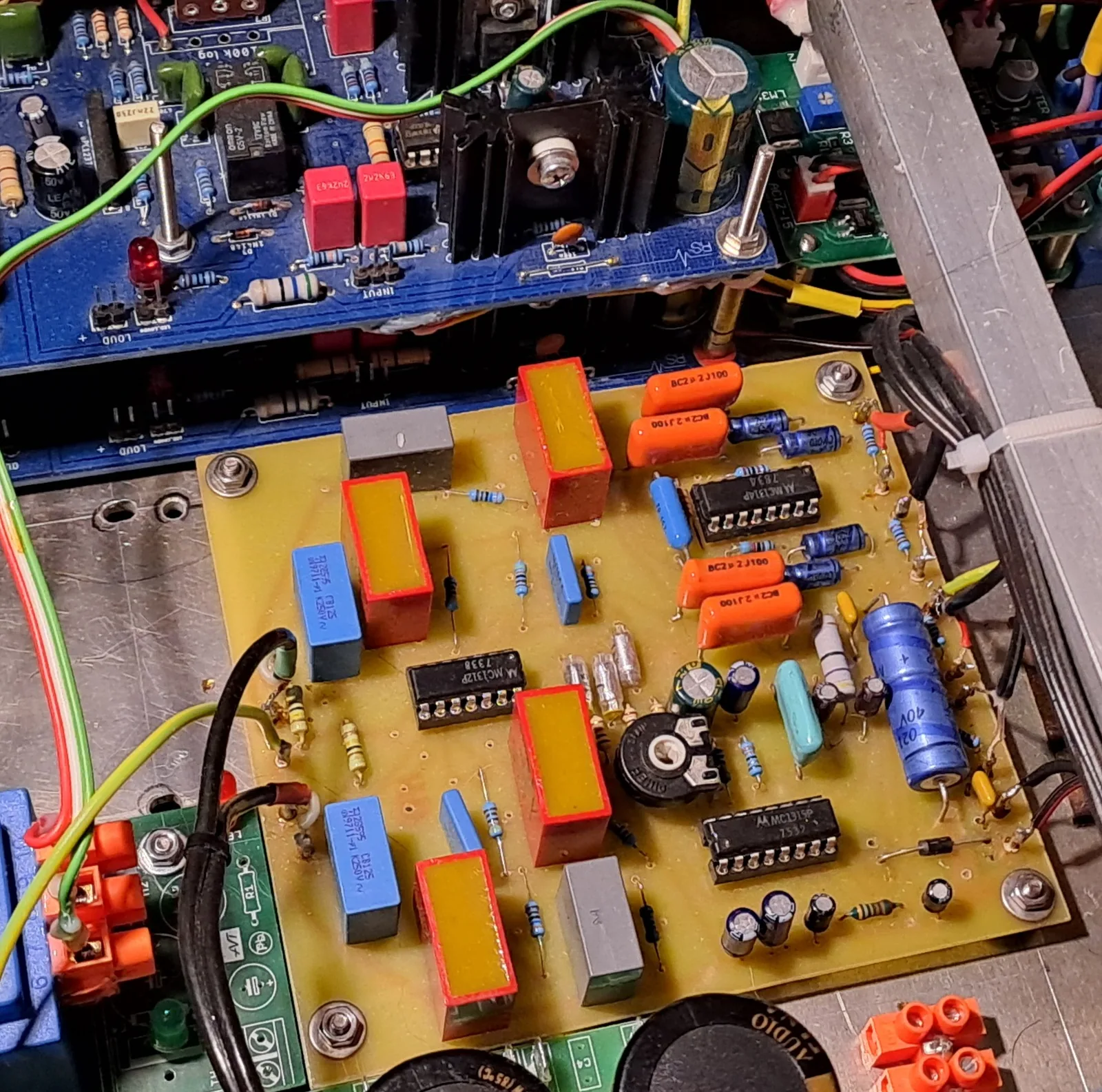
The decoder today — on period ICs
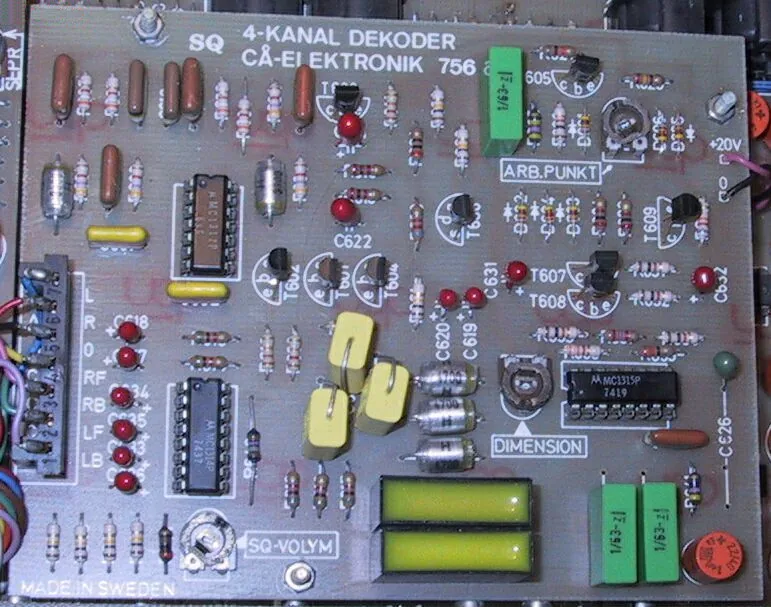
The new board is an SQ decoder with logic, built on original Motorola ICs. The date codes on the packages speak for themselves — these chips were made in the heyday of quadraphony.
- MC1312P · code 7338The heart of the decoder: an SQ matrix with phase shifters. The date code means week 38 of 1973.
- MC1314PA four‑channel, logic‑controlled gain block — it’s what boosts channel separation.
- MC1315PSQ logic: detects the direction the dominant sound is coming from, and controls the MC1314.
- Preset potentiometerFor adjustment on first power‑up of the decoder.
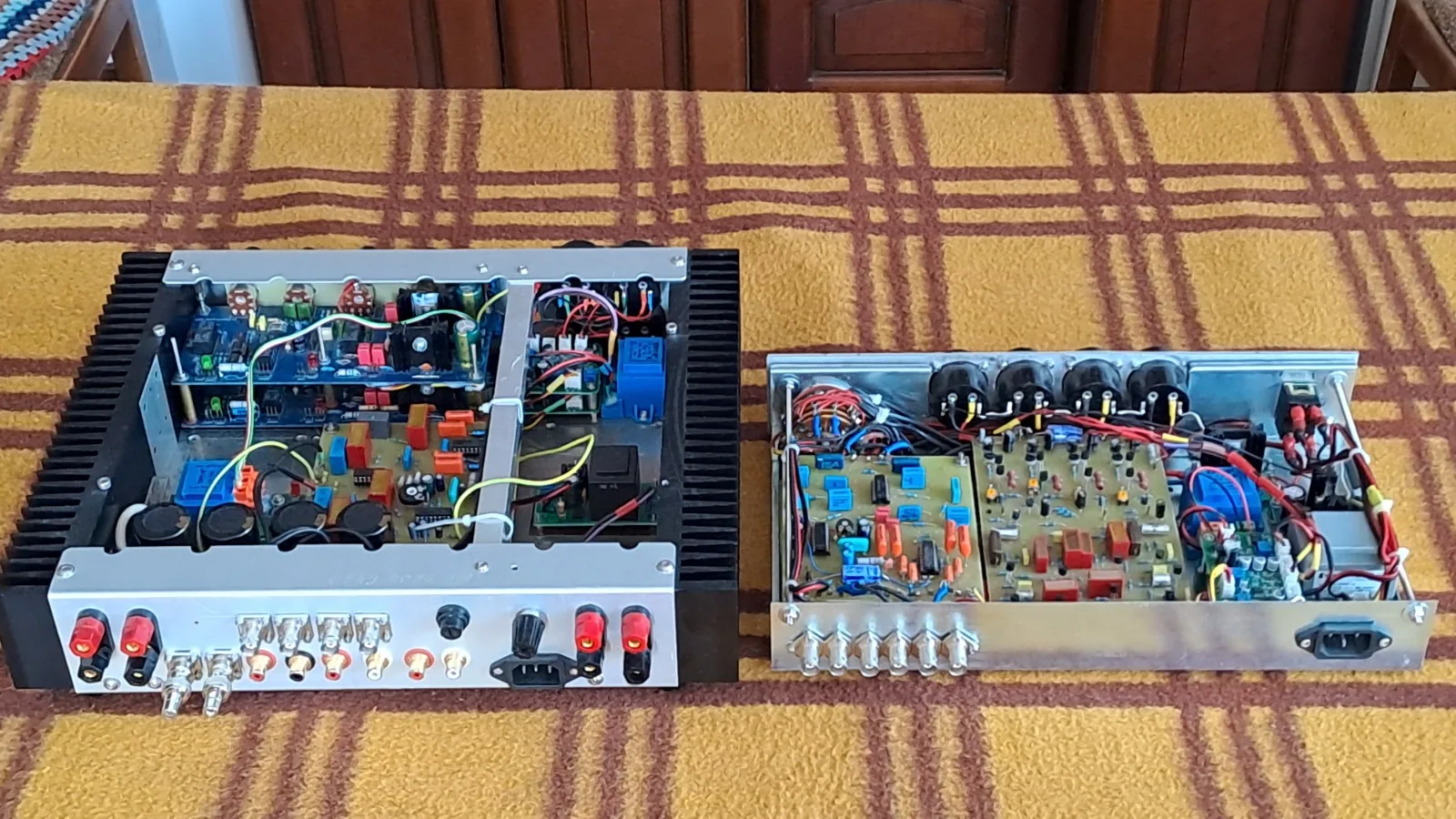
- One level upMore boards with a heatsink and inputs — here the decoder is part of a larger, neatly assembled unit.
Valves, needles
and four speakers
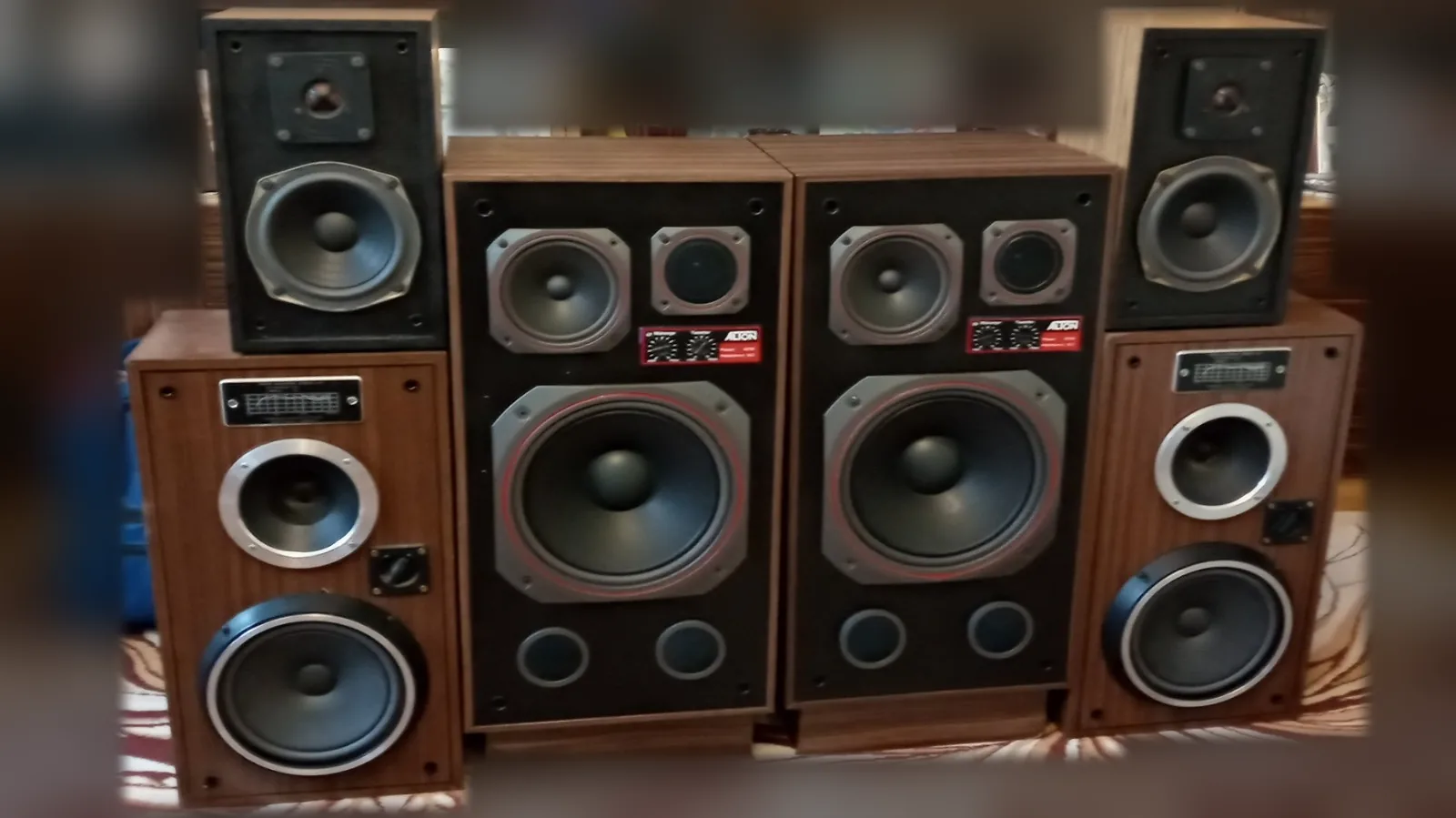
A complete quadraphonic chain built by hand: from the decoder, through the amplifiers, to positioning the speakers around the armchair.
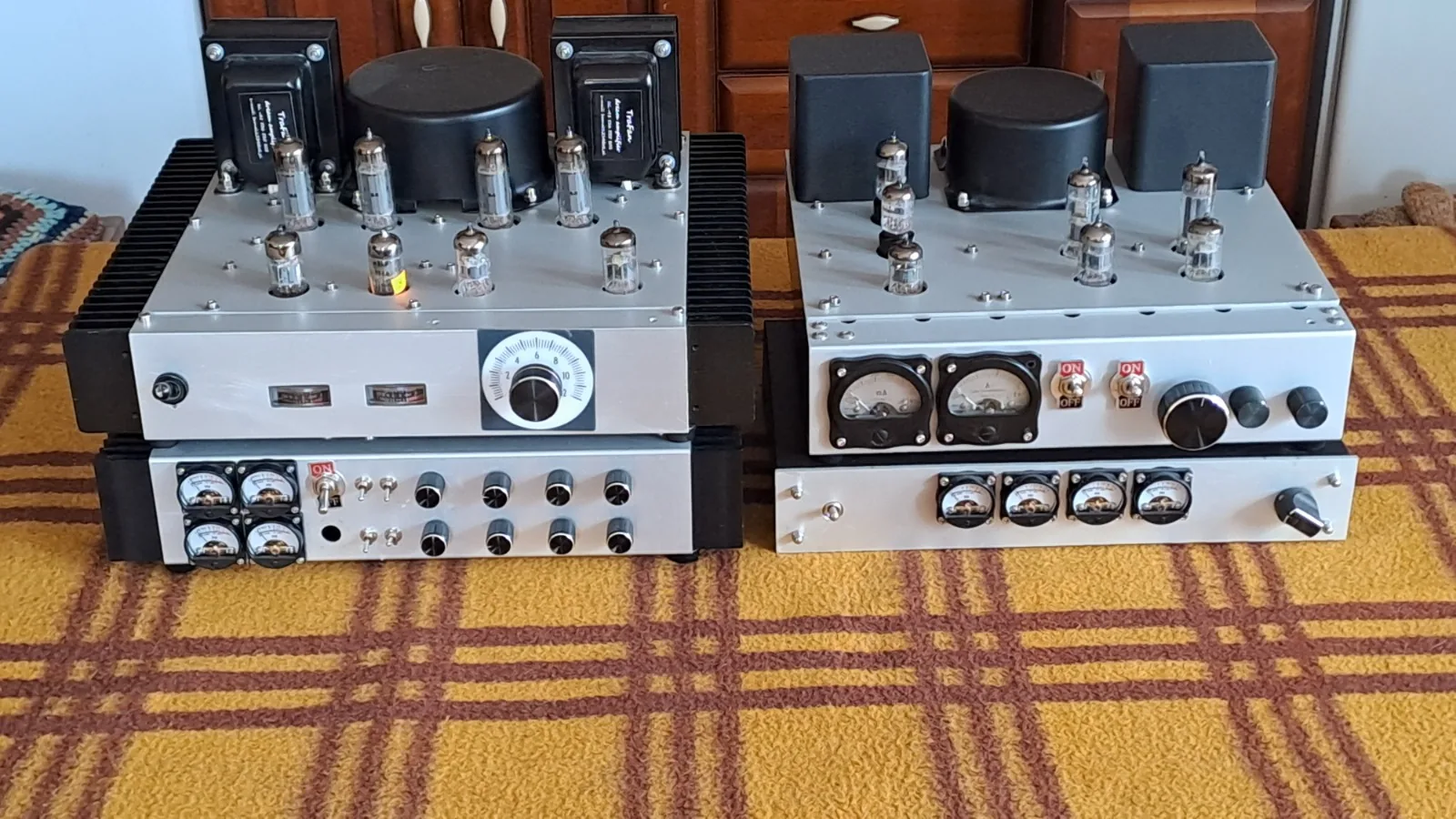
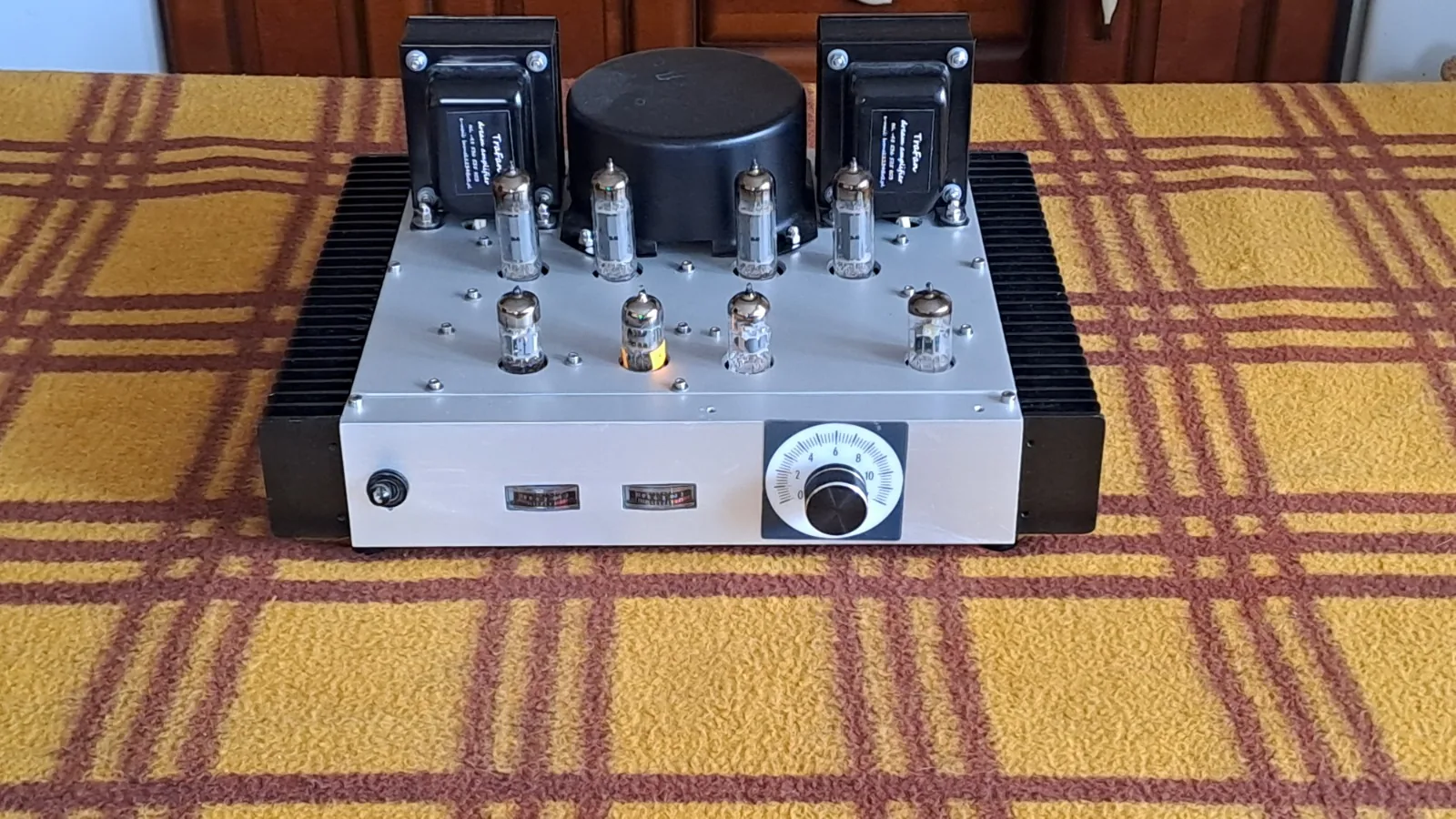
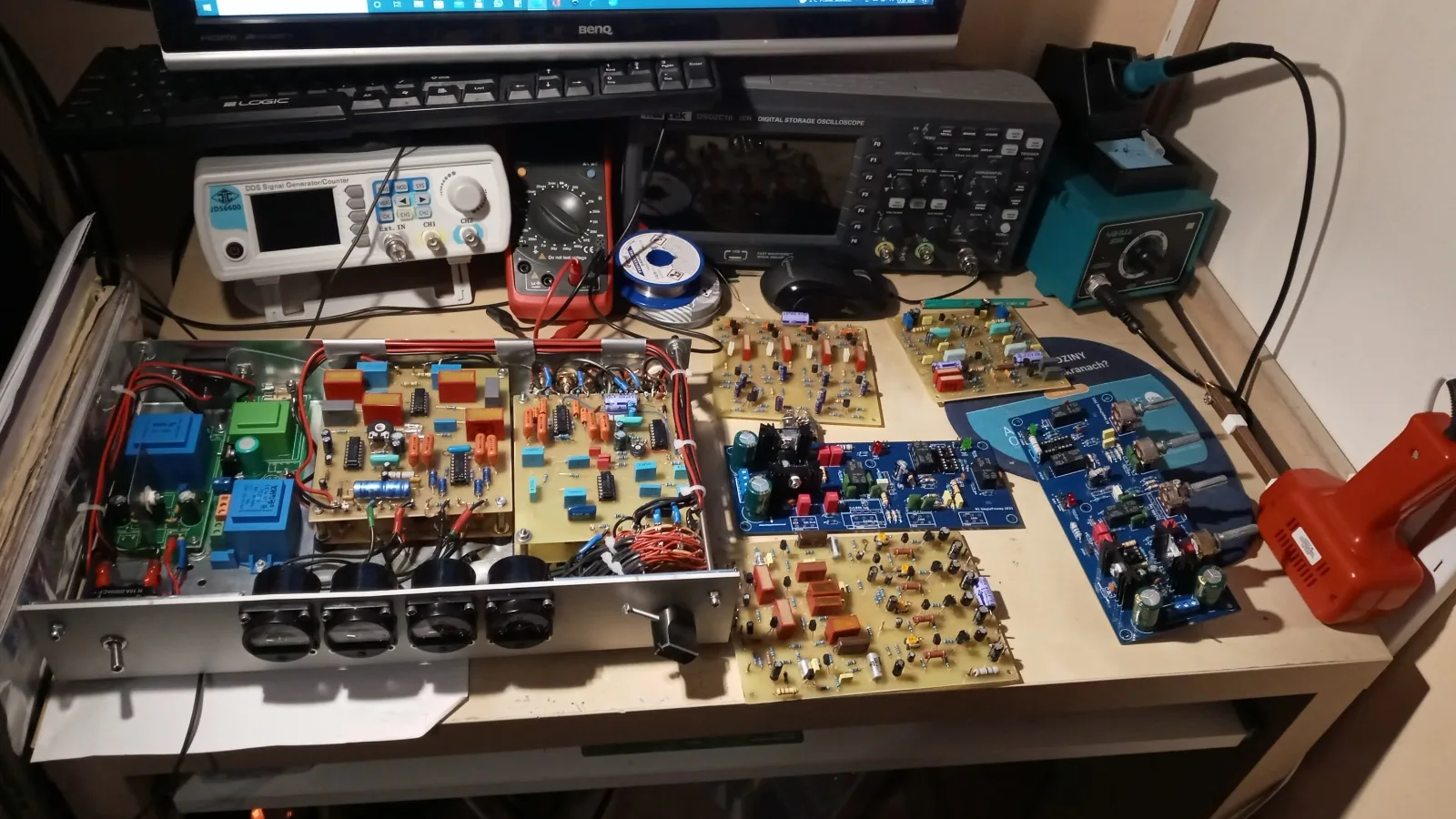
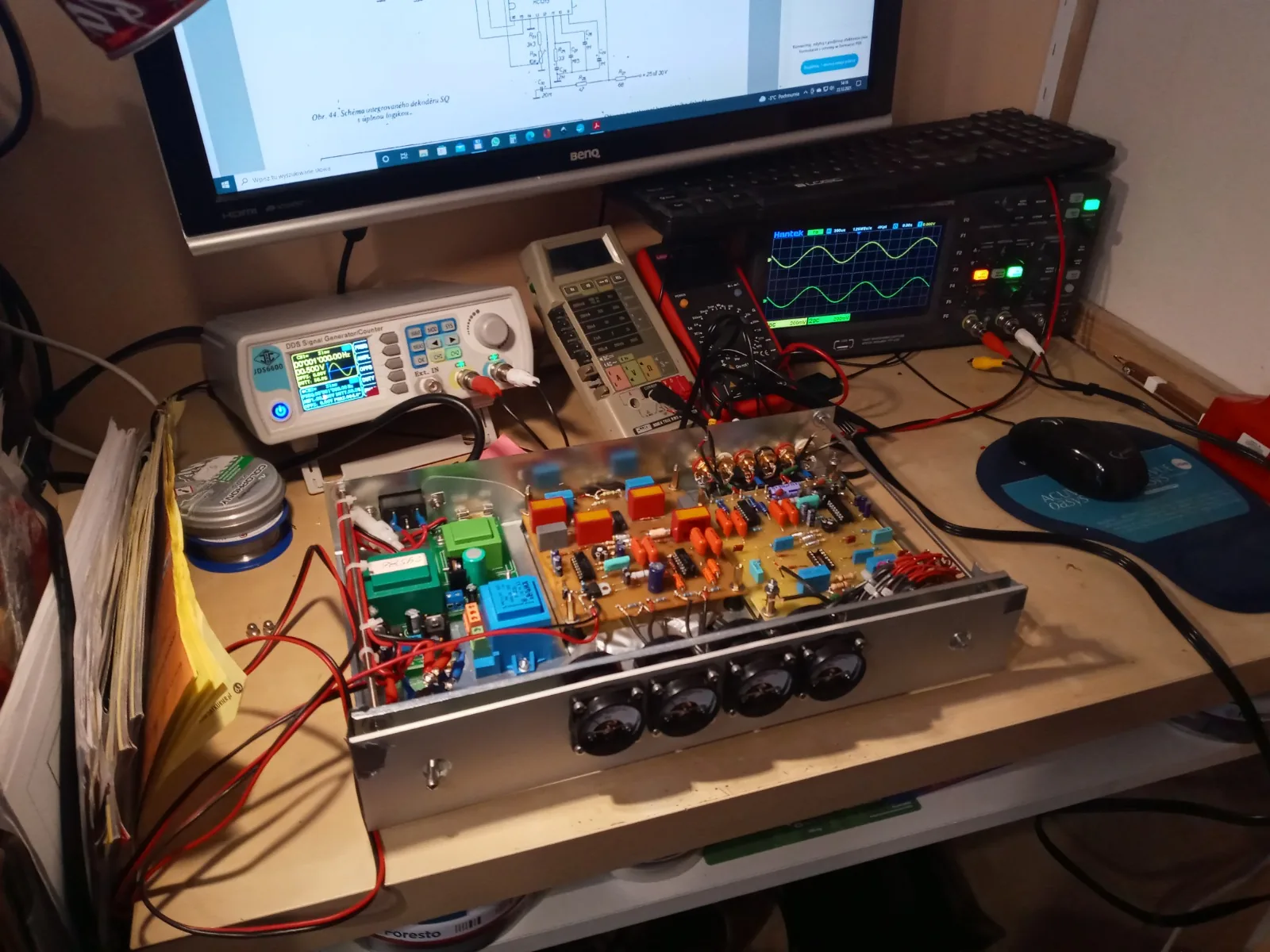
Where it’s all made
Test record
CBS SQT-1100
Released in 1973 by CBS Laboratories — the same laboratory that developed the SQ system. It’s the record the decoder sits its exam on.
Side A: 1 kHz reference tone, a 40–20,000 Hz sweep with RIAA equalisation for each channel separately, cartridge phase measurement and voice channel identification. Side B: decoder logic test — a tone turned on and off every second, switching between channels, and finally a spiral modulation of the rear channels.
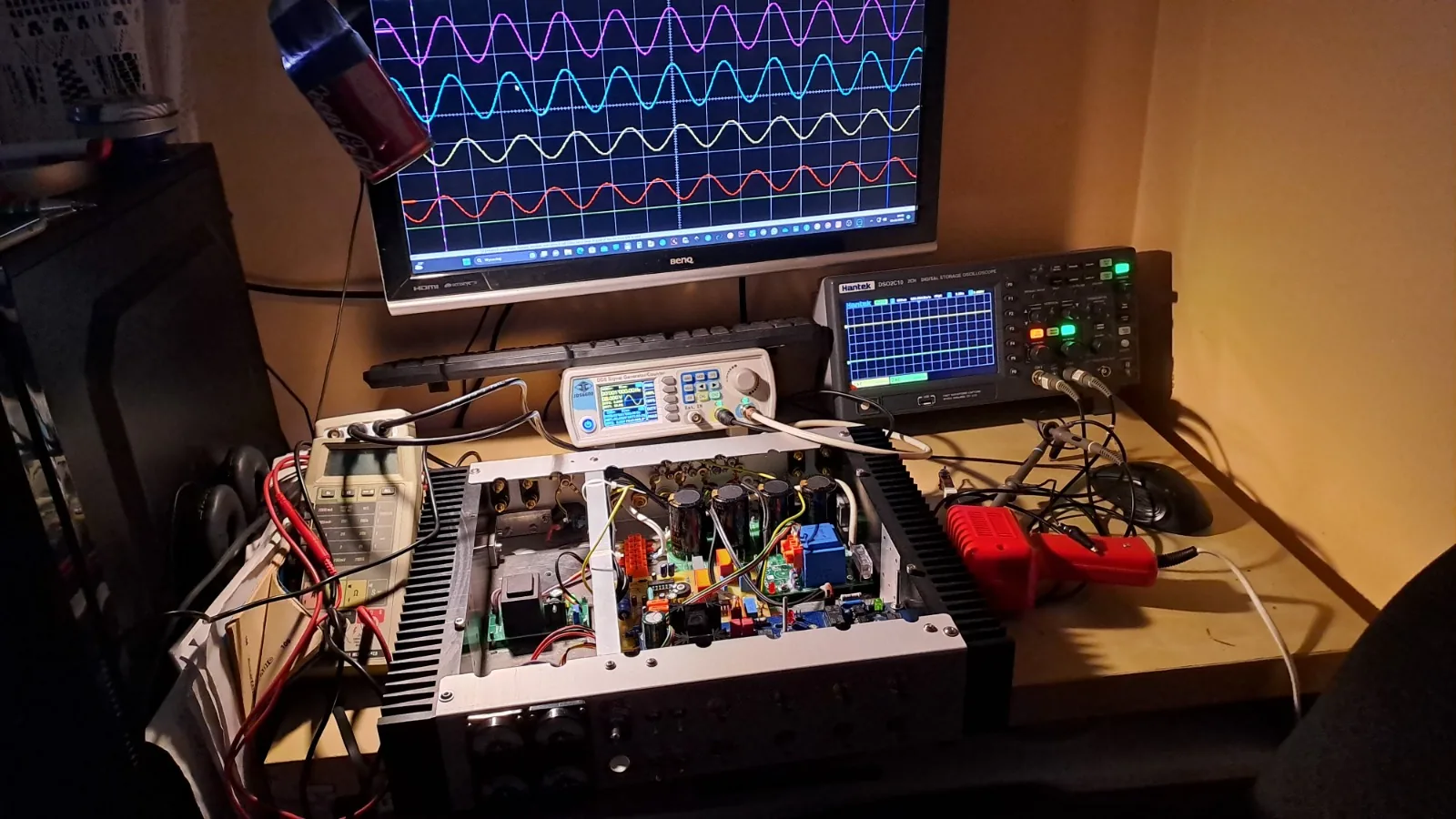
In Marian’s video the announcer on the record calls out in turn “Left Front”, “Right Front”, “Left Back”, “Right Back” — and the needles and traces respond exactly where they should.
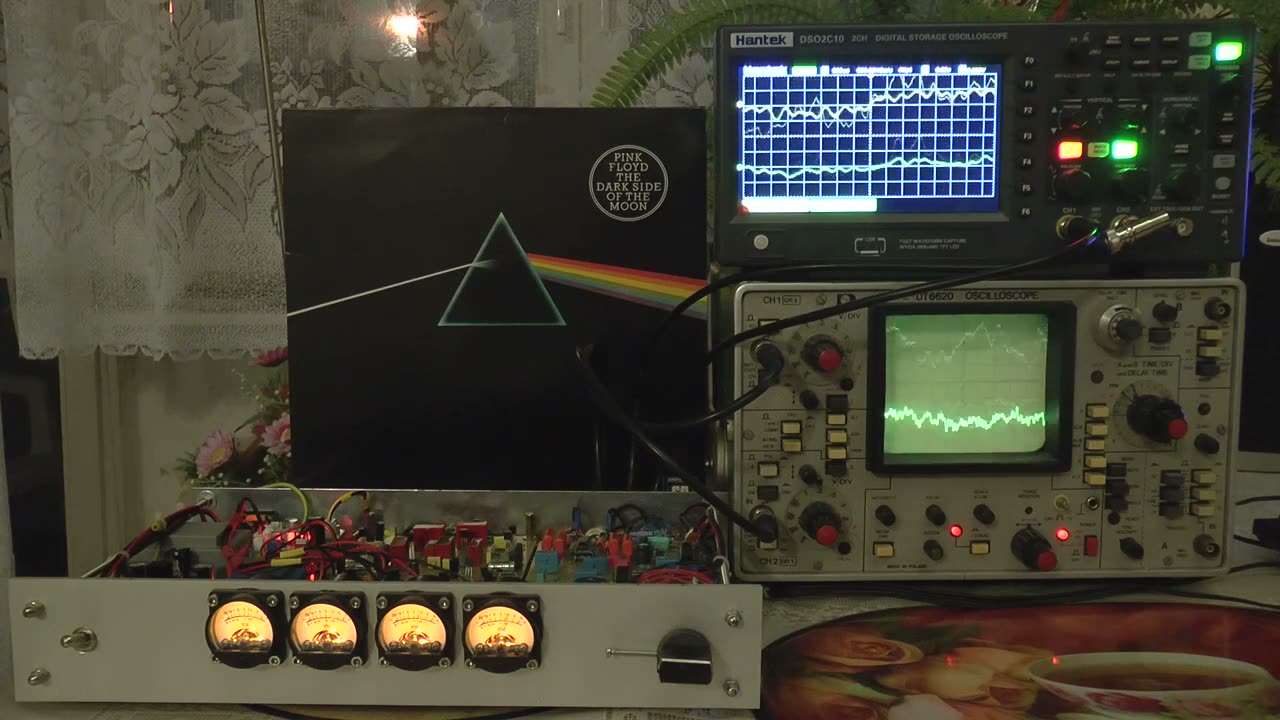
Channel identification test: four VU meters and four traces · recording: Marian SQ4MN
Sit in the middle
Put your headphones on. Drag the sound source across the room or set it going in a circle — the browser will arrange the sound around your head, and the meters will show how much reaches each of the four speakers.
A short history
of four channels
Quadraphony was one of the great promises of the ’70s: three competing systems, special styli, meters with four needles. The market abandoned it — but the idea lived on.
Two channels in one groove
The 45/45 stereo disc becomes standard: each wall of the groove carries one channel. Horizontal stylus motion is the sum of the channels (mono), vertical — their difference. On this foundation record‑based quadraphony would be built.
CBS announces SQ
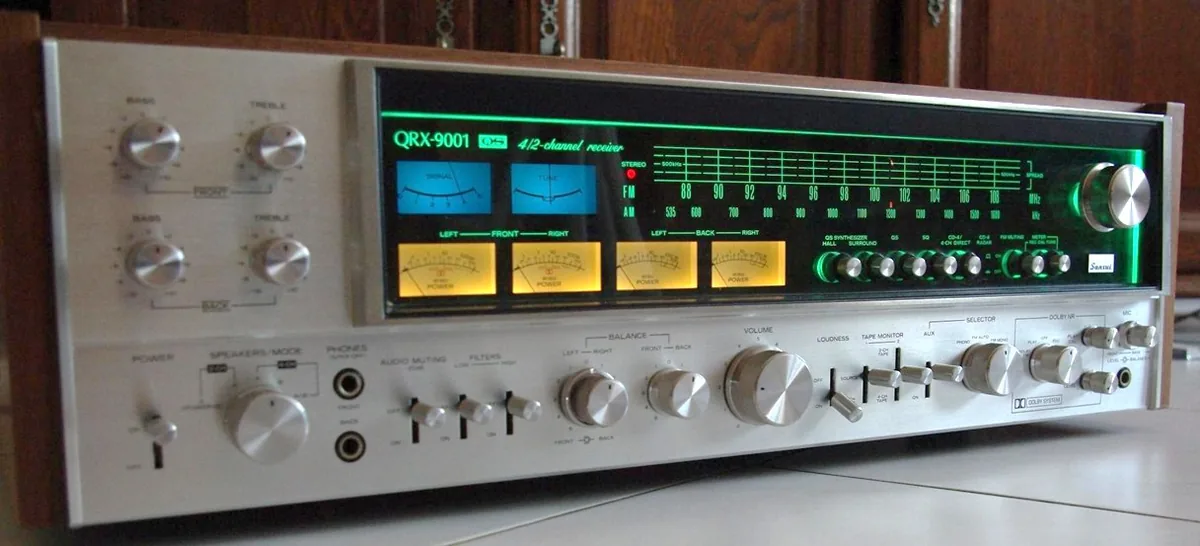
“Stereo Quadraphonic” from CBS Laboratories: four channels matrixed into two tracks, fully compatible with an ordinary stereo turntable. At the same time Sansui offers the competing QS matrix. Receivers with four meters on the front panel become a symbol of the era.
CD-4: discrete channels
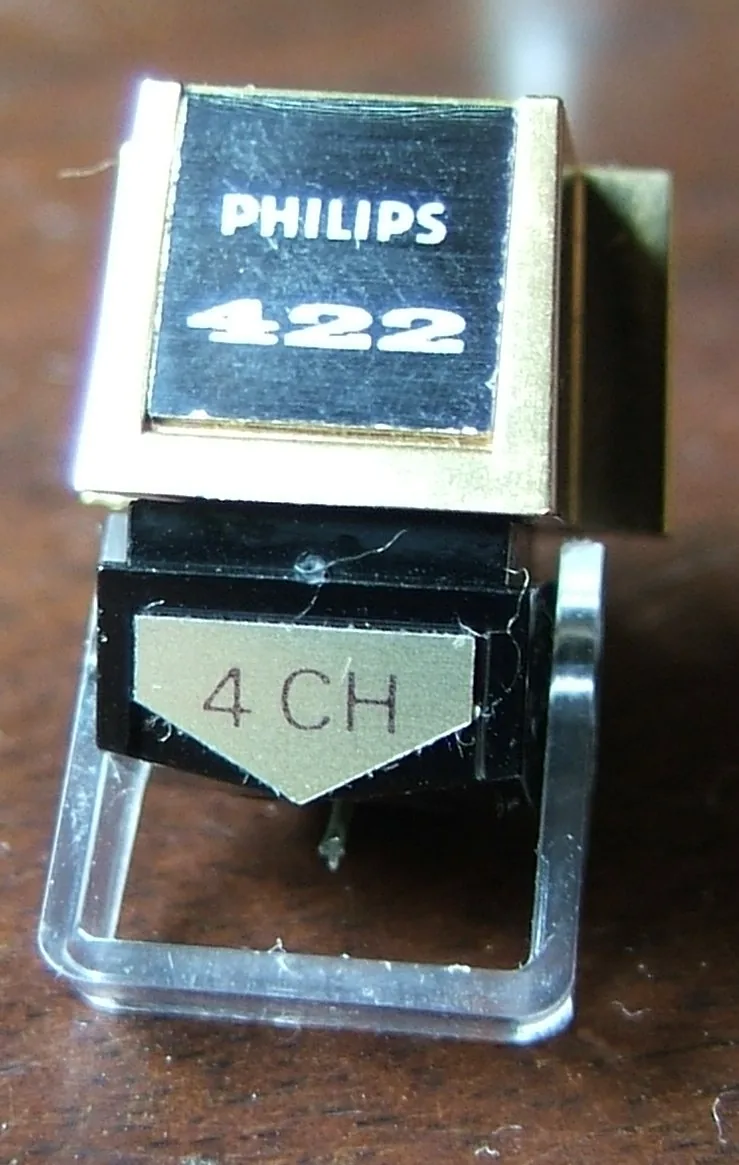
JVC and RCA take a different path: CD-4 “Quadradisc” records carry the channel difference on a 30 kHz carrier — ultrasonic information cut into the groove. You needed a demodulator, a cartridge reaching 45–50 kHz and a specially profiled stylus. In Marian’s materials there’s an insert from a 1973 Quadradisc — with a mono/stereo/quad diagram that inspired the diagram on this page.
The year of records
CBS releases the SQT-1100 test record. A quadraphonic version of “The Dark Side of the Moon” by Pink Floyd, mixed by Alan Parsons and issued as an SQ record, appears — that’s the very pressing Marian plays through his decoder.
Decoders with logic
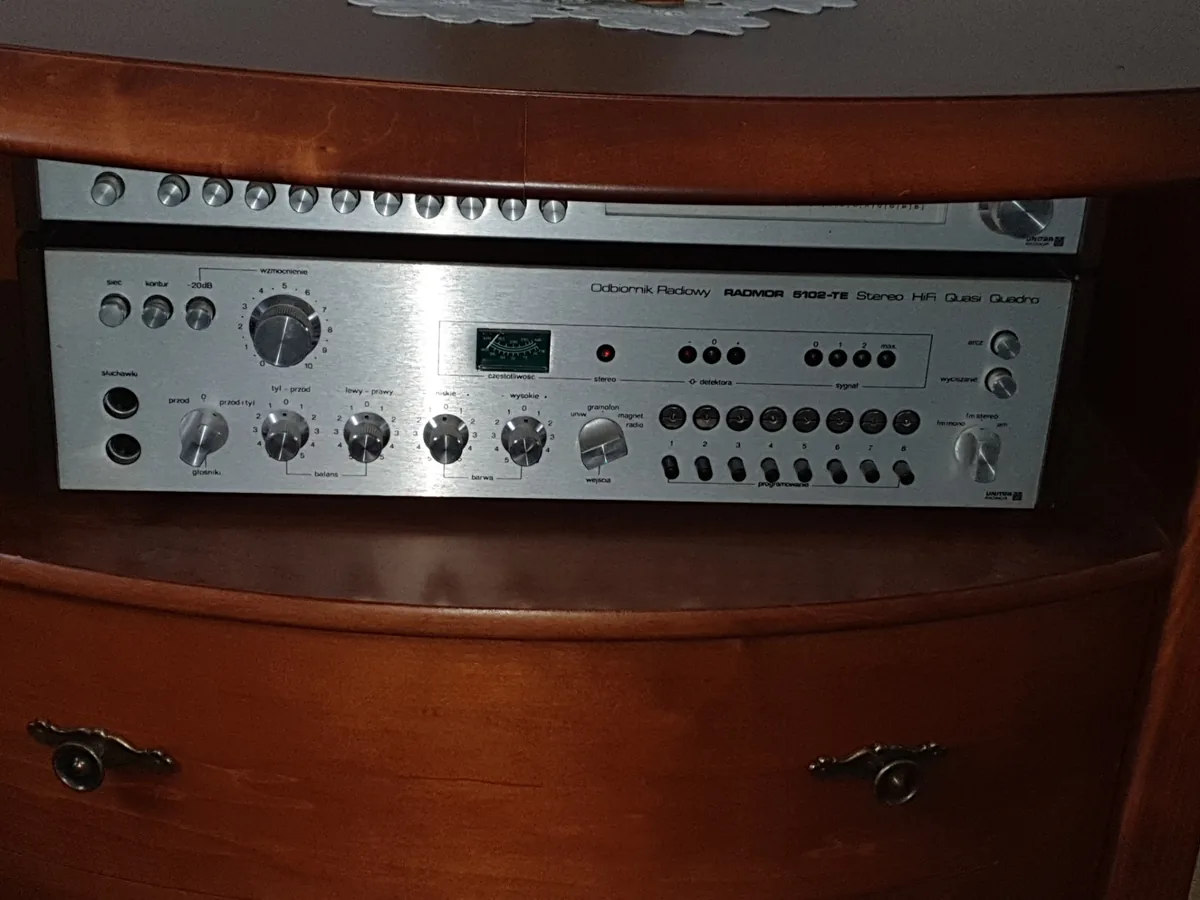
Mid‑decade the simple matrix gains ‘logic’: decoders automatically follow the direction of the dominant sound and boost front–rear separation. Motorola adds the MC1314 and MC1315 to the MC1312 matrix. Enthusiasts across Europe build decoders from kits, and towards the end of the decade in Poland Radmor of Gdynia releases the 5102-TE receiver with a four‑channel ‘pseudo‑quadro’ amplifier.
Quadro comes off the shelves, the matrix goes to the cinema
The format war wore buyers out and quadraphony disappeared from the shops. The idea of recording four channels in two tracks lived on in the cinema: Dolby Stereo encodes left, centre, right and effects channels in a film’s two tracks. Then came Dolby Surround and Pro Logic — children of the same matrix.
6 December: SQ4MN decoder
As the world puts quadraphony back on the shelf, Marian draws the tracks, etches the board and solders his first SQ decoder. He signs it with the date and his initials MK. The decoder still works today.
SQ4MN workshop
A new decoder with logic on original ’70s ICs, two valve amplifiers, units with four meters, measurements on the CBS test record and “The Dark Side of the Moon” in four channels. Quadraphony at Marian’s has never gone out of fashion.
Film: quadraphony in Marian’s workshop
From the groove under the microscope, via the SQ matrix and a 1980 board, to the CBS test record and “The Dark Side of the Moon” on four meters.
2:38 · cut together from recordings and photos by Marian SQ4MN
“The Dark Side of the Moon” in four channels
Seven minutes without cuts: the quadraphonic record “The Dark Side of the Moon” in the SQ system, Marian’s decoder and four illuminated VU meters. Above them two oscilloscopes — a digital Hantek and a classic analogue — draw the traces live.
It’s worth watching the meters: each of the four channels has a life of its own.
Marian SQ4MN
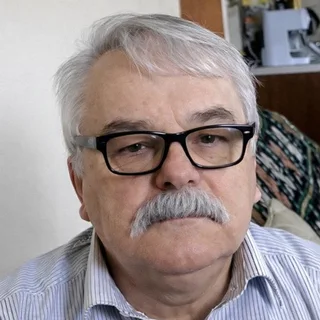
A radio amateur and builder. He built his first SQ decoder in 1980 — and it still works today. He then added valve amplifiers, units with meters and his own test lab. The photos of his equipment and all the recordings on this page are his.
Also on sq5cba.pl: Marian’s 70 cm antenna with an extra support.